
Ellijay resident Padgett recalls lessons, losses in Vietnam
Fresh out of high school in 1960, Willis Padgett landed a job at the Pickens County Progress in Jasper. His employment initially forestalled him being drafted for Vietnam when Uncle Sam came calling.
“Ermie Edge kept me out of the Army for several years,” he said of the woman whose family owned the newspaper at one time. “She had some say. They drafted me, so she called the colonel she knew and said, ‘I don’t want him drafted, he’s the only one that knows how to run my linotype machine. So we don’t need to let him go.’”
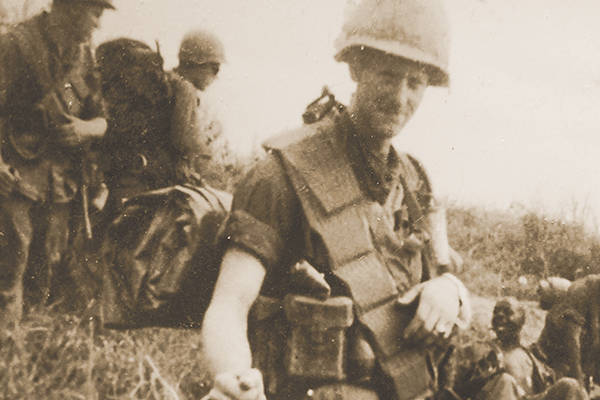
When a second linotype machine was eventually purchased by the Progress and another man was trained on it, however, Padgett was drafted at age 25. After boot camp at Fort Benning and advanced infantry training (AIT) at Fort Polk, La., he landed in Vietnam in November 1967. He had only been there a few short weeks when he saw his squad leader and platoon leader killed in combat. He thinks of them and others who lost their lives there as Memorial Day approaches.
As a rifleman in Bravo Company of the 1st Battalion, 8th Cavalry Regiment (the “Jumping Mustangs”) of the 1st Cavalry Division, Padgett was stationed in II Corps (central Vietnam) in Bong Son area.
“They would load our company up on helicopters and fly us to God-knows-where and drop us off to patrol by platoon, and stay out there maybe a week or longer and do search-and-destroy (missions),” he said. “Sometimes we’d have two or three combat assaults a day in helicopters. They’d fly us out to an area, we’d search it and they’d come get us and fly us to another area and we’d search it.”
Oftentimes, his unit would be dropped into a “hot” area rife with enemy troops.
“It was Dec. 6, and we were on LZ (landing zone) English,” Padgett recalled. “They sent us out and then we came back, and then they got us all together and said they’re having a firefight out there, and we need you to go rescue an APC (armored personnel carrier) that got ambushed. They flew us out there, and it was a battalion of the (North Vietnamese Armor), and we were in it, buddy.
“We stayed out there for two days. My squad leader got killed, our platoon leader got killed, the platoon sergeant got wounded — it was hot. It was one of the biggest battles in Vietnam. We killed over 600 of them. They were dug into a village, Dai Dong was the name of it. I hadn’t been there long, and it was my first battle. It really broke me in.”
Padgett was taking cover next to the APC when it was hit with a B-40 rocket-propelled grenade.
“The guy was up there (on top) shooting the .50-caliber and (the rocket) hit that .50-cal,” he said. “The barrel on it just bent, and that old boy dropped straight down (into the APC). I don’t think it killed him — because there’s a shield in front of the gun — but it peppered him pretty good (with shrapnel). I’m sure it was the concussion of the blast too.”
Help was called in, and U.S. forces “blew that place to smithereens with bombs and artillery.”
“The palm trees were splintered and shattered and all over the ground — I don’t see how anything could have lived through it, but they did because we got resistance,” said Padgett. “It was a long night, wet and cold, couldn’t sleep.”
What did he learn from that first intense engagement?
“Keep your head down! You learn to move and communicate,” he replied. “We went back to the LZ; we’d had several people killed and wounded. Most of them were in my platoon because we were one of the first ones there. We had not known what to expect, and had to get more bodies in there (to replace them). That was my worst battle, and they say it was the 15th-largest battle fought in Vietnam the whole time (of the war).”
Padgett earned a Bronze Star with a ‘V’ (for valor) during the attack for “providing covering fire for a medic that was attending the wounded, and for machine gunners and the captain — I still communicate with him.”
Early in 1968, his unit moved to I Corps in the Quang Tri Province, close to the DMZ (demilitarized zone). Although the fighting was not as fierce, the conditions could be miserable.
“That was fun,” he quipped. “We carried all this gear on our backs traipsing up and down those mountains. They told us to travel light, we’re going to fly you out to this area and you’re going to check it out. We just had one C-ration meal with us, for lunch, and they said we’ll come back and get you this evening. We got out there and the monsoon blew in — we were out there for three days and nights, pouring rain and nothing to eat. Nobody had their ponchos with them, and they couldn’t get in and get us. We’d hear them flying around, but it was so foggy and rainy and the wind blowing they couldn’t see. We couldn’t get a fire going and were just soaking wet, laying on the ground with water just pouring by you on the side of a hill in the mountains.”
Padgett became a squad leader in April after being promoted to sergeant. He had made meritorious PFC out of AIT at Fort Polk, winning a proficiency reward by scoring a 199 out of a possible 200 points. In November 1968, his unit moved south to III Corps near Saigon in the Tay Ninh area of the delta, but he didn’t have to go back out into the field due to his “short-timer” status (two weeks before returning stateside).
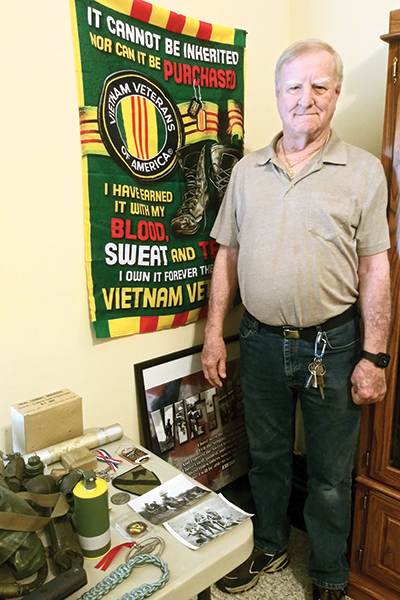
Now 80, Padgett retired from the Progress after 46 years of being ‘production manager’ and moved to Ellijay.
“It encompassed a whole lot of things,” he said of wearing many hats at a weekly, “but mostly I was in advertising, making ads in the newspaper on the computer.”
Padgett also earned an Army Air Medal for combat helicopter assaults and an additional Bronze Star.
“Fortunately, I was never wounded and didn’t receive a Purple Heart,” he said. “But we were in some bad areas, including the A Shau Valley and Khe Sanh where the Marines were.
We have a reunion every year of the ‘1st of the 8th’ (Cavalry battalion), we’ve been doing it since 1987. We meet all over the country.”
How was he treated when returning home from Vietnam?
“Everybody was glad to see me,” he said. “Nobody said anything untoward against me; I probably wouldn’t have took much of it if they jumped on me. If they’d spit on me, that wouldn’t be good. Mostly, it was in the larger cities where they were doing that. Jasper was where I had a lot of kinfolks and friends.”
What does Memorial Day mean to him?
“I really hated to see it, people getting hurt like that and killed,” Padgett said of men losing their futures. “I think we should honor them, I sure do. They’re protecting our freedom, so they deserve to be honored. If people don’t have an appreciation for Memorial Day, I’d tell them to go try it (combat) and then come back and tell me that.”
Padgett said he’s “tight” with fellow Vietnam veteran Bryant Strickland of Ellijay. He and his wife, Mickey, took RV trips with Strickland and his late wife, Doris.