
He ran his own experiment
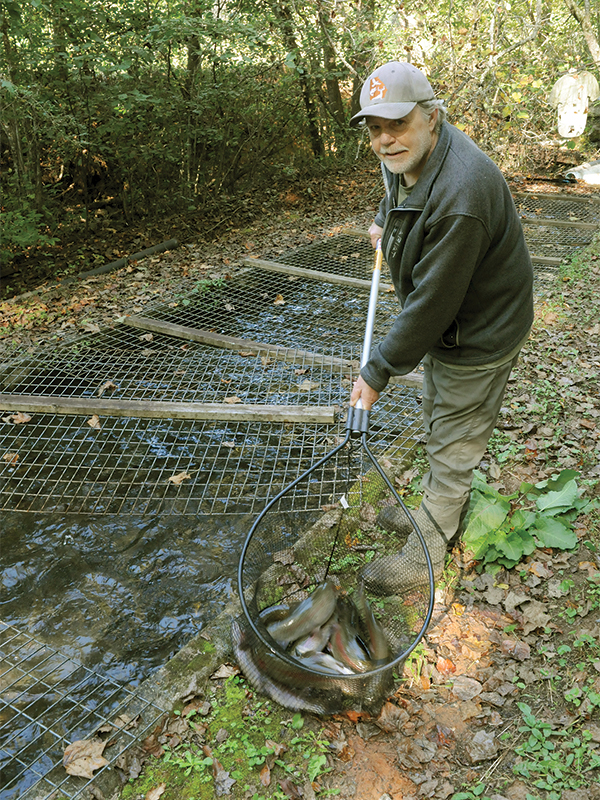
There’s a clear difference between Gilmer trout fishing in the past compared to trout fishing today, one longtime resident said.
Trout fisherman David Cantrell has been fishing here since he was a boy. Today, he is 72 years old. He is a fisherman and runs a business stocking brook trout.
“When I was just a child, you could fish and catch brook trout in these streams. And now they don’t thrive,” he said.
The reason fish numbers have declined is that cold water bypasses on local dams aren’t working properly, Cantrell said. And he has run an experiment that seems to prove his argument.
Cantrell said that he remembers fishing before many of Gilmer’s dams were built in the 1960s, and fishing in the years afterward. Back then, brook trout were plentiful.
“You could go out and catch the limit within at least an hour,” Cantrell said.
Today, it’s much harder.
His theory is that the cold water bypasses in Gilmer dams aren’t functioning properly. These systems bring up cold water from the bottom of reservoirs so trout can thrive.
“In areas that have not been stocked, you can’t hardly find fish,” he said.
To test this theory, Cantrell performed an experiment in 2023. He released some fish above Cartecay River Watershed Structure 1 and some fish below it.
This dam belongs to the Limestone Valley Soil and Water Conservation District (LVSW).
When water is too warm, parasites latch onto trout. But in cool water, trout are energetic and rarely get these parasites.
Cantrell’s results confirmed his theory. When he looked at trout below the dam, many had parasites. Trout above the dam were alright for the most part.
The dam is the only major difference between these two areas of the river, Cantrell said.
According to Georgia Soil and Water Conservation Commission Project Manager Greg Walker, the cold water bypasses in LVSW dams are functioning properly.
Dams aren’t the only thing that heats up water, Cantrell said. When people cut down trees near rivers, the extra sunlight helps heat the water, too.
And if any stream gets too warm, it raises the temperature of larger bodies of water.
“By the time those tributaries reach the main rivers, they’re going to be much, much warmer,” he said.
Dirt in the water from development also harms trout, even if it’s less impactful than heat.
However, with enough cold water from reservoirs, trout populations will increase, Cantrell said.
“I would love to see that fixed so we can actually have brook trout in our steams,” he said.