
The outdoors can be tasty
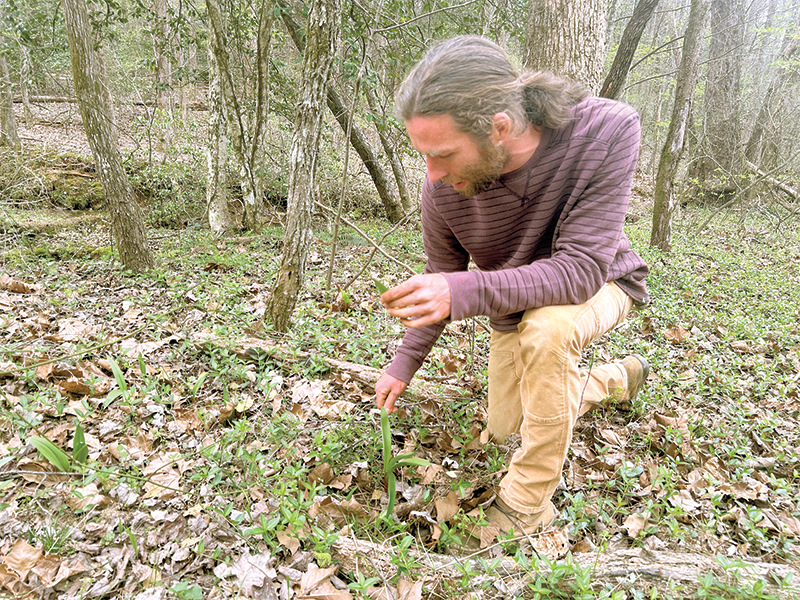
If you look for food from the forest in Gilmer County, you’re not the first.
Ethical forager Caleb Arnold has found Stone Age spearpoints on his property from people who hunted and foraged thousands of years ago.
“You can get everything needed for life from the land around us,” he said.
Arnold runs Ever Wilder Farm, a local farm with a focus on foraging. His expertise reveals that Gilmer is bountiful.
Edible spring plants include spring greens, ramps, dandelions, violets, chickweed and plantains.
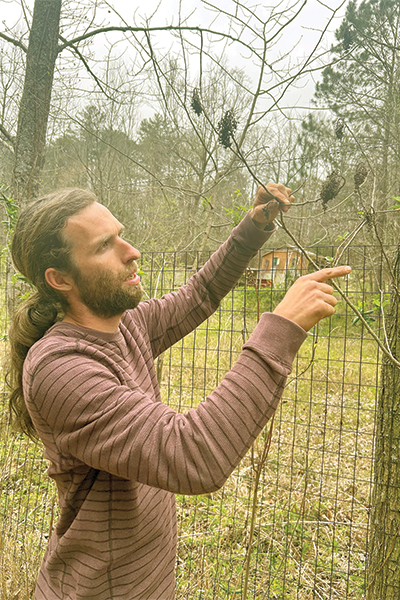
In summer flowering plants, herbs, chokeberries, raspberries, blackberries, dewberries, and more flourish.
In fall, pawpaw trees, American persimmons, passionfruit and nuts are in season.
Even in winter, roots offer something to eat.
“What I try to do here is empower people,” Arnold said.
Successful foraging requires skill. If you want to start, it’s best to buy a book on local edible plants and find a local expert to learn from.
An ethical forager harvests wild plants in ways that ensure they don’t get overharvested.
For example, ramps are a very popular foraging food. They’re a relative of garlic and onions, with a taste somewhere in between the two.
An ethical forager can harvest a ramp’s leaves without pulling up its onion-like bulb.
If you still want to eat the bulb of the plant, you can cut off the tip with the root and replant it.
“If we plant back one ramp for every ramp we take, then we’re doing pretty good,” he said.
Little changes like this one can ensure Gilmer’s forests remain productive.
Over a ten-year time frame, a forest can produce more wealth with growing plants than the timber industry can.
In many ways, foraging is what our bodies are designed for, Arnold said.
“Wild foods and foods less touched by man are generally very much more nutrient dense, and therefore more healthy,” he said.
For instance, some edible plants in nature are naturally bitter. Hardly any modern food is bitter.
But there’s a reason people have taste buds designed to pick up bitter flavors.
“We’ve removed 20 percent of our entire taste spectrum and pretend there’s no physiological ramifications,” he said.
Bitter foods can often help our digestive tract.
“Salads used to be bitter because they were gonna help you digest a heavy meal,” he said.
It’s important to be careful when foraging, especially when you’re not experienced.
Some plants can look edible but actually be poisonous.
“It’s important to stick to stuff that you know and start small,” Arnold said.
That’s why you should always verify a plant you want to eat with three reliable sources.
Some sources he’d recommend include a book on foraging, an experienced local forager and the University of Georgia Gilmer County Agriculture Extension.
If you want to email Arnold with questions on foraging, you can reach him at everwilderfarm@gmail.com.
“I’ve never misidentified something that I’ve consumed,” he said.