

At a Tuesday, Aug. 9, information session led by the Ellijay Downtown Development Authority (DDA), attendees heard analysis of the county’s housing market from a member of the state realtor’s association, as well as personal housing experiences from a handful of current and former local residents. The purpose of the expanded DDA meeting at the First Baptist Church Fellowship Hall was to advocate for more workforce housing in the county, noted Reece Sanford, Ellijay DDA chairman.
“This is an issue severely hampering our local economy,” Sanford said. “This impacts positions throughout the county that are drastically needed to make a small town function. Mostly these are middle class positions — law enforcement, EMS, teachers (and others).”
Workforce housing is predominately for households earning between 80 and 120 percent of the county’s median income, Sanford noted. For Gilmer, that applies to families earning between $42,000 and $64,000 a year.
“These are bank tellers, courthouse employees, food service workers (and others),” Sanford said. “Affordable housing, for them, looks like rent between $900 and $1,350 per month. There is no inventory right now (in that range). In order to increase the inventory, we’re going to have to look at different properties that are (under-represented) in Gilmer County, such as apartments, tiny homes, duplexes, townhouses, trailers.”
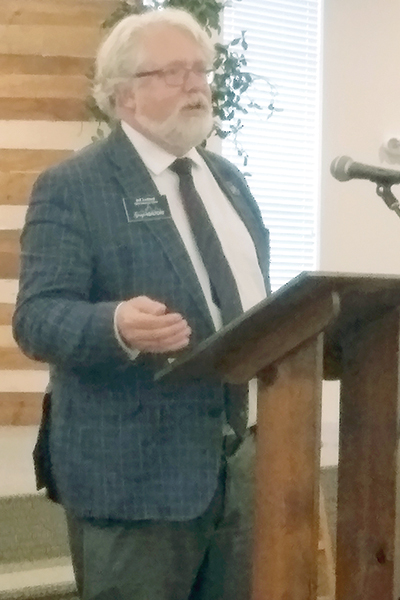
Scarcity of affordable housing options is not exclusive to Gilmer County, said Jeff Ledford, chief advocacy officer for the Georgia Association of Realtors, in his remarks. The trend is statewide.
“Everything went up from last year, no matter what part of the state you’re looking in, because there was an enormous lack of supply,” Ledford said. “The data I found supports what we’re seeing statewide, but it’s even more staggering in Gilmer County.”
The two biggest groups of available homes in Gilmer County have three or four bedrooms, Ledford noted.
“If you’re willing to spend over $400,000, you can get what’s really available here,” he said. “If you’re just starting out and have your first job, you’re looking at up toward $125,000. Last year, the median price (for a) one bedroom was $67,000.”
One of the big factors driving high housing prices and the shortage of certain size homes is that empty nesters and young people in the millennial-genie age groups are often looking for the same thing, Ledford explained.
“Your two largest groups are the older group and the young group. Almost half of your population is the group of people who, by age, are likely going to be downsizing and looking for something smaller,” he said. “You’re creating a market, now, where they’re (all) fighting for the same thing.”
‘Couldn’t find anything’
Attendees also heard from four local or former local residents — a physical therapist, a hairdresser, a former county extension agent and a fifth-generation Gilmer County native — who described their personal difficulties in finding or keeping a place to live.
“I’m a single guy. I didn’t need a three bedroom house or a yard to take care of, just a nice, simple apartment that the lights would turn on and the oven would work,” said physical therapist Josh Northway.
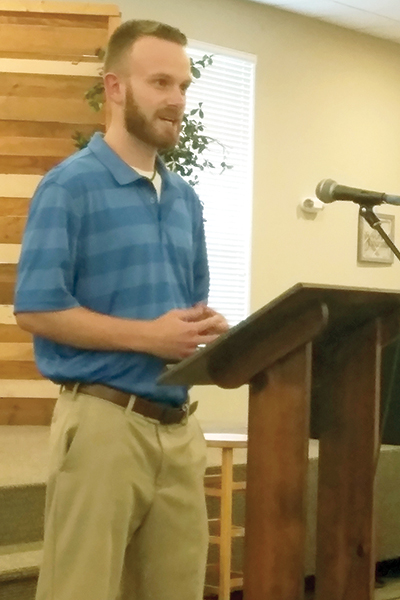
Northway was eventually able to find an apartment here after he’d searched all the way from Union to Murray to Cherokee County.
“I couldn’t find anything. I was looking in Murphy, Blairsville, McCaysville, Ellijay, Blue Ridge, Canton. I looked all the way down to Chastain Road off 575,” he added.
Jessie Moore, formerly Gilmer’s UGA Family and Consumer Sciences Extension Agent, said she expected to find a place to live in short time before moving here from Athens in 2017, but that didn’t happen.
“I tried every resource and went home empty handed. I was finally lucky to find a place,” she said.
That place was a basement apartment, Moore noted. Later on, she wanted to put down roots here and started looking at houses. That search also yielded slim results.
“After going on several visits and working with a real estate agent, I realized it was going to be a little harder than I anticipated,” Moore said. “I had some conversations with my landlady of continuing to stay there. She was very appreciative of me being there, and I was very appreciative of her allowing me to have a place to live. But there was always in the back of my mind, if I wasn’t able to rent from her, I would probably be forced with the decision to move out of town to find a suitable place to live.”
Moore said she recently did move to Hall County, where she now works for the extension service there. After looking for a while again, she finally found a place there, but not before having to move back in with her parents while still searching.
“You would think, in a more metropolitan area, you’ve got lots of opportunities. There were, but there were no vacancies,” she said.
Betsy Sheppard, a representative from Gilmer’s Georgia Initiative for Community Housing panel, spoke about the three-year Department of Community Affairs program in which Gilmer is a first-time participating county this year.
“Our goal is to create vibrant housing options that are accessible for individuals and families to live, work and thrive at all income levels. We hope to provide potential housing solutions to our community. We believe all people deserve a safe, affordable and comfortable place to live,” she said.
“We have a lot of work to do. We are working hard on our strategic plan,” added Sheppard.