
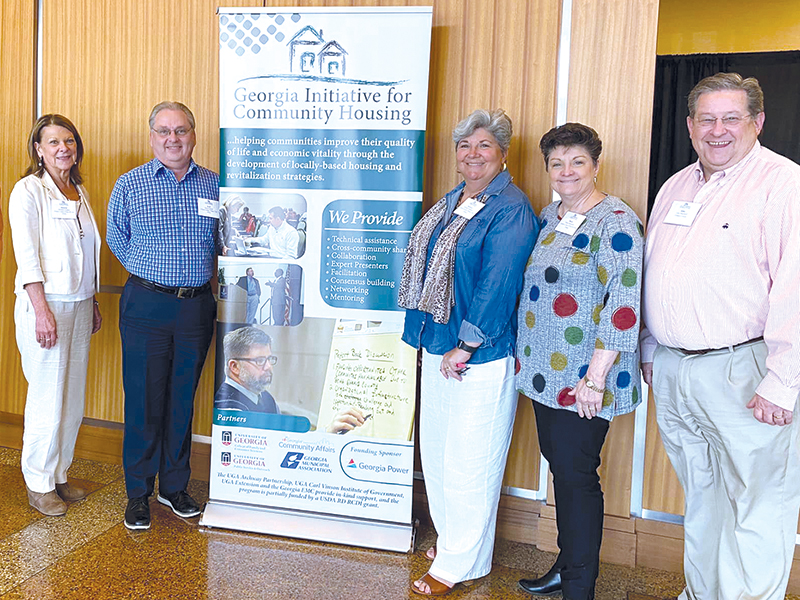
Members of a 20-person panel representing Gilmer County in a state-sponsored community housing initiative recently attended the first of many conferences the three-year program will entail.
Representatives from the five Georgia counties taking part in the 2022 Georgia Initiative for Community Housing (GICH) met for their spring retreat March 29-31 at the Clarence Brown Conference Center in Cartersville.
The end goal for all participating communities is to develop plans that meet their specific housing needs. The local panel represents Gilmer County, as well as the cities of Ellijay and East Ellijay.
At a recent meeting of the Ellijay Downtown Development Authority, DDA member Melinda Hadden, a longtime local real estate agent who’s also on the GICH panel, discussed some of the group’s takeaways from the first conference.
“We were partnered with other counties in our region that are very similar to us. We’re all dealing with the same issues, with the high tourism and the high short-term rentals. This is not just a Gilmer County crisis. It’s a national crisis and a crisis in the state of Georgia because there’s so many people coming here,” Hadden said.
Josh Moyers, Ellijay DDA member and pastor at Ellijay First Baptist Church, told the DDA board the lack of realistic housing options for young people is something he’s seeing in the church congregation.
“This is near to my heart because I’ve got four young couples at my church who are all getting married, and they have nowhere to go. They’re looking at places (that are) $950 a month and can’t afford it,” he added.
Gilmer has the second largest population (32,000) of the five counties now taking part in the program offered by the state Department of Community Affairs in conjunction with the University of Georgia. Also participating are Baldwin, Chattooga and Rabun County and a joint team representing Hiawassee, Young Harris and Towns County.
“A lot of us have the same type of demographics as far as retirement and vacation-type communities. Towns County is not that big, and Chattooga isn’t that large considering its proximity to Chattanooga,” said Kent Sanford, Greater Gilmer Joint Development Authority director and a member of the local GICH panel.
Sanford said the 20-person panel includes representatives from local churches, nonprofits, businesses, the school system, both cities and the county.
“It’s still extremely early on, but it’s off to a good start. The biggest thing is seeing the variety of efforts in communities around the state and what’s been successful in some of those areas — partnerships with nonprofits like Habitat for Humanity and others — as well as what’s not been successful,” he added.
Hadden noted that, with the current housing market and rising cost of building materials, those types of partnerships are needed here.
“You have to do it with grants from different agencies and partnerships with your city and county governments, (as well as) your development authorities, private developers and nonprofits. That’s what we are there to learn about,” she added.
Sanford said growth in Gilmer County over the past several years has largely been on the retirement end, and there’s now an imbalance between retirees and workers. Gilmer’s housing plan should address that imbalance, he noted.
“There’s more pressure on working-class people to be able to stay here. We’ve been building largely on the upscale in the last 15 years, but we need to be providing something on the other end of the spectrum. Not overwhelmingly, but some,” Sanford said. “We have situations right now where school teachers can’t find places to live. It’s in the school system, law enforcement, the fire department and virtually any other area you want to look at. We don’t want to run the retirees off. We just want to make room for some of the workers to stay here.”
It’s already clear that a housing plan will not be developed or implemented overnight, even after the three-year program is done, Sanford confirmed. The next conference for the five GICH counties will be held in October.
“The team from Bartow County (has) been seven years in this process and just had their first highly successful announcement (about new housing). We are looking for incremental opportunities to make improvements. That’s why partnerships with churches, nonprofits, etc., make the most sense to us,” Sanford said.