
Team intent on restoring ancestors’ graves, compiling map
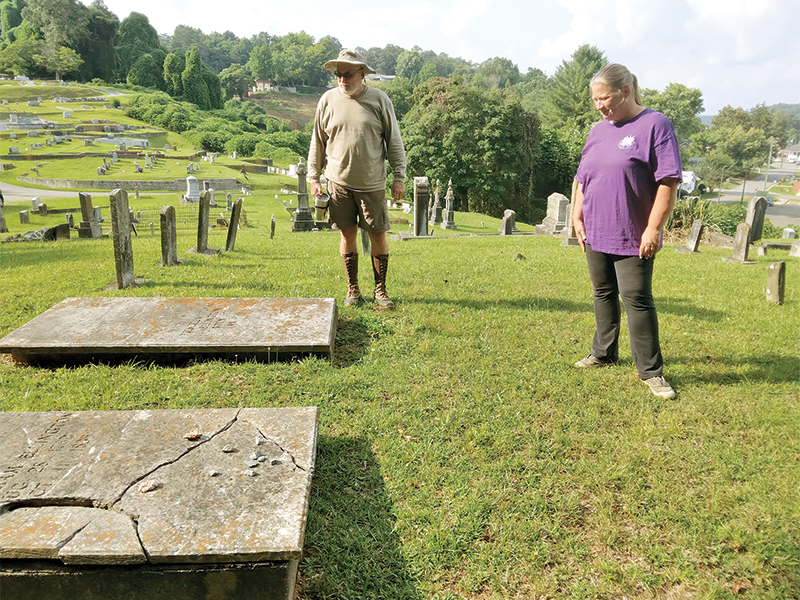
Some of the oldest grave sites in Ellijay’s hilltop city cemetery are getting much-needed attention from folks with a shared interest in genealogy and local history.
Beverly Ratcliff and Richard Holt have been teaming up at the cemetery that overlooks downtown Ellijay for a few months now. So far, they’ve uncovered hidden grave markers, repaired and straightened several damaged headstones and removed invasive kudzu that had overtaken numerous grave sites.
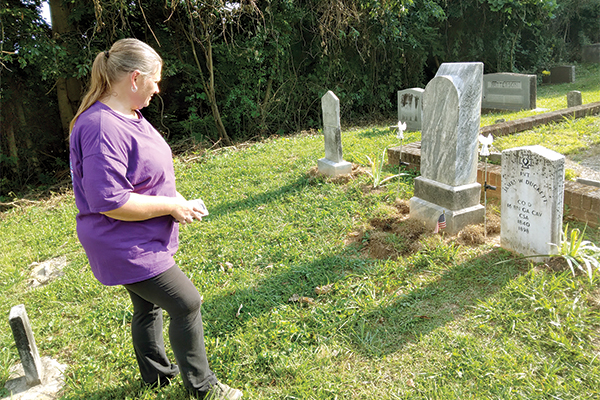
The headstones they’ve cleaned or repaired mark resting places of ancestors of Ratcliff, who lives in Bartow County, and Holt, a Gilmer County resident.
“We’re both trying to clean up the cemetery and expose (grave sites) that have been taken over,” said Ratcliff. “I’ve been coming up here back and forth all my life, so this area is very important to me. We used to bring my grandmother up here to put flowers on her folks’ graves. This is a project I’ve been determined to do, and I’ve really gotten into it, as well as the genealogy aspect of it.”
Holt said he and Ratcliff had been coming to the cemetery separately, but with a similar goal — locating the graves of their ancestors — when they crossed paths earlier this year.
“I came here through the Find a Grave website. I wanted to check our family members to see the conditions of their stones and see if they needed to be straightened or leveled. It all kind of happened at the same time,” Holt said.
The headstone of Ratcliff’s great-great-grandfather, John W. Duckett, had been scattered on the ground in pieces till just recently.
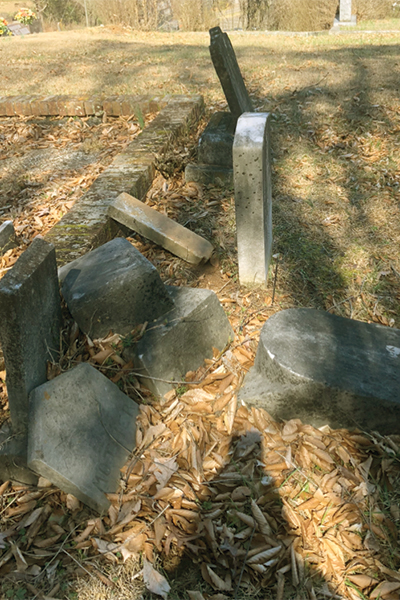
“I’m unsure as to exactly how it got this way,” said Ratcliff. “His three-part monument was in separate pieces on the ground, and those of his first wife, Martha, and second wife, Lettie, were broken apart from their bases.”
Now, with help from Holt, John Duckett’s headstones — he has a second marker incorrectly marked “James W. Duckett” recognizing his Civil War service — have been put back together. They now stand straight and newly polished.
“What he did was remarkable in such a short period of time,” said Holt about Duckett, an early city planner.
“He was basically responsible for developing East Ellijay (before it was called that),” said Ratcliff. “He laid out the plats, roads and bridges.”
The marker for Ratcliff’s great-great-grandmother, Martha Duckett, is being kept steady with a wooden brace and will need further attention.
“(It’s been) no easy task, for sure, but it’s so worth the effort,” said Ratcliff.
Holt, a former machinist, said he used a hoist rig to pick up and straighten the Duckett headstones, as well as those of other ancestors of himself and Ratcliff.
“This (marker) has been down since Find a Grave has been coming, so for at least 12 years,” said Holt, pointing at another displaced headstone. “I could get that put back up in about an hour’s time.”
“To say I am appreciative of Richard’s efforts and assistance would be an understatement,” said Ratcliff. “His advice and instruction on how to get this process done correctly made all the difference in the way these markers have been restored.”
The two would like to do more work at the cemetery to correct disheveled or displaced grave markers, of which there are plenty. However, they would need family members’ permission, and it’s tough tracking down family of the long deceased, whose responsibility it is to tend to fallen or damaged markers. Some of the people buried there have no living family at all, Holt said.
“One of these is like the 15th oldest grave in the county and one is the 17th oldest,” he said, pointing to an obelisk engraved with the name Wakefield. “They were an old couple that didn’t leave any family. I want to fix this so bad. If it breaks, as tall as it is, it will most likely shatter. I’d hate to see it get damaged any further.”
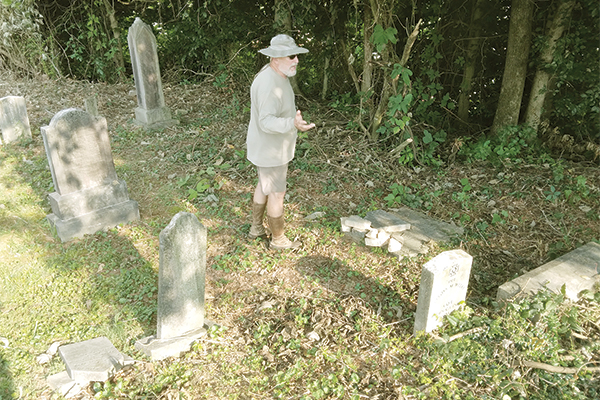
The lower portion of the cemetery where the two have been working is rife with names that should be familiar to those with even a cursory knowledge of Gilmer County history. Monuments bearing the names of such early families as Tabor and Hyatt are prevalent. Former mayors are buried there, as are Drs. E.W. Watkins Sr. and Jr., both early local physicians. Multiple Civil War veterans, who fought for both the Confederacy and the Union, are also laid to rest at the cemetery, noted Holt.
“There’s so much history here, and there are a lot of folks who walk up through there and don’t know that history,” Ratcliff said. “We know that these people, no matter who they were, whether they were a mayor or a farmer, made a difference.” A lot of these headstones tell a story, and some of the inscriptions are amazing. To think that somebody (hand) carved all that way back then.”
As part of their efforts, the two also hope to assemble a map of the lower section of the cemetery. That’s a document the City of Ellijay does not have, as records salvaged from that era are minimal.
“We’ve already got 400-plus names documented, so we’re coming right along with it,” Ratcliff said.
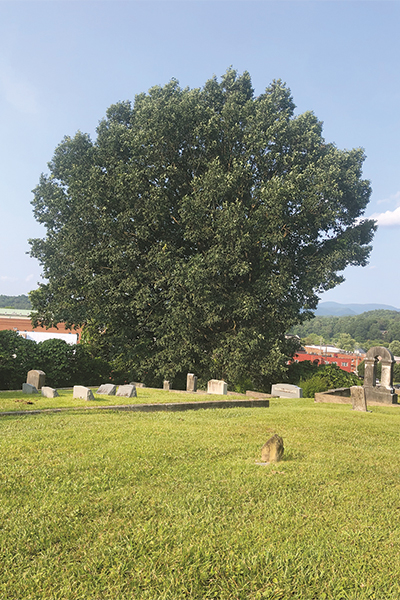
Overlooking South Main Street stands a white oak tree thought to be centuries old. As gargantuan as the tree is, it was tough to discern at first, said Holt. It had been taken over by kudzu vines, some of which were as thick as a sapling.
“I took a break from working one day and faced the big tree. It finally dawned on me what that big green blob was. It was the crown of that white oak tree, which is a big one. I knew immediately what type of tree it was from the leaves,” said Holt, whose father was a professional forester. “The kudzu was well in the top of it, and you couldn’t even see the base of the tree.”
Holt said he had some kudzu-clearing experience, which came in handy getting the vines unattached from the oak.
“Kudzu can be handled. You keep it out of the trees and deal with it on the ground. You’ve got to contain it first,” he added.
“People don’t realize that kudzu grows a foot per day. That’s a lot (of growth) in a short amount of time,” said Ratcliff.
After measuring the circumference of the old oak, Holt estimated it to be 220 years old. If so, that means the tree is older than Gilmer County, which was established in 1832.
“There are online calculators where you can put the type of tree in and the measurements,” Holt said. “(For this particular tree), it threw out 220 years old. That means this tree was an acorn in 1800.”
Shaded by the tree’s lush canopy are a couple of headstones, which, till just recently, had also been hidden by kudzu. One of them, a baby’s simple stone marker, has nearly been upended by the tree growing thicker through the decades. A couple of feet away is the newly-cleared headstone of Ida Cowart, who was 18 when she died in 1902.
“This tree was probably about 100 years old when she died,” Holt said.
Ratcliff and Holt don’t intend for this to be just a summertime project. Ratcliff has over 40 family members buried in the older section and more in the rest of the cemetery. Holt also has several other relatives’ graves he hasn’t tended to yet. The two have also started cleaning and straightening family headstones in the nearby Jarrett Cemetery.
“There are some issues (in the cemeteries), like when the stones get knocked by mowers or get vandalized,” Ratcliff said. “I feel like, if we let them go on, we’re going to lose a lot, and it’s history we’re losing.”
Ratcliff said she appreciates recent efforts by the city street crew to do additional kudzu clearing around the cemetery tree line. That’s something she and Holt hope will continue to be done there.
“I want to bring more attention to the trees and the history (of these cemeteries). I hope this will bring a renewed interest in these wonderful assets that Ellijay and Gilmer County are fortunate to have,” Ratcliff said.