
A Memorial Day remembrance
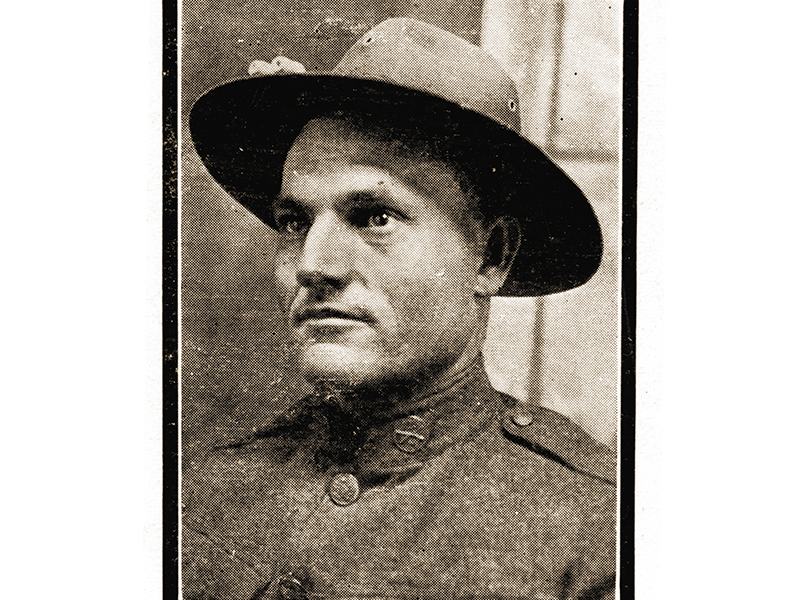
When Thomas Monroe Brown joined the U.S. Army during World War I, he didn’t know he had less than a year to live. Brown, who was born in Gilmer County, was listed as a resident of Eton in Murray County when he was killed in action in October 1918.
His great-niece, Laurie Houston, never knew him but knows it affected her family deeply over a century ago.
“I just think it’s remarkable of all the young men who went over there and then never came back,” she said during a phone interview before Memorial Day 2025. “What gets me is thinking about the families, and I know at that time my grandmother — his sister — was very young and some of (the troops’) siblings never even knew them that well, the ones that went and served. So it’s extraordinary to me what they did for their country, and to think how many never returned.”
The Murray County Museum website notes Brown “entered service” on Nov. 20, 1917, and as a corporal in the U.S. Army was killed in the Battle of Argonne Forest on Oct. 12, 1918. However, the World War I Centennial Commission website reports he was killed eight days later on Oct. 20.
Brown, 28, was serving in Company M of the 325th Infantry Regiment in the 82nd Infantry Division when he “experienced a traumatic event which ultimately resulted in loss of life,” according to the Honor States website. He is buried at Meuse-Argonne American Cemetery in Romagne, France, and was awarded a Purple Heart and the World War I Victory Medal, the site states.
Brown’s entry in the worldwar1centennial.org site contains several acronyms under the category of citations earned. The acronyms and names used are “MB, Murray, GDC, ABMC (and) Knight.” Although they are not explained on the webpage, an emailed question about them was answered with a phone call from Lamar Veatch, a commission member.
Veatch, who was also the state director of the Georgia Public Library system for 15 years, explained that “MB” stands for Georgia State Memorial Book (published in 1921) and that Brown is in the book that has been digitized with old copies still “floating around at libraries around the state.”
The “Murray” designation means Brown’s name is inscribed on the World War I memorial monument on the courthouse lawn in downtown Chatsworth. “GDC” stands for Georgia Death Cards and means Brown’s name is included in the collection that was prepared by the Army’s Adjutant General and sent to State Archives in the 1970s-’80s. “ABMC” stands for the American Battle Monuments Commission, and “Knight” refers to a set of notebooks/scrapbooks kept by the wife of the state archivist during World War I, Rosa Talbot Knight.
“She kept a page on every soldier that she could identify, including newspaper articles,” said Veatch. “They’ve been digitized and are available online. This Ms. Knight may have been the only person to identify and write down any information about some of these soldiers. She had friends throughout the state who were archivist-type, librarian-type people. The State Archives got newspapers from around the state — that’s when every small town had a newspaper — so she would scour those papers and write up anything she could find out about a boy coming home or dying, or having been killed in some way during the war.”
According to Honor States, 1,541 Georgians are listed in its Gold Star Veterans Gallery as having been killed during World War 1.