
Local representatives of a grant-funded program aimed at reducing opioid abuse are asking folks to take a good, hard look in their medicine cabinets and safely dispose of unneeded high-strength prescription meds.
The North Georgia Opioid Prevention and Education Network (OPEN) is funded by a $1 million grant from Mercer University. In effect since 2020, the grant program targets four north Georgia counties — Gilmer, Fannin, Gordon and Polk — with higher than average rates of opioid-related deaths.
“When you apply for these types of grants, you have to prove a need,” said Sherrie Williams, project coordinator for Mercer. “When looking at the data for Georgia, these four counties rank in the higher need counties in the state. They may not rank as number one, but they’re definitely in higher need as opposed to some of the other counties.”
Gilmer County’s overdose mortality rate is more than twice the state average, according to the Mercer School of Medicine’s Center for Rural Health Disparities.
“Our opioid deaths are higher than some of the Atlanta areas,” said Steve Purvis, North Georgia OPEN member and owner of Ellijay’s Huff’s Drug Store. “You find (that’s true) in a lot of the more rural areas. A lot of people in our rural communities either don’t have (treatment) opportunities or resources available. If there are resources available, they may not have a way of reaching them.”
Supported by the Health Resources and Services Administration of the U.S. Department of Health and Human Services, the OPEN group is tasked with promoting and developing resources to help reduce the likelihood of opioid abuse.
“There are a lot of different pieces to the whole thing,” said Purvis. “From an epidemiology standpoint, where you just look at the numbers, you want to find out why this is happening at such a high rate here. There are a lot of different resources in the community, and we’re trying to coordinate those and get the word out to people. A lot of times, someone might have a problem, but they just don’t know where to turn. If it’s a person who’s got themselves in a situation with addiction, they may just not know where to go or what resources are out there.”
Williams said the project’s four-pronged approach includes education, prevention, treatment and recovery. Grant funds have been used to provide Narcan (naloxone) training in the four counties. The medicated nasal spray can be used to quickly reverse an opioid overdose.
“Mercer is partnering with the Georgia Council for Recovery, which is the actual boots on the ground in these four counties. We’ve (also) partnered with Family Connection, the drug courts and Highland Rivers Health,” said Williams. “Part of the goal of this grant is to get as much naloxone out in these communities as possible, and we identify where training needs to occur. At Mountain Education (Charter High School), they allowed us to come in and train their staff. We were also able to talk to the students about the opioid epidemic, as well as do naloxone training. When we do the training, everyone leaves with at least two doses (of Narcan) to take with them.”
Purvis noted that opioid abuse has really “exploded” over the past two decades as the pain management medications have become more prevalent. They are drugs of necessity for some, but often become drugs of choice for others.
“Opioids aren’t bad. They have a very good place in medicine, but they are very easily abused and can lead to many other negative (things). We’ve seen this escalation with people getting way more into opioids. A lot of that is due to importing from foreign countries,” Purvis said.
Many times, young people are first exposed to opioids at home, noted Purvis. That can easily lead to the drugs, which may have been forgotten about, being taken by people other than those for whom they were prescribed.
“Over 40 percent of drugs that are entered into schools come from mom and dad’s medicine cabinet. It’s the easiest access point,” Purvis said. “A lot of times, it’s the peer pressure — I’m going to take some pills to school to look cool. They may not even know what they’re doing.”
That’s one of the negative consequences OPEN members hope to reduce.
“If you’ve got some heavy pain medication just sitting around, it really is a liability waiting to happen, (especially) if you have children or grandchildren,” Purvis said.
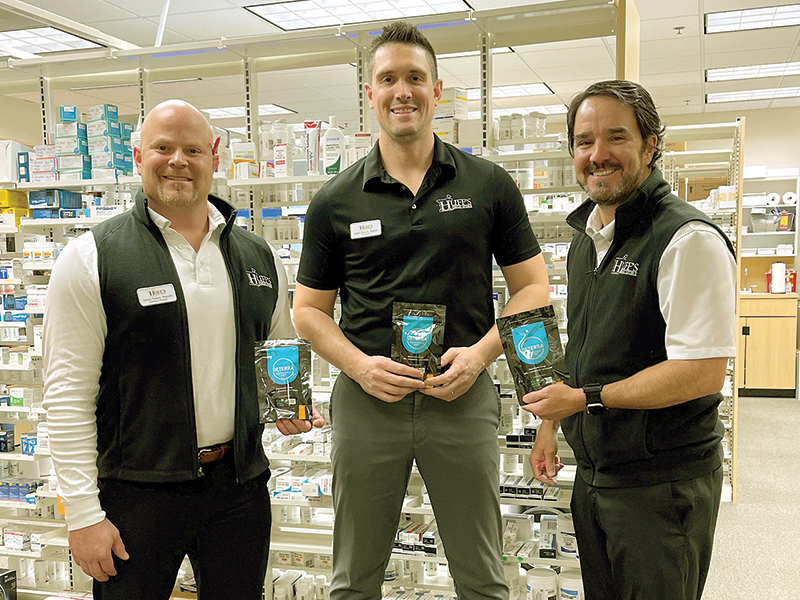
The Huff’s pharmacy offers Deterra drug disposal pouches to the general public at no charge, Purvis noted. Funded by the Mercer grant, the pouches use carbon and added water to de-activate prescription pills, including opioids. The sealed pouch can then be safely disposed of in the trash.
The de-activation pouches can also be used on fentanyl, according to the Deterra website. Purvis said increased use of that high-strength synthetic opioid is “the big shoe falling right now,” on top of everything else.
“People are taking fentanyl because it will mimic some of the opioids, but it works differently in the system,” he added. “Fentanyl is very cheap to make in a chemical lab. They make tablets that look like opioid tablets, and sometimes people will take one thinking they’re taking an opioid, but it’s fentanyl.”
Pharmacies in some states can take back prescription drugs and incinerate them, but Georgia pharmacies aren’t allowed to do that, Purvis noted. “The DEA doesn’t have that ability, but we are working on it,” he said.
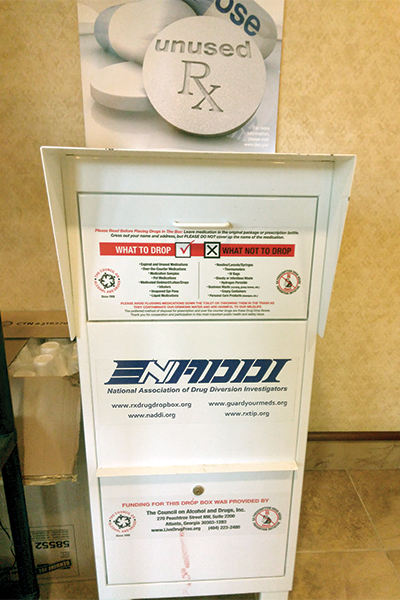
There is a drug takeback box available for public use at the Gilmer County Courthouse. All you have to do is drop unwanted prescription meds inside, Purvis said.
“You can put whatever (prescription medication) in there, no questions asked, and leave it. The sheriff’s office will take and incinerate it,” he added.
Sheriff Stacy Nicholson said the drug takeback box has gotten a great deal of use since it was first put in the courthouse lobby more than 10 years ago.
“We have folks coming in every day and dropping off unused meds. As we stand here and speak, someone is actually dropping off their unused meds,” he added. “We take any legal medication, as long as it doesn’t have needles. We store it until we can get enough to where it makes it worthwhile to be incinerated. We coordinate with places that have access to incinerators and destroy it.”
Williams said the Mercer grant will also fund the establishment of a recovery community organization (RCO) in Gilmer County, which will offer counseling and other addiction recovery services. The RCO, which will be called Bright Spirits, is still in the planning stages.
“They’ve already gone through certification, and (are now) working on securing a physical location,” said Williams. “Every RCO functions a little differently. Each one focuses on different things as a way to support that (particular) community. The whole idea is to meet the community where it is and put things in place so people struggling with drug addiction have a place to go.”
Williams said a renewal of the four-county opioid abuse reduction grant has been applied for, but it’s too early to know whether it will be approved.
“The grant was for $1 million over three years, and we’re in our third year now. This funding cycle will end Aug. 31. (As for a renewal), it’s kind of wait and see right now,” she added.