
Class 22-1 recruits almost a month into new program
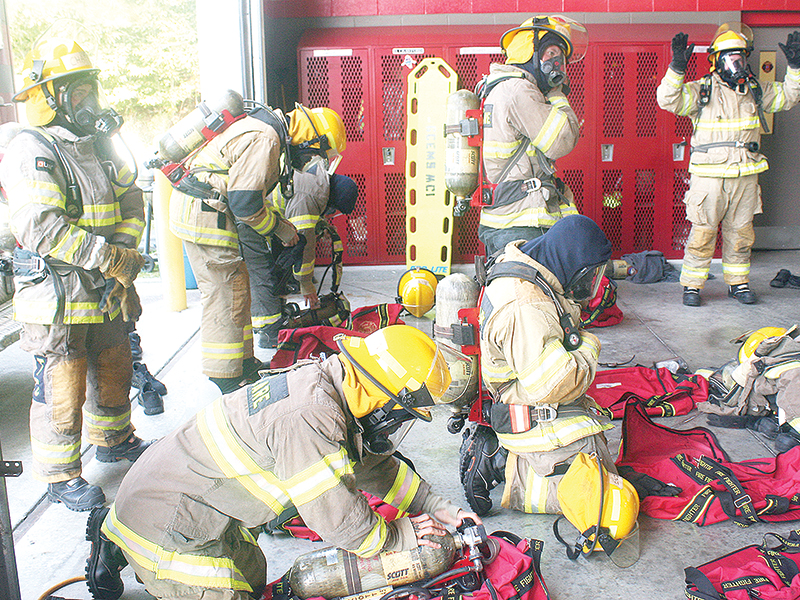
Being comfortable being uncomfortable.
That’s among the starting points for the first class in Gilmer Fire and Rescue’s noncertified recruit training program.
“That’s the key to the whole thing,” said Fire Chief Daniel Kauffman. “Being in tight places, being in gear that’s bulky and cumbersome, carrying the extra weight — it’s not what they’re used to. We’re getting them acclimated to that.”
A lot like boot camp
The fire department is almost a month into the new program, in which a dozen new employees are training on the clock to become certified firefighters and EMTs.
It’s still early in the game, as training will last until April 2023, but it’s off to a good start, Kauffman confirmed.
“The first two weeks were kind of pushing their physical limitations, getting them into the gear, and comfortable wearing the gear and a mask,” he said. “They learned a lot about themselves over (those) two weeks.”
The workday usually starts with physical fitness, which includes such exercises as pushups, situps and squats. Walking leisurely is not an option. Instead, recruits run in teams to get from place to place.
“If they leave the classroom and go to the bay, they’re not allowed to walk. They’re running everywhere they go,” Kauffman said. “They go in pairs because, at the fire department, you work in pairs.”
For Tristian Chaffer, one of the new recruits, running back and forth has become a tough habit to break when away from the firehouse.
“I think its more of a mindset, instead of just running,” said Chaffer, 23. “This weekend, while helping my father-in-law do some yard work, I started running around the yard to pick up tools. He was like, ‘What are you doing?’”
When members of Class 22-1 run, they’re expected to carry a flag they designed. The flag is symbolic, confirmed Battalion Chief Jason Bryant, one of the training instructors. It can represent anything from lifesaving tools, a piece of bunker gear or anything else firefighters are expected to keep up with.
“It’s a good way to teach accountability and paying attention to small details,” said recruit Raegan Dempsey. “The flag goes with us everywhere. If we leave it unattended or not in its home, it will get taken by someone.”
A staple routine of the introductory training has been timed quick dress, in which recruits have to put on all their bunker gear — including hat, coat, pants, gloves, shoes, a self-contained breathing apparatus (SCBA) and airpack — in two minutes or less. That’s the standard suit-up time adhered to by the State of Georgia, confirmed Bryant.
“I realized real quick that it doesn’t matter how fit you are, that gear is a different story,” said Chaffer. “The training (is) a lot harder than what I thought it was going to be, but that’s a good thing (for) preparing ourselves.”
“The first time you see your gear laid out in front of you, it’s just daunting,” agreed recruit Jon Henderson, 27. “You’re like, ‘I don’t know what any of this is,’ and you have to put it on. But seeing the progress that’s been made is really motivating.”
 One of the toughest things to learn, noted Henderson, has been relying on the SCBA and regulator to get air.
“It’s not like how you’re breathing now. You’ve actually got to work for it,” he said.
Other early training exercises have included a 400-foot fire hose entanglement scenario with several twisted hoses. Recruits have to follow the correct hose all the way to the fire truck while overcoming obstacles along the way.
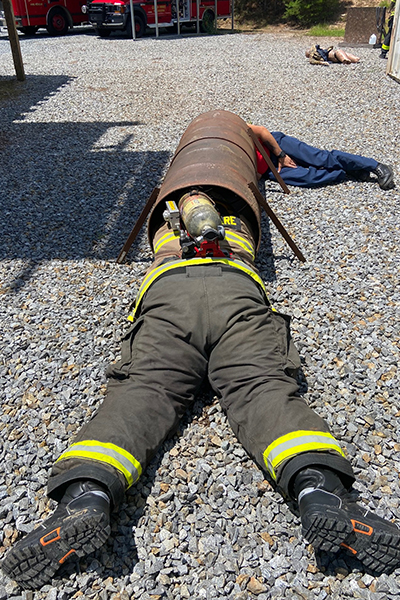
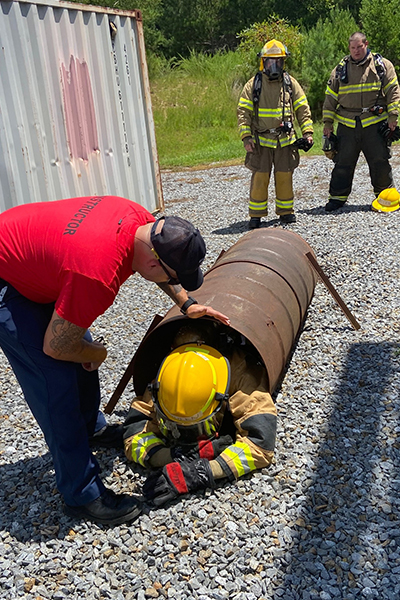
“It teaches them survival skills and how to get around and manage their way through an entanglement,” said Kauffman. “They have to go through some tight areas where they would have to remove their airpack, push it through a small space, then put the airpack back on and continue with the hose.”
Overcoming fear and anxiety in confined spaces is another example of learning to be comfortable in an uncomfortable situation, Kauffman explained.
“They (also) had a critical objective of a 200-foot crawl and back on their belly, which is the length of a fire hose. In a survival situation, if they were at the very end of the firehose and had to get out, they would have to go 200 feet. Everybody completed that objective,” he added.
It’s fair to say the program is a lot like boot camp, confirmed Battalion Chief Cass Harris, a class instructor.
“It is very paramilitary in design, which is to re-enforce chain of command, accountability and team building. Having a strong team is very important,” he added.
Before she was a member of Class 22-1, Dempsey, 20, participated in the fire department’s Explorers program for high schoolers. That program gives students a firsthand look into firefighting and EMS careers.
Some of the material that’s now being covered in class is familiar, but it’s “very much a different ball game,” she said.
“This is groundbreaking for our county, and I feel so grateful that we get to be the first recruit class to go through this and get experience from the instructors. It really is a great opportunity,” Dempsey added.
‘Very comprehensive’
Kauffman said the “noncert” program follows what would be taught at the Georgia Public Safety Training Center in Forsyth County, but most of the training will be done in-house by the local fire department’s battalion chiefs and crew members.
“We’re following what the state requires,” he added. “There will be a few occasions to go off-site to do things, but, otherwise, we’re able to do it with the instructors we have here. We’re pretty fortunate in that area.”
Harris noted this is not only the first in-house fire and EMS certification training program of its kind for Gilmer, but also in a large area of north Georgia.
“For me, it was a lot of nerves (on the first day),” he said. “Knowing it’s the first time to do something like this was nerve-wracking and exciting at the same time, just wanting to make sure everything goes right. It will go right. We’re just making sure that happens.”
After fire school ends in December, EMT training will begin and go into April. Class members will take written and hands-on practical exams in each area of certification. When the program ends, graduates will have obtained Firefighter 1 and 2 and Advanced EMT certification.
“It’s all very comprehensive,” said Bryant.
The fire and EMS training go hand in hand, but the two areas will follow different paths of instruction, explained Harris.
“Fire school is a lot more labor intensive and physically demanding, although there are some academic challenges to it. That gets flipped when they get to EMT school, which is more academically challenging. You can do great in fire school, but when you get to EMT school, it’s typically a game changer,” he said. “It’s nothing that can’t be obtained, but you’ve got to stay on top of it and stay in the book.”
The recruits will not be able to respond to actual emergency calls until they’ve obtained the proper certification, but live fire training will be part of the class, Bryant confirmed. The emergency scenario will be simulated, but the fire will be real and self-contained, he noted.
“There are parameters that the NFPA (National Fire Protection Association) says we have to hit before we’re allowed to do a live fire,” he added. “SCBA and personal protection is typically about a two-day class, but we’ve done it for two weeks because those things will save your life. By the first time they get to their first live fire, they should be very competent in that situation.”
Plenty of challenges still lie ahead, but, with their first month of training almost done, the inaugural class is faring exceptionally well, confirmed Harris.
“We’ve got a great group. They’ve picked up on things a lot quicker than most I’ve seen in the past,” he added.