
Fifteen will be picked for paid training/certification program
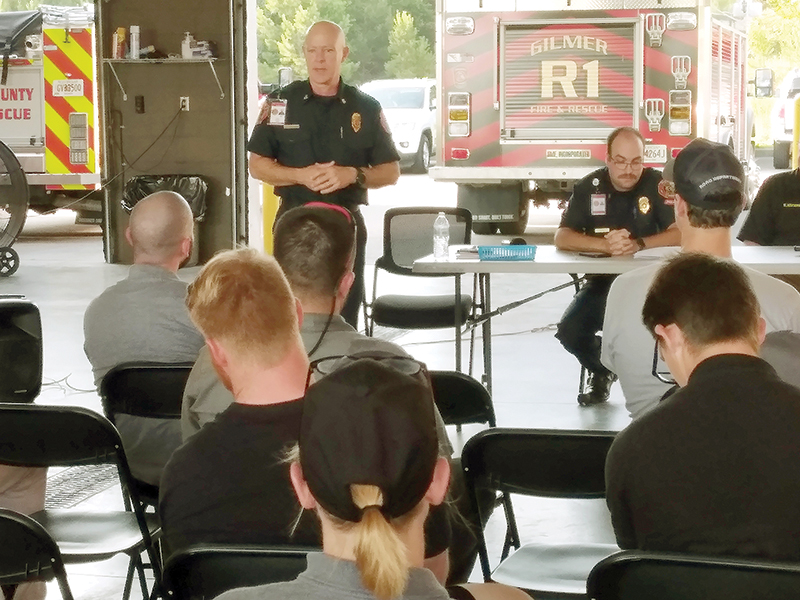
Thirty-two applications were received from two June open houses at which the public could learn more about Gilmer Fire and Rescue’s new training program for non-certified employees.
No further applications will be accepted for the “noncert” program, in which unexperienced applicants who are hired will be paid as they attain firefighter and EMT certification.
At the last of those open houses Tuesday, June 14, members of the fire department’s leadership staff took turns explaining what being a firefighter/EMS worker in Gilmer County entails and what’s expected of employees.
“If you qualify for the position, we’re going to pay you to go to school 8 a.m.-5 p.m. Monday through Friday,” Fire Chief Daniel Kauffman told those who attended the open house.
“This is going to be a physically and mentally demanding course,” Kauffman stressed. “There’s going to be physical fitness involved. You’re going to have classwork, (and) you’re going to have outside physical activity. You’re going to be raising ladders, pulling hose and doing all kinds of physical activities that are going to test you physically.”
At the end of the nine-month training program, those who finish will be Firefighter 2 and EMT-A (Advanced) certified. That means a $41,717 starting salary with the option to ride on an ambulance and earn more, Kauffman noted.
“Come May 1 (2023), you’ll transition to a fire station and a 24-hour shift. You’ll come in at 9 in the morning and work till 9 the next morning. You may sleep at night, or you may not sleep at night. You may work the whole 24 hours. You’re going to miss birthdays, baseball games, ballet recitals and anniversaries. That’s part of the sacrifice of this job,” he said.
Battalion Chief Mike Dempsey said the mountains and water in Gilmer County make for calls some metro Atlanta fire departments never see.
“You will do stuff you never imagined you’d be doing. You will do stuff up here where you have to think outside the box,” Dempsey said. “If you like to swim, you will swim. We’ve had wrecks with cars in trees. Not (run) into a tree, but in a tree.”
Dempsey said about 85 percent of the department’s response is for EMS calls.
“If you’re looking to just be a firefighter, there’s so much more to it than that,” he said. “You’ll (also) have to treat your patients because we don’t have hospitals.”
EMS Chief Andrew Burnette said the first EMS portion of the training is 290 hours, 60 of which will be in the field. After that’s been completed, the new employees will move on to the advanced EMS portion, which is another 358 hours, 120 of which will be in the field.
“You’re going to see things you’re never going to unsee,” Burnette advised. “If you live in this county, there’s a possibility you could be called for an emergency involving your own family members, friends or someone you grew up with. These are things you have to prepare for. You can’t unsee them. We’ve all got them in our closets.”
The training will basically be like going to medical school, Burnette noted.
“You’ll be doing a lot of lifesaving skills. You’re going to learn the human body inside and out. You’re going to learn all the systems, injuries and illnesses and how to treat them, how to start an IV, take all the vitals and everything,” he said.
Public Safety Director Keith Kucera covered some of the other situations recruits will encounter and be trained for, including wilderness search and rescue, drone operations and Hazmat operations.
“Don’t make it a job. Make it a career. This is one of the best careers you’ll ever find,” said Kucera.
To be considered for the “noncert” training program, applicants must pass an NCIC criminal background check and have a clean driving record.
The tentative start date for the program is Aug. 1, and interviewing applicants was scheduled to begin this week, Kauffman said.
“It’s going to be a selective process, (and) 15 will be given the opportunity to begin the program. We hope to have recruit candidate position offers by the middle of July,” he added.