
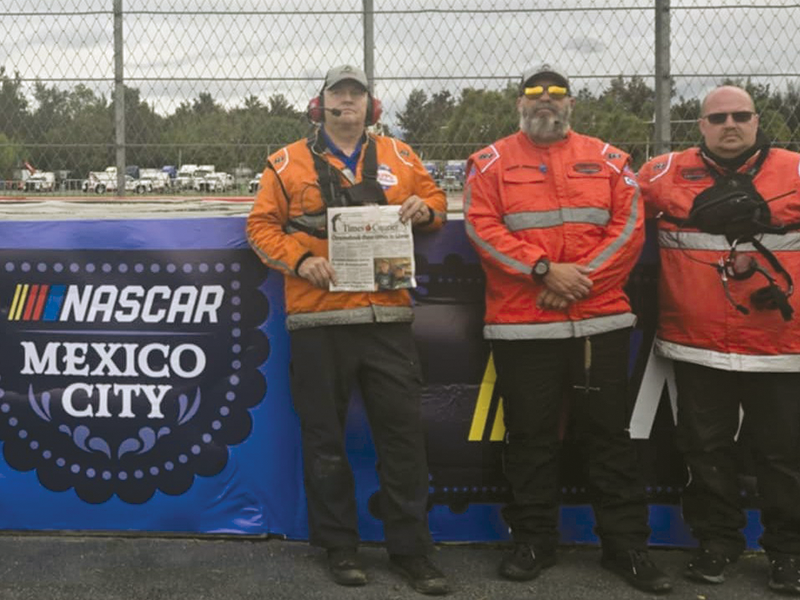
Max Frady has been working NASCAR Cup Series races as a tow truck operator for more than 20 years. However, the recent race in Mexico City, Mexico, proved to be one of the most exciting in his career.
“The people in Mexico City were most appreciative and the most hospitable crowd that we have ever seen,” said Frady, the owner/operator of Clark’s Towing, in Ellijay. “They were excited for us to be there. It was great! American fans get kinda mundane, but they never have a race like this in Mexico, and the people were overjoyed with excitement.”
The NASCAR race south of the border known as the Viva Mexico 250 is actually 241 miles long, consisting of 100 laps around a “road course” that is 2.41 miles long instead of the usual oval tracks raced in America. Frady said he has been involved with NASCAR since 2004.
“My wrecker manufacturer, Miller Industries of Chattanooga, manufactures the bodies for the tow trucks, and I volunteered with them for awhile to get started,” he said. “Then I got trained and got up into the paying class.”
Working for NASCAR at any level is an exacting process, Frady noted.
“I’ve worked a lot of races with them, and they really critique your performance, they micro-manage you in every way,” he said. “Track services that I am a part of includes fire crews, ambulance, rescue, recovery guys, wall guys (who fix damaged race walls and barriers), that sort of thing.”
NASCAR — the National Association for Stock Car Auto Racing — handled logistics for the Mexico City race. That meant a total of 3,000 race-oriented people crossed the border for the Viva Mexico 250.
“I flew to NASCAR’s airline hub at Charlotte, N.C., then it was on to Mexico City,” shared Frady, who has also pulled tows in Whitfield and Murray counties. “NASCAR sets the itinerary of where we’re going — arrival times for all the haulers, support equipment and track service people at the border — and then trucked all of them across the border with security in tow. As far as I know it went really smoothly, except one truck broke down. We stayed in the Meridian Hotel, and each one of our seven team members had deluxe accommodations, including a one-room suite that was provided by NASCAR this time.”
‘The camaraderie’
Currently, he is employed by Stepp’s Towing out of Tampa, Fla., on race days, and believes he has worked between 150 to 200 races in 21 years.
“They have a contract (with NASCAR) and offer me races, and I mostly work super speedways,” said Frady. “Talladega is my home track, I was the training coordinator for race recovery there for several years. This is the fourth group I’ve worked with, because it’s ever evolving and someone will buy the contract out. But we’re NASCAR-sanctioned and certified, and you have to be so you can be on the track.”
Does he have a favorite driver?
“My favorite driver is the one that wrecks and I get to tow,” Frady replied. “I’m not really wild about any of them. I don’t dislike any of the drivers, but my wife and family are the fans and always have been.”
Is there communication with the drivers?
“Maybe in the garage, but on the track NASCAR liaisons the doctors and the rescue teams and they get to them first and get them out of the car about the same time we pull up to hook up the car,” he explained. “It’s a pretty fast revolution with the race going on. We never have any conversation or confrontation with the drivers after they wreck; we’re trained about that.”
What’s his favorite part of working NASCAR races?
“The camaraderie of the guys I’m there with,” Frady said. “We ran an interesting race there with the NASCAR Mexico Series on Saturday. It’s the equivalent to NASCAR here, and it was fun and exciting with some really nice cars. We got to work some really good wrecks, and it was sort of a warm-up for Sunday. And we ran an Xfinity race on Saturday too, and then the Cup race on Sunday.”
Even with all the races worked through the years, NASCAR in Mexico was unique.
“It was the first time just about all of us had raced in Mexico City, so it was a learning curve when we went,” Frady said.