
College and Career Academy propelling students into workplace
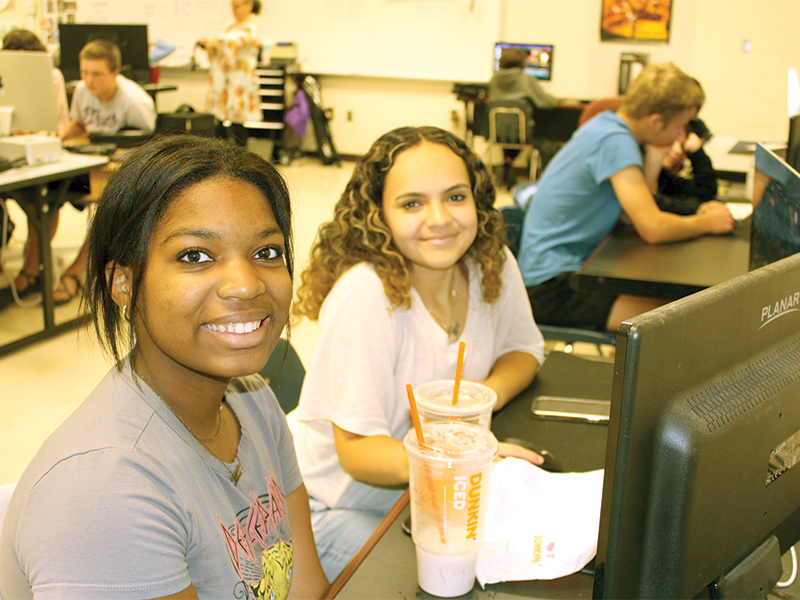
Shelby Shirley’s goal of serving as a pediatric nurse is becoming reality at the Gilmer College and Career Academy (CCA).
“I’ve actually already finished all the required Early Childhood Education courses in this class, and I’m interning as a work-based learning intern,” she said during a recent interview session with other students. “This class has taught me a lot. The first semester has taught me about traumas and what to look for in neglect in kids. There are certain things that you can tell has happened to them, how they respond to things like verbal skills, motor skills. It’s just helped me a lot with children, and I have a natural (ability) to take care of them.”
Coming from a “long line of nurses” also contributes to Shelby’s desire to continue a family tradition.
“I’m already in the CNA (certified nurse assistant) program that they offer here at the CCA,” the Gilmer High School senior added. “This class has really helped me toward a nursing career.”
The academy is based in the Larry Walker Education Center, the past home of both Gilmer High and Gilmer Middle School. There are several different “pathways” students can pursue, said CEO Carla Foley, at both the high school and the CCA.
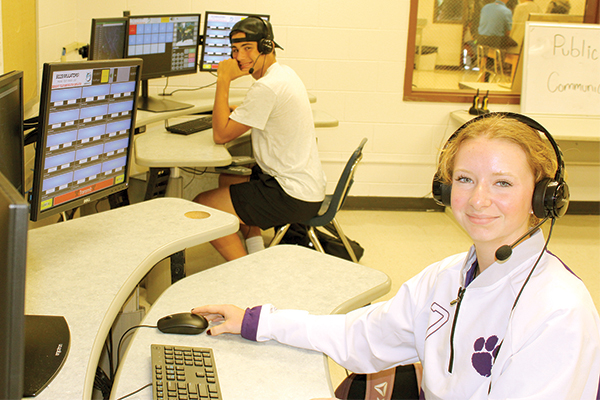
“Poultry science, floriculture, horticulture and animal science can lead to a variety of different things for students,” she began. “We try to meet those needs or interests within the community. Construction, carpentry, automotive. Computer science is a really broad pathway and includes programming for apps, making games and social media. All of those are at the high school. Down here (at the CCA), we have audio/video tech, early childhood education, public safety, nutrition and food science, work-based learning and dual enrollment.”
An aspect of the A/V tech class is that students are “kind of creating their own career pathway” as they focus on the new scoreboard technology at Huff-Mosley Memorial Stadium and in the gym.
“So the students are actually using the same software that some major league soccer and baseball stadiums use,” Foley detailed. “It’s really the industry-certified software, and so when our kids are getting ready for a Friday night game they do all the animation. They do everything you see on the big screen — they put all of that together. So they could walk out of here and get a job at a major league baseball stadium or college stadium. At our first home (football) game I thought, ‘I bet people have no idea our kids put this together.’ And they’re actually in the booth running everything you see on the screen. It’s really neat.”
Although the College and Career Academy is a separate facility, it’s still a part of the high school that students schedule as part of their day.
“Students are focusing on, ‘Where can I take this to get me a job when I graduate? What’s going to give me those certifications?’” she added.
New research facility
Foley said some students — and herself as an administrator — are enthused about the new poultry research facility that’s opening on the expansive campus of Clear Creek middle and elementary schools, as well as the relatively-new Gilmer County Agriculture Education Center.
“It ties in perfectly with our poultry science pathway,” Foley said of the research facility. “People who are familiar with the ag program know that it’s more than just farming, because there’s so much more to that industry. I think the poultry research facility will be huge for that, for research for Pilgrim’s. They’re going to be testing certain feeds, different habitats and the environments the chickens are in — changing things up and seeing how the birds thrive. So kids will actually be doing research in there. So that’s really exciting.”
Some students ask her, “‘Why don’t you offer cosmetology?’” she shared. “We don’t have a need for cosmetology in Gilmer County, that’s a saturated business right now. We’re trying to produce whatever the community needs — automotive, construction — we know those are huge. And anything in agriculture.”
Another popular pathway is public safety.
“Within that pathway, we offer criminal investigations and a 911 public safety communications class,” she pointed out. “When students finish that class, they actually sit for the national exam. When they graduate, they take a two-week Georgia Public Safety Training course and they can go right to work as a dispatcher. It usually takes 10 to 12 weeks for someone to get that position, so they do it here to graduate and they’re in as a 911 dispatcher.”
Impacting children, seniors
The early childhood education pathway is having an immediate impact on local communities inside the county.
“We have a big purple bus that goes out into the community that has a preschool classroom set up in it, so we go up to Tower Road and over to Faith, Hope and Charity (Recycle Store),” said Foley. “We’re trying to find the kids who are not in preschool — either at preschool age or before preschool — and get them some skills they can use to be successful. We have high school kids who are actually teaching lessons and doing things with the kids, and it’s really cool to see that. These students are targeting a career in education, so that lets them put some of those skills to use. They love it and it’s fun to watch them.”
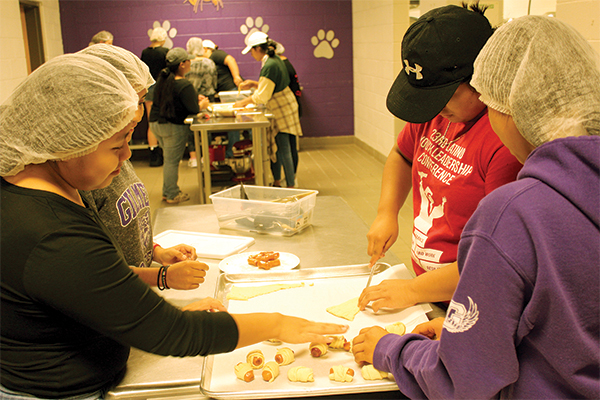
There’s also the nutrition and food science program whose students are also getting real-life experiences.
“We had a culinary program, but culinary (here) is not going to produce high-demand, high-wage jobs for kids,” she continued. “Nutrition and food science leads to dietician jobs, and it’s a good backdoor entry into health care for students. The health inspector came and talked to our kids last year and said she could use six more health inspectors right now — it’s an important need. That pathway will actually produce students who can go to school and get their certifications to go into that. And with Manor Lake and The Oaks (assisted living centers), and at Parkside (nursing home) they can fill jobs there through that pathway.”
Dual enrollment
For those focused on attending college, there are dual enrollment classrooms and related opportunities in the community.
“Chattahoochee Tech has teachers who provide dual enrollment classes in this building,” Foley noted. “One of those is the certified nursing assistant (CNA) program. We have students who take those two courses, one in the fall and the following one in the spring. They sit for the exam, graduate and are ready to work.”
Students can start in a pathway program in their freshman year.
“Along the way they can do internships with a business or agency in the community and take part in dual enrollment as well,” she said. “We can get them out in the community for work-based learning.”
At any given time there will be between 250 to 300 students under the roof at the CCA; three shuttle buses between there and the high school stay busy.
“I want people to know how we’re benefiting our community,” said Foley. “All of the classes we’re offering have some kind of value to add back to the community.”
She was asked if students are willing to work when so many ‘Help Wanted’ signs can be seen at businesses in the community?
“I have seen more students interested in going career paths and talking about their future,” she replied. “When I was a principal (at GHS) sometimes I’d talk to kids at graduation and ask, ‘What are you going to do after you graduate?’ and so many kids would say, ‘Oh, I don’t know, I have no idea.’ That would just kill me! I mean, how did you get to this point and you don’t know what to do? That’s why I love being the CEO (at the CCA), because I can ensure when kids leave they already know what they’re doing because they’ve already talked about it.
“And we’ve seen our work-based learning program grow as a result of that. We had 87 students at the end of last year who had participated in work-based learning. It’s where students are actually going out and working in the community and earning high school credit for working. That does a lot of great things. It helps us build partnerships with the community because we’re sending kids to them … and it helps them see what they do and don’t want to do as a career. Some who did work-based learning three or four years ago are still employed at some of those places.”
About Larry Walker
The Larry Walker Education Center — the former home of Gilmer High and then Gilmer Middle School — is named after local career educator Larry Walker, who was killed in a tragic accident in 2018.
Carla Foley, the chief executive officer of the College and Career Academy housed inside the center, knew Walker and spoke of his character.
“Larry was the principal at Gilmer Middle School which was here then, and the very first person I met when I got to Gilmer,” she said. “I was an assistant principal at Gilmer High when they hired me. At my first admin meeting he came right up, introduced himself and said, ‘Whatever you need, let me know.’ He was always a kind person, just very welcoming. Larry was straightforward and so if I ever had a question, he just told me, ‘This is how it is …’ He didn’t sugarcoat anything, and I appreciated that about him. He was great, and I miss him.”
The Larry Walker Education Center also has under its roof the night school of Mountain Education High School, the Mountain Innovation Program (an alternative school), Family Connections and some other school district-level offices. All are able to use the Professional Learning Room at the center, which is the former library.
Early Childhood Education students share
Students who are in Phase 3 of the Early Childhood Education program are motivated, said Career and College Academy CEO Carla Foley.
“Most of them are going to be teachers,” she said. “This class also works great for students who want to go into either child care, want to be a pediatrician or pediatric nurse or go into the medical field. Because it’s not just about being a teacher, it covers the whole lifespan of birth to five years old. So they learn nutrition and healthy pregnancies also, and early-learning skills that are not taught in schools.”
Following are some comments from students about their goals:
Ashley Camacho — “I want to become a teacher, but I’m not sure what grade. I like kids.”
Kayla Mooney — “I want to be teacher, probably fourth grade and under, early childhood. I just want to make a difference.”
Do you have younger brothers or sisters?
“I have one.”
Are you practicing on them?
“Probably not as much as I should!”
Sarah Baxter — “I’d like to teach in the same grades, fourth and under, somewhere around there. I like helping kids and watching them grow and learning stuff.”
Emily Shorter — “I would like to become a pediatric nurse, to help me learn how kids develop and help them with what they need.”
Katelyn Williams — “I want to become a teacher, K through fifth. Little kids have better personalities than high school (kids)! I believe they would be easier to handle, and I just like them better.”
Amayah Jones — “I just want to be in some type of childhood care — something to do with child care — but not necessarily a teacher, but maybe at a day care center. I feel like there needs to be more people to help kids, and I really like being around kids.”
Luke Janssen — “I’d like to be a gym coach at school, or go into golfing. That’s my life, I’m on the golf team. If that doesn’t work out, I’ll become a gym coach — and maybe a golf coach.”
Gladys Lopez — “I want to be an ER nurse; I think it takes a special person to do something in an emergency when people need it the most, whether children or adults. I think it takes a lot for someone to do that, and I have that natural instinct to want to do that for people. I rode along on an ambulance (call) and it was kinda weird, very cold in there! I’m doing work-based learning at a Piedmont (Hospital) position (with a physician), so that’s helped me a lot to see how my future would look like.”