
Robot will be “asset” in underwater operations
Sometimes, a firefighter’s job can be exhausting. Sometimes, it can be heartbreaking. And sometimes, it can be fun.
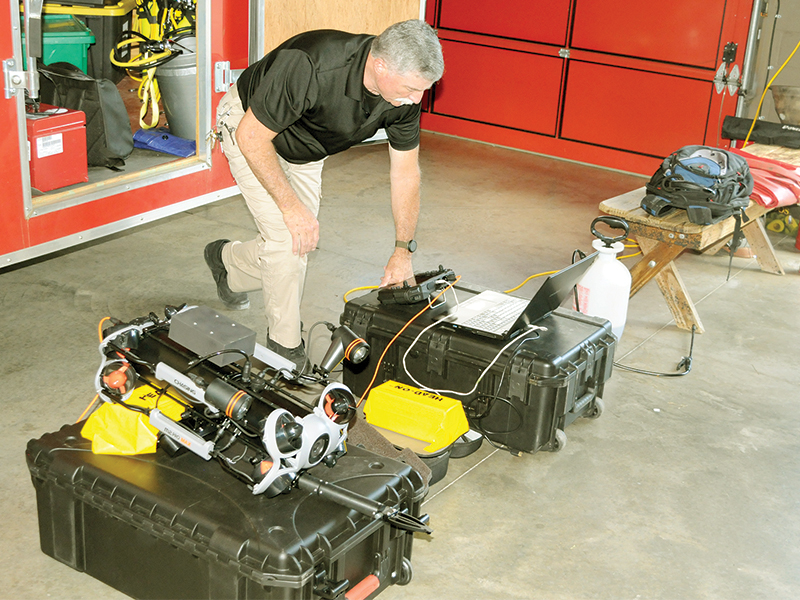
At 64 years old, experienced firefighter Division Chief Jeff Statham said he enjoyed testing Gilmer County Fire and Rescue’s (GCFR) new underwater drone.
“It’s gonna be a great asset to the department,” GCFR Chief Sam West said.
The drone, an M2 Pro Max, will help GCFR in underwater search-and-rescue operations and evidence gathering. It cost $14,000, Statham said.
The drone is cheaper than a diver, he added. Even without training, a diver’s equipment costs around $10,000.
Drones have recently gotten cheap enough for local government organizations to benefit from their use, he added.
It has a video camera and a sonar system for detection, and a grabbing claw for holding onto items. It can go up to 400 feet away from its boat.
When searching underwater without a drone, firefighters have two main tools, Statham said.
The first is boat-based sonar. When water gets deep, it can be difficult to know just what sonar has found.
“If you go out to 90 feet, that image that may be my size becomes this big on screen,” he said, making a small gesture with his hand.
The second tool is sending divers.
It can be dangerous to send divers out on extended missions.
On an underwater search, GCFR would normally have to send down divers every time sonar saw something worth investigating, Statham said.
But now, the drone can confirm sightings with its own systems before GCFR sends down a diver.
This new option “makes it safer for the divers,” Statham said.
Depending on the mission, divers might have to take photographs or do other precision work the drone’s claw can’t do.
Just like air drones, this drone is one more tool that will help GCFR do its job better.
“You want to integrate it,” Statham said