

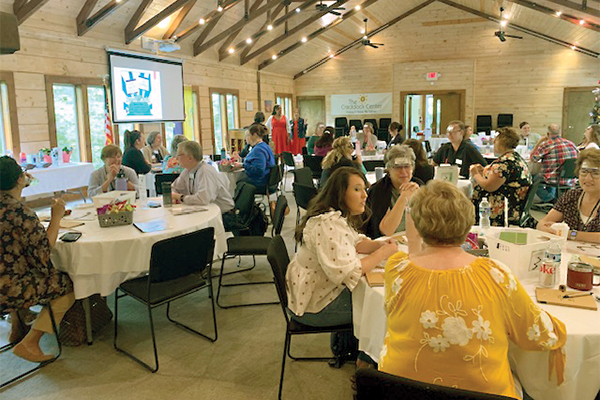
Representatives of Family Connection chapters in Gilmer, Pickens and Fannin County convened at a recent first-time conference to discuss future priorities for the three community outreach nonprofits.
The Journey to Action event at Cherry Log’s Craddock Center was funded by a grant from Resilient Georgia, an Atlanta nonprofit that shares Family Connection’s aim of improving challenges and barriers faced by families and children.
“There are 15 counties in (Georgia Family Connection) Region 1, and the counties of Gilmer, Pickens and Fannin work closely together since we are in the same judicial circuit,” said Tiffany Watson, Gilmer Family Connection director. “We had roughly 50 people attend (the event), who were from different nonprofits, our different Family Connection collaboratives and concerned citizens interested in taking a deeper look at some of these issues in the three counties.”
Lack of public transportation and lack of affordable housing are two examples of issues and focus areas in the three Family Connection chapters, Watson noted.
“In any meeting I’m at, housing comes up and lack of transportation comes up,” she added. “I work a lot with single mothers (and others) calling every day asking about housing. There are a lot of different individuals needing help with housing.”
Watson, a member of the Gilmer Initiative for Community Housing (GICH) panel that is enrolled in a three-year Department of Community Affairs housing solutions program, hopes that program and additional training provided by the University of Georgia will be of use in finding ways to alleviate the housing shortages.
“We can use that training to bring back solutions that may work in our areas, things that other counties have done,” she added.
Several issues shared by the three counties stem from poverty and family trauma, noted Watson. Family trauma can come from several factors including poverty, abuse, neglect and drug use.
At the conference, which was led by Georgia Family Connection Regional Manager Gabrielle Stewart, participants used memo boards and informational maps to plan out their Journeys to Action. The results will be used in the three chapters’ annual plans, which, said Watson, are “marching orders” for what all the chapters will focus on in a given year.
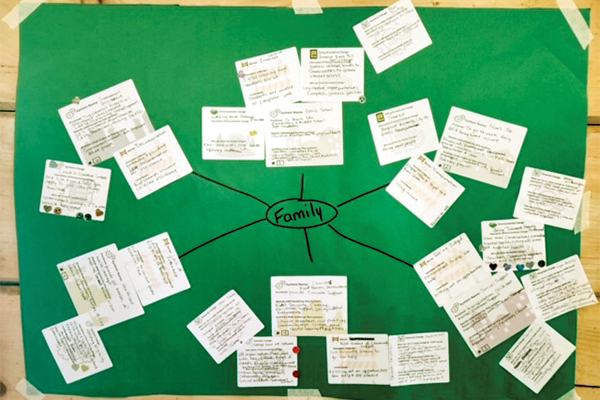
“We are going to use the information we collected to move into action in our communities. We’ll be able to take this data back to our collaboratives in our individual (chapters) to see what people really think the needs are,” Watson said.
The opioid epidemic is another shared issue in the three-county area. Currently, Gilmer is among several north Georgia counties receiving two state opioid abuse reduction grants — one from Morehouse College and another from Mercer University. The grants have provided funding for various means of opioid abuse reduction including community Narcan training sessions in which Gilmer Family Connection and the Craddock Center previously partnered. Narcan is an easily administered nasal spray that can overturn the effects of an opioid overdose.
“As Family Connection directors, we can push out to do some training in different organizations. I’m working with both those grants in our area to be able to get more training (on how to better deal with opioid abuse) here,” Watson said.
Rivers of Peace, an addiction recovery center funded by the Mercer grant, is expected to open in Blue Ridge this summer. A site for the recovery center could not be found in Gilmer, but the Blue Ridge location will be the closest facility of its kind to Gilmer County, Watson noted.