
Local telecommunications company gets $21 million ARPA grant
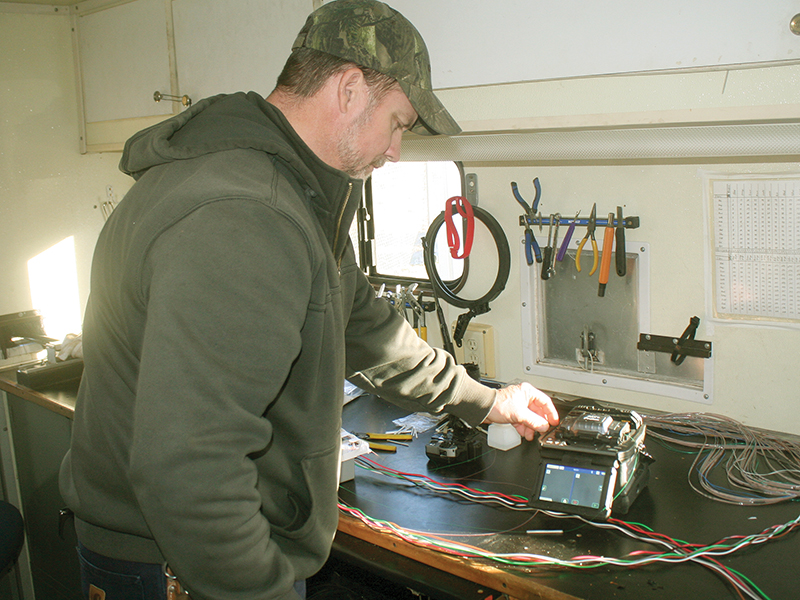
Ellijay Telephone Company (ETC) will greatly expand its broadband internet service in Gilmer and Pickens counties with $21 million in American Rescue Plan Act (ARPA) grant funding.
Almost $408 million in ARPA funds was recently disbursed in the high-speed broadband initiative for rural Georgia, which will fund faster internet projects in 70 counties.
ETC was awarded $21,418,727 that will be used to build approximately 574 miles of high-speed fiber optics in Gilmer and Pickens.
“It’s the largest (project grant) ETC has received,” said Jason Smith, ETC Chief Operating Officer (COO).
In Gilmer County, the new fiberoptic network will provide broadband capability to current customer locations that don’t already have broadband or aren’t included in ETC’s ongoing ReConnect project funded by a $4 million USDA grant.
“If they don’t currently have (broadband) service and are not part of the Reconnect (project area), they will be part of this,” Smith said. “I’m not going to say every location in Gilmer County will get it because there may be some locations we’re not aware of that have never had service from ETC. We built it based on all our location data in our mapping systems, so anywhere we currently have a network is what’s going to get replaced.”
With the new infrastructure, current DSL customers will have the option to switch to faster internet, Smith confirmed.
“Everyone in this grant will have the ability to subscribe to the same service, and the minimum speed will be a 50-by-50 connection. We’re going to reach out to them and say this is happening in your area,” he added. “We have a few customers on a service called VDSL that allows for faster speeds than basic DSL and is considered broadband, but it’s very few customers. All of the other basic DSL customers will be (able to get) fiber. We will have tiers of service at the same monthly cost they currently pay, but there will also be additional tiers of service with higher speeds if they so choose.”
In Pickens, ETC will use a partnership with Amicalola Electric to run the fiber optic line.
“In Pickens, it will be more in areas that are already near our existing service and that are close to that Amicalola partnership (area). We’ll be leveraging that partnership in a big way for for the Pickens portion of the grant,” Smith said. “In Gilmer, we were lucky enough to get the option funded that covered all locations that are currently served.”
The Joint Development Authority of Gilmer and Pickens County was instrumental in ETC getting the funding, Smith confirmed.
“If you had the ability to partner with a local entity like that, you scored stronger versus if a company went it alone and didn’t show community support,” he added.
According to a release from ETC, Georgia House Speaker David Ralston, Sen. Steve Gooch and Rep. Rick Jasperse were among those involved in the broadband-boosting effort by the House Rural Development Council.
“We had several different legislators, community groups and businesses that wrote letters of support that were very helpful,” Smith said. “The schools wrote us letters of support, and I think it’s a big thing for them.”
‘A wonderful opportunity’
Broadband expansion has been a topic of increasing concern, both in Georgia and nationwide, particularly with the COVID-19 pandemic causing more people to work or do school work from home.
ETC said the project is expected to serve 4,259 customers in 334 unserved census block groups. Among those that could benefit are students doing virtual assignments, remote and home workers, businesses that need strong broadband connections and anyone who uses tele-health services, Smith noted.
Gilmer Schools Superintendent Dr. Brian Ridley said wider access to broadband internet is a wonderful opportunity for students and the local community.
“It’s great news. We’re excited about it,” Ridley said. “I come from a county (Haralson) that, when the pandemic started, had about 25 percent of households with reliable internet service. We worked with some legislative partners to help bring Comcast into the area. That was a long process, but it helped turn things around for us.”
Being able to use a computer to study or complete assignments is a crucial part of today’s school world, Ridley noted. In Gilmer, third through twelfth grade students regularly use Chromebooks in some way to complete schoolwork.
“First and second grades use Chromebooks and tablets, too, so we’re exposing kids pretty early to these concepts. This will definitely improve academic outcomes for students who are working remotely, even when we’re not virtual. (For) kids who just want to do homework or collaborate across the internet on regular assignments, it’s also going to be a great thing,” Ridley said.
Not happening overnight
Smith said ETC hopes to start the project work within the next six months, but how fast it all moves will depend on when supplies, including fiberoptic cable, can be received.
“A grant this large is definitely not going to happen overnight. There’s a lot of supply chain issues right now, too, Smith said. “Right now, we’re in the engineering and planning stages and deciding where it will make the most sense to begin the project. A lot of it is going to be dictated by the parts we can receive and when. We’ve been told by our current supplier that the lead time for fiber is up to 15 months. We do have some supplies on hand that we’re hoping to use to get started.”
As the local telecommunications provider gears up for the big project, fiberoptic internet is still being run to areas of Gilmer pre-designated for the ReConnect work.
That project is ramping up, and hoped to be completed within the next 18 months, but it also depends on availability of needed supplies, Smith said.
“We’re probably half complete on the (ReConnect) construction and splicing and probably a little more than a third complete on the actual customer conversions,” Smith added.
ETC will put almost $4 million in matching funds toward the forthcoming broadband project, bringing the expected cost to $25.4 million. They will have until Dec. 31, 2026, to use the ARPA funds.
“It would be our goal to be finished by then, but with the supply chain issues we honestly don’t know what’s going to happen. We’re getting orders placed right now for literally the next four years. Hopefully the materials start flowing in before too long,” Smith said.