
Gilmer Fire asks those burning to keep close watch
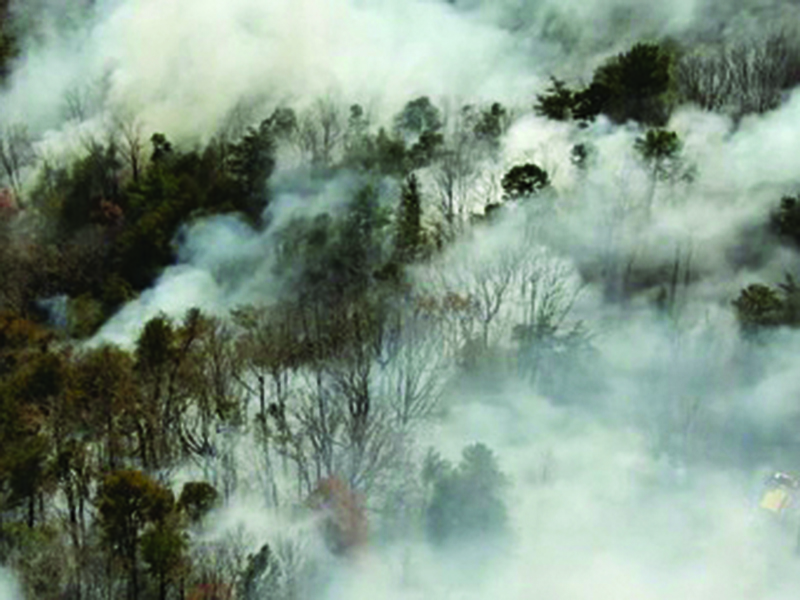
Gilmer County Fire and Rescue has responded to multiple brush fire calls over the past few weeks, a time in which weather conditions have been just right for small outdoor fires to get out of control.
A Nov. 24 fire in the Talona Mountain Road area is an example of how quickly flames can spread given current conditions.
“I think it’s safe to say that, for this particular calendar year, this was the worst one we’ve seen,” said Gilmer Public Safety Director Keith Kucera.
Kucera said the Georgia Forestry Commission is still investigating the Talona fire, and a definite cause for it starting hasn’t been determined yet.
Deputy Fire Chief Mark Chastain said the fire spread across 7-8 acres of steep terrain on the back side of Talona Mountain before it was put out.
“It did get close to a couple of homes, but we had some really quick response from our first arriving units. They made some good solid decisions, then it was just a matter of getting in and getting a fire line or break around the fire with blowers, rakes and things like that,” Chastain said.
“Once the fire reaches that break line, it has no more fuel to eat and starts to put itself out,” Kucera added.
It took about three hours to get the fire under control, and Gilmer Fire was aided in that task by firefighters from Pickens County and Georgia Forestry, Kucera noted. The Ellijay Fire Department responded to a separate small brush fire off Highway 282 while the Talona fire was being attended to, he added.
Several smaller outdoor fires have been fought all over the county recently, Kucera noted.
“If someone is burning leaves, dead debris or brush, it can get out of control very quickly. The low humidity is one of the key factors to it, and the leaves have fallen, so all that becomes dry fuel,” he said. “The minute you put a flame to it, it’s going to go ahead and catch. When you’ve got winds that kick up, that just adds to the spread of a fire.”
Chastain said a good rule of thumb is “just don’t burn” if the relative humidity level is below 30 percent.
“We want citizens to pay very, very close attention if they’re doing any outdoor burning,” he added.
“We’ve had a lack of rain through the latter part of October and November. We’re in a rainfall deficit for those months, so our fuel moisture in the leaves and stuff on the ground starts to drop. The lower the humidity gets, the more the atmosphere will pull out of that and there (will be) more potential for your fire to get out of control.”
‘You have to stay with it’
Burn permits for hand-piled leaves and vegetation were previously issued by the forestry commission, but state legislation that went into effect this year eliminated the need to notify the forestry commission prior to doing that type of yard burning.
“Georgia Forestry doesn’t issue burn permits now, except for land clearing. (We still advise that) people make sure they’ve met all the requirements for outdoor burning as presented by the forestry commission,” said Chastain.
When burning outdoors, the forestry commission recommends using its Take 5 approach, outlined with the following “SSTAR” acronym:
◆ Space – 25 or more feet between fire and woodlands.
◆ Space – 50 feet or more between fire and structures.
◆ Time – sunrise to sunset.
◆ Attendance – Have someone responsible onsite until the fire is extinguished.
◆ Reasonable precautions – Have tools and measures in place to prevent an escaped fire. Examples include a continuous, pressurized water source, man-made or natural barriers to contain fires, hand tools or fire-containing equipment and weather awareness.
The biggest thing is to never leave an outdoor fire unattended until it’s been completely put out, Chastain advised.
“I would like to see people pay more attention to their fires. You have to stay with it. Just a few minutes of neglect can get people in trouble,” he said. “If you walk away just to go to the rest room, those minutes can be the difference between burning down the neighborhood and keeping the fire under control. When you think it’s out, wet it down to make sure. When the ground is black and wet, the chances of something happening decreases tremendously.”
When it’s dry outside and the humidity is low enough, tossing a lit cigarette butt into brush from a moving car or pulling off the road into tall grass can cause a fire to suddenly ignite, Chastain confirmed. Both those have been actual causes of roadside fires responded to by the department.
“Just the catalytic converter on the car being hot is enough to set the grass on fire,” Chastain said.
Several weather apps, such as WeatherBug and Active Radar, give daily changes in humidity levels, Chastain noted. A couple of rainy days, like those seen earlier this week, isn’t enough to offset the fire danger posed by low humidity and a rainfall deficit, he added.
“’Tis the season when the weather changes dramatically,” Chastain said. “Last week, we were at 70 degrees and sunny, but it was really cold the week before. It’s been raining (recently), but after a day of sunshine and the humidity gets down to 15 percent, it’s just going to suck that moisture right out, and you have fire conditions again.”
It’s also the time of year when the fire department usually starts seeing more chimney fires, noted Kucera.
“We see (them) this time of year because people haven’t had their chimney swept by a certified chimney sweep. (They) go ahead and light the fire assuming the chimney and flue are OK. It happens at regular, full-time residences, and a lot at cabin rentals,” he added.