
Citizens’ Law Enforcement class gets eye-opening visit to county’s 911 center

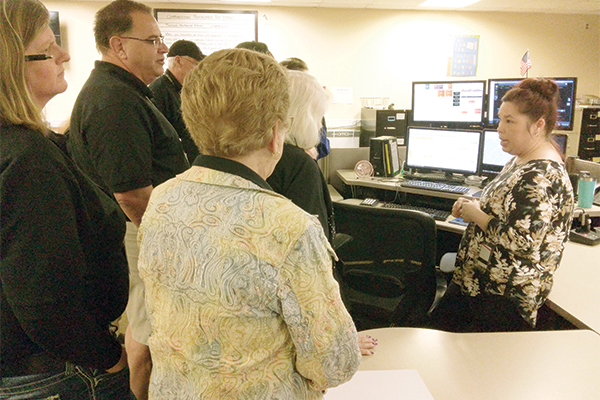
Participants in the Gilmer Sheriff’s Office (GCSO) Citizens’ Law Enforcement Academy (CLEA) got a crash course in what it takes to be a 911 dispatcher during last week’s session of the educational program in which citizens get an up-close look at different GCSO departments.
The CLEA class visited the county’s 911 Communications Center inside the courthouse on the heels of National Public Safety Telecommunicators Week, observed the second week in April.
Gilmer County communications officers Sgt. Donavie Laney and Sgt. Ashley Laney (sisters who’ve been with the local 911 center since 2005) gave the CLEA presentation, which included some valuable takeaways on how 911 operators can get first responders to the scene of an emergency as soon as possible.
Location is #1
Gilmer County 911 is the dispatching service for not only the sheriff’s office, but also Ellijay and East Ellijay Police and the county and city fire/rescue departments. In 2022, local 911 dispatchers entered more than 37,000 total calls into the center’s computer-aided dispatch system.
“We’re a one-stop shop. We answer emergency and nonemergency calls and dispatch those out,” Ashley told the CLEA class. “We also house warrants. We pull warrants and answer other counties when they (need) warrants. We have addressing attached to us, so we (also take) those calls.”
Location is the first thing Gilmer’s 911 dispatchers ask of callers. With the frantic nature of some emergency calls, that’s not always an easy item to get, but it’s the most important piece of information a caller can give a dispatcher.
“If we don’t get anything else, we need to get the location,” said Ashley. “We train (dispatchers) to go after the location hot and heavy, When you get that, you can branch out from there.”
“In a lot of movies and things that portray 911, the first thing they ask is ‘What is your emergency?’ We don’t ask that, and (our questions are) not open-ended,” said Donavie. “We try to ask closed-ended questions, and it all starts with the location. If we’ve got a location, we’re going to send everybody. We don’t know what all is going on, so we send police, fire and medical.”
One class member asked if a caller’s address can still be pulled up using their phone number. Ashley said the popularity of cellphones over landlines is making that less and less possible nowadays.
“Back when you had landline phones, it was connected to an address, and that still is the case,” added Donavie. “But how many of y’all have landline phones?” Less than half the 15-person class raised their hands.
Instead of the caller’s location, a cell phone call to 911 provides location of the cell tower handling the call, the dispatchers noted.
“It gives latitude and longitude, but it’s hit or miss on the accuracy. We can do a ping where we do what’s called a rebid on the line where it will try to narrow (the location down),” said Donavie.
“It comes in as the tower you’re closest to. Your phone will bounce from tower to tower till it finds one that’s not busy and it connects to that tower,” said Ashley. “Whatever agency that’s closest to that tower is what you’re going to get. We’ve (actually) gotten calls here from Atlanta and Decatur.”
All lines can go off at once
The local 911 center normally has up to three dispatchers working a 12-hour shift. There are also 12 lines on which dispatchers can accept calls.
“We have six emergency lines and six non-emergency lines. That means all 12 lines can go off at once,” said Donavie, who gave a 2016 wreck at Highway 515 and Whitestone Road, in which a tour bus headed north collided with a tractor-trailer crossing the highway, as an example of how busy the lines can get when a big emergency happens.
“It’s impossible to be able to catch every line, especially in a major event,” she said. “The (bus wreck) call came in at 11:02 (a.m.), and by 11:32 there were already over 100 transmissions between phone calls and radios. That was handled by three dispatchers at the top end. That call didn’t end till about 18:00 (6 p.m.) that night.”
Class members listened to excerpts from actual 911 calls, including one made by someone already en route to a medical facility. It’s not uncommon for a caller in motion to try and meet an ambulance en route to the hospital, Ashley noted.
“People think (they) can keep driving and meet (the first responders), but that actually makes it harder for them to get out to you,” she added. “Most people, if they keep driving, are not giving you updates. Their emergency is the most important thing, and they think if they’re on the phone (with us), we can figure it out. But I can’t figure it out without their help and them giving updates.”
The average time to have units dispatched to most calls is less than three minutes. “We train to do that faster. We want it out in a minute to a minute and a half,” Ashley said.
With Gilmer County’s mountainous terrain, the average response time for an emergency call is usually 15-30 minutes, but factors like inclement weather and heavy traffic can make it take longer.
“We have 22 miles of Highway 515,” said Donavie.
“Our units are separated out into zones. If a zone unit is busy, you might get a unit that’s (working another area in a different part of the county). In some places, the response time with good driving (conditions) is 30-plus minutes.”
“We want them there as quick as you do, and we know it seems like it’s been three hours, but it’s (really) been maybe 30 minutes,” said Ashley. “(If we have your location) and we keep asking you questions, it’s information we need to relay to the officers. Just because I’m talking to you doesn’t mean nothing is happening or nobody’s coming.”
It’s a calling
The average employment time for a 911 dispatcher, from the day they start till the day they quit, is only one year, Ashley said.
“That’s as much as they can take. If somebody starts and gets past a year, they will usually stay with us for awhile,” she added.
Dispatcher training normally ranges from 3-8 months, Donavie noted.
“When we train, it’s all done in (the communications center). Everything is hands on in there,” she added. “It’s live and these are real people you’re listening to and real units on calls, traffic stops and things like that. From day one, you’re exposed to what we do here.”
The most important abilities a dispatcher can have are being able to multitask at a high level and work efficiently as part of a team, both dispatchers confirmed.
“If you can’t multitask, you can’t do this job,” said Ashley.
To test their multitasking ability, class members took part in a split ear exercise where a series of overlapping sound bites were played simultaneously. They were supposed to listen especially for names, colors and numbers, then write down each one they heard. The exercise is meant to mirror the multitude of overlapping events a team of dispatchers can face on a daily basis.
“(Our day) is never regular,” said Ashley. “This a team sport. You must work as a team, and you’re only as good as who’s helping you.”
Dispatchers are prone to “adrenaline dumps,” sometimes even PTSD, after taking high anxiety calls such as those involving suicides or deaths.
“You’re all go, go, go, and when it’s all done and you’ve gotten all your emergency response out there, that’s when you might have that (happen),“ Donavie said about how an adrenaline dump can occur. “We wouldn’t be in this if we didn’t love it. It’s a calling. You stay because you want to help people, and, at the end of the day, you want to see your units get home safely to their families.”
The 911 center keeps a database and lists of such information as lockbox locations, gate codes and addressholders with certain medical conditions including Alzheimer’s. Those types of details can be relayed to the nonemergency line at 706-836-9111, noted Lt. George Ellis CLEA program manager.
“If you’re a keyholder for a relative, you can call us and let us know. We can add you to a list,” Ashley said. “That will facilitate us being able to get into the residence so your loved one gets help faster.”
Ellijay’s Chuck Prater was among the class members surprised by the depth and daily demands of the dispatchers’ work.
“It’s a lot bigger and more complicated than I pictured. I appreciate the professionalism and dedication that y’all (have),” he said.
The 2023 Citizens Law Enforcement Academy began in March. The class has already covered such topics as uniformed patrol training, department budgeting and internal affairs procedures. They will also visit the county jail, criminal investigations and other GCSO divisions before the program wraps in June.
“They visit with every unit in the agency, and every week is a different topic. The sheriff is an advocate of as much transparency as we can provide. Everything the sheriff’s office has that’s not privileged information, they have access to,” ” said Ellis.