
Be cautious with unknown emails, law enforcement advises

Email scammers have targeted two local churches by claiming to be the pastor.
The Gilmer County Sheriff’s Office (GCSO) app warned the public of a scam attempt targeting Pleasant Grove Baptist Church on Aug. 6, and of another targeting Cartecay Baptist Church on Aug. 11.
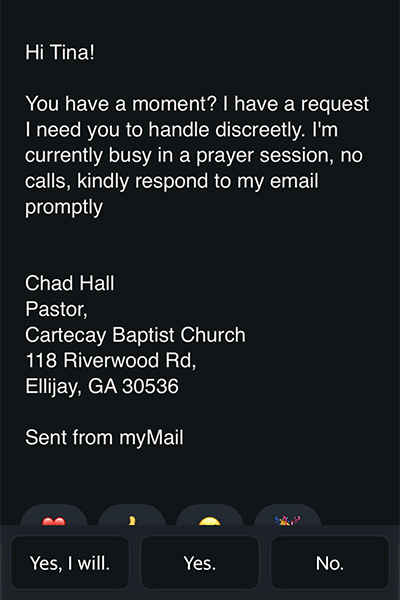
The first attempt impersonated Pleasant Grove Baptist Church’s Pastor Dan Rosser and the second impersonated Cartecay Baptist Church’s Pastor Chad Hall.
“People should be cautious when they see something that doesn’t look real,” Hall said.
The scam attempt was an email claiming to be Hall to three church members.
“I have a request I need you to handle discreetly,” the email read. “I’m currently busy in a prayer session, no calls, kindly respond to my email promptly [sic]”.
The email sounded different enough from Hall that all his congregants didn’t answer.
“I’m from South Georgia, I don’t talk that way,” Hall said.
After he learned his congregation was being targeted, Hall announced to church members that they were being targeted.
“If you get an email that looks suspicious, give the church office a call,” he said.
It’s not clear how the scammer got names for Hall and email information for three church members, he said.
In recent years, email and text scams have become more common, said GCSO Captain Frank Copeland.
Scams often rely on creating a sense of urgency or excitement so people don’t think twice, he said.
They also target the elderly.
“You’ve got to be really cautious about ensuring the legitimacy of the person who has sent the email,” Copeland said.
When unfamiliar emails claim you have “invoices,” a “refund,” or some urgent problem, it’s best to be careful.
“Know what you have spent and who you have paid,” Copeland said. “Make sure email is coming from your actual source.”
Sometimes, scammers even hire someone from DoorDash or another delivery service to show up at your house to pick up cash, he said.
After a scam takes your money, it can be very difficult to get it back.
Some scammers live in foreign countries. Others ask victims to send cash using untraceable green dot credit cards, Copeland said.
Even so, scam victims should file a report with law enforcement.
The money might not prove recoverable, but law enforcement and the federal government might eventually be able to catch the scammer or put diplomatic pressure on their home country.
“It might mean that somebody can be stopped from doing this type of thing,” Copeland said.