
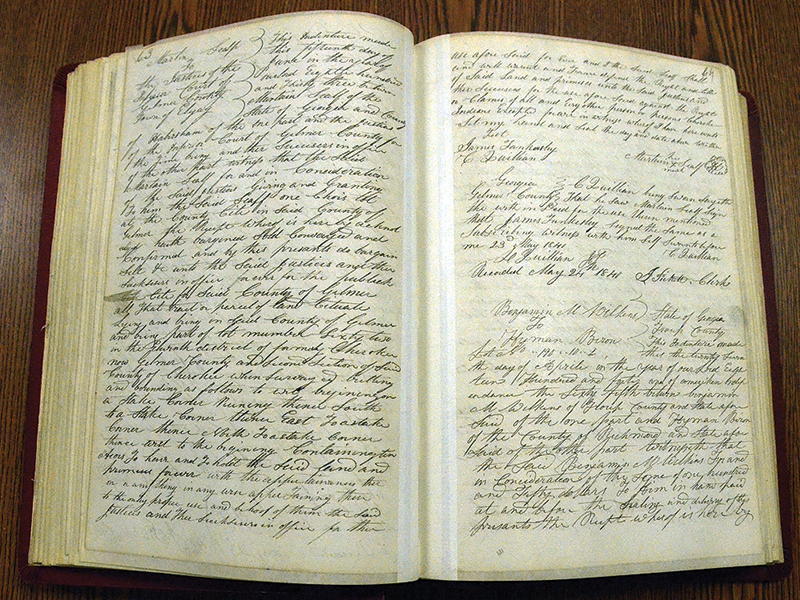
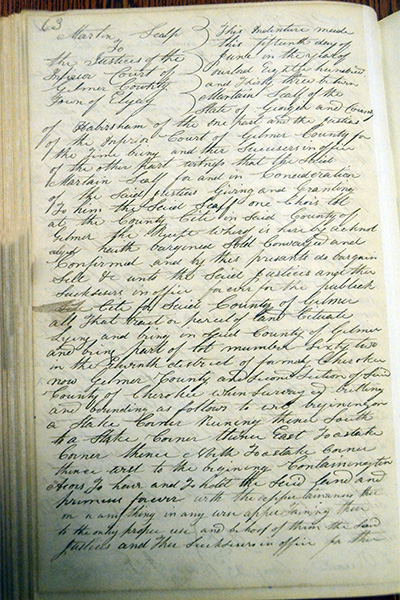
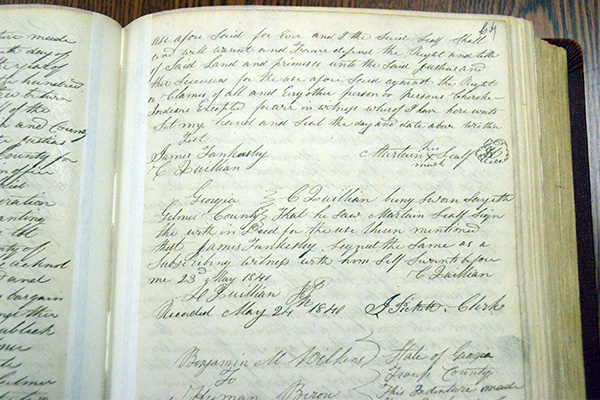
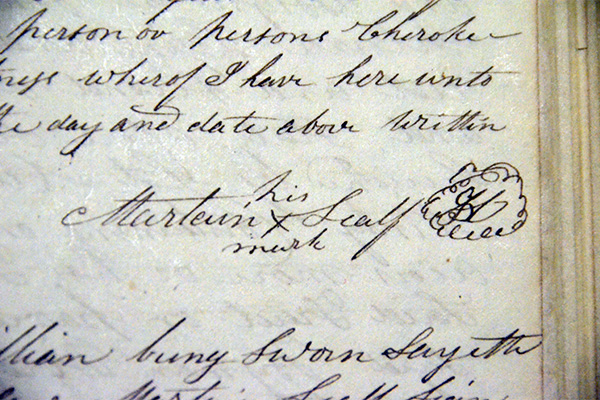
By Whitney Sherrill, Contributing writer — On June 15, 1833, a blind man named Martin Scalf drew an “X” on a deed indicating his desire to donate 10 acres to “the Justices of the Inferior Court of Gilmer County Town of Elijay (sic)” for the construction of government buildings and development of the town center.
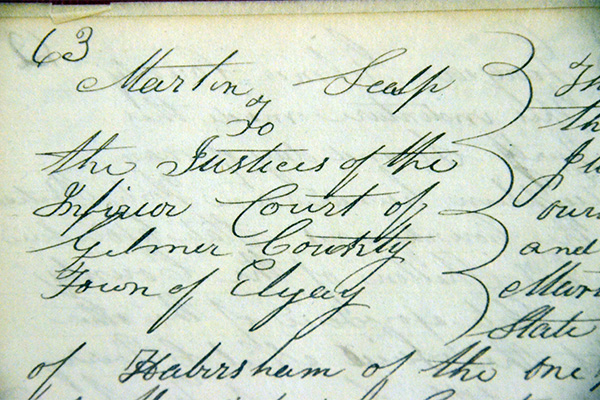 The clerk of the court, Jon Picket, then signed Scalf’s name on the document, according to George Gordon Ward’s book Annals of Upper Georgia Centered in Gilmer County.
While this transaction marked the establishment of Ellijay as a town site, it was not until the following year that the Georgia General Assembly passed legislation to officially incorporate the community. In an act passed Dec. 20, 1834, the state legislators meeting in Milledgeville also designated Ellijay as the county seat of Gilmer County. Friday marks the 190th anniversary of this decision.
“One might well imagine the excitement of the residents of Gilmer County to have at last an official center of government,” wrote John Sirmans in a 1984 Times-Courier article marking Ellijay’s 150th anniversary. “Between the time Gilmer County was formed and Ellijay was made the seat of county government, elections, sheriffs sales and other matters of county business were held on various farms and in communities throughout the county.”
As part of the documentation outlining the incorporation of the town, the state legislators also appointed William P. King, Henry K. Quillian, B.L. Goodman, Nathan Smith and Joshua Bourn as the commissioners for the new township.
The act was signed by Speaker of the House Thomas Glascock, president of the Senate Jacob Wood and Gov. Wilson Lumpkin.
The deed was recorded seven years after its signing and is on file at the Gilmer County Courthouse.
 Cherokee roots
Although the General Assembly’s actions helped to create an official center of government, 1834 did not mark the beginning of human settlement near where the Ellijay and Cartecay rivers converge to form the Coosawattee. The Cherokee arrived in the area that eventually became Gilmer County more than a century earlier and settled in a village near the confluence before Savannah was established in 1733.
Many possible meanings of the settlement’s Cherokee name — Ellijay — have been suggested, including “many waters,” “new ground place” and “place of green things.” Alternate spellings, such as Allagae, Elechaye, Elatsay yi, Elija, also have been used over the years to identify the site.
By the early 1800s, the Cherokees saw an influx of white settlers in the north Georgia area. Many of them traveled to the area along the Federal Road near Talking Rock, which was designed to encourage westward migration. Even more came when gold was discovered in the area in 1829.
Land lottery leads to donation of town site
Gilmer County was created Dec. 3, 1832, from the original Cherokee County and later a part of Union County. It originally included most of Fannin County, as well as some of Pickens and Dawson counties, and currently encompasses about 68 percent of its original size.
In response to the growing interest settlers had in the area, the state of Georgia distributed large swaths of land that had belonged to the Cherokee in Gilmer and surrounding counties as part of the 1832 Land Lottery. Eligible individuals could enter their names into a drawing for a chance to receive a 160-acre lot for a grant fee of $18.
Deed records show Martin Scalf, of Habersham County, drew land lot number 62 in the 11th district of the second section of northwest Georgia, which gave him a 160-acre plot in Gilmer County.
It was from this land allotment that Scalf carved out a 10-acre portion in the center of his holdings and donated it for the creation of the Ellijay town center. One acre was designated as a public square (the site of the modern-day roundabout in downtown Ellijay), and the county courthouse was later built in the middle of it. The remainder of the donated acreage was divided into 20 town lots and streets.
Before long, log buildings began to crop up in the newly established town.
 As Leslie Thomas of the Gilmer County Historical Society wrote in an article to the Times-Courier, “Adiel Sherwood, a prominent Baptist missionary, reported in 1837 that Ellijay had 20 dwellings, three stores, one lawyer but no doctor. He also noted that this was one of the most populous of all the places he’d visited for 600 Cherokee Indians with their families were living in the town.”
The Cherokee would not be allowed to remain on their ancestral land for much longer, however. The year after Sherwood’s visit, federal troops and members of the Georgia militia rounded up the Cherokee within the county and confined them in Fort Hetzel in modern day East Ellijay. Approximately 1,100 Cherokee men, women and children were held there before being marched westward to the Oklahoma Territory as part of the Trail of Tears. A total of 15,000 people from across the Southeast were forcibly removed from their homes and sent on this arduous journey. One out of every four of them died on the way.
The county is named after George Rockingham Gilmer (1790-1859), a former Georgia governor, state legislator and member of Congress, who was a strong proponent of Cherokee removal.
The changing face of Ellijay
In the years that followed Ellijay’s establishment as the county seat, the community began to attract more residents and industries. By 1845, the area boasted 22 gristmills, a rifle factory, several sawmills and multiple distilleries. Over the decades, timber, apple and poultry production became mainstays in the local economy.
 By and large, Ellijay and its environs were isolated until the arrival of the Marietta and Northern Georgia Railroad in 1884. The railway opened the door for the beginning of the area’s tourism industry.
As the years passed, the downtown area grew from a small collection of log-hewn structures to a number of brick buildings fanning out from the public square. In 1912, fire swept through Ellijay and destroyed 23 buildings, but the town determinedly rose from the ashes.
“The population had grown to 150 by 1850 and the town (had) five stores … The population of Ellijay grew to 659 by 1910 and began to acquire many new modern conveniences, such as electric lights and power, a telephone company and many new businesses,” according to the city of Ellijay’s website.
The construction of the Zell Miller Mountain Parkway (Georgia State Route 515) in the early 1990s had a similar impact to the arrival of the railroad and opened the area to more people.
The 2020 census recorded 1,862 residents of the city.
While its original meaning is uncertain, the name Ellijay is now synonymous with small-town charm, scenic beauty and, of course, homegrown apples. With so much to offer, it’s no wonder the Gilmer Chamber encourages people to “Pick Ellijay.”