
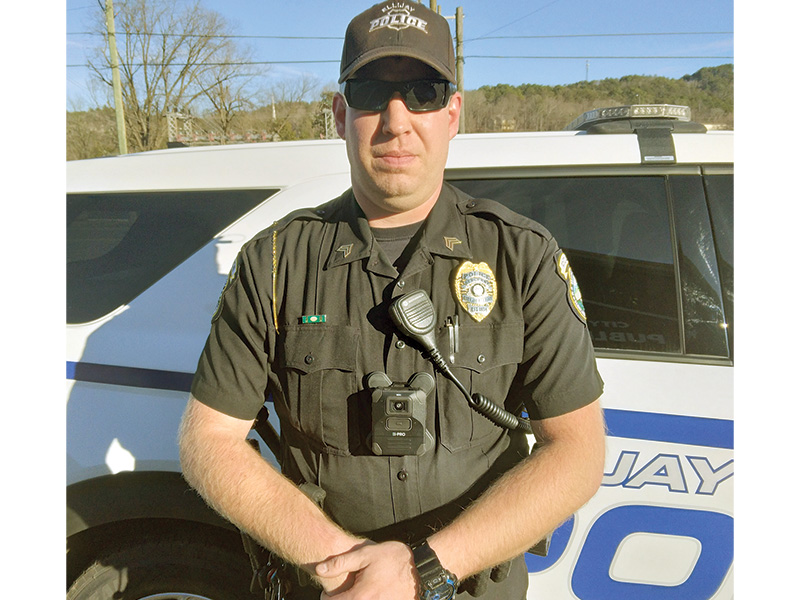
A recent grant donation from a local charitable nonprofit will add body cameras to the equipment used by the Ellijay Police Department.
The $60,000 grant from Faith, Hope and Charity Recycle Store will allow the city police department to purchase several body cameras for its officers and also update its in-car camera systems, said Tom Rippy, FHC business manager.
“Both I and the board of directors at Faith, Hope and Charity feel this is something that’s very important,” added Rippy. “We try to work closely with our police departments, and we think this is a good and needed cause. It’s a safety feature that’s as much for the officers as who they’re talking with.”

In recent years, body cameras have become standard equipment for police departments, noted Ellijay Police Chief Edward Lacey. They are currently unbudgeted items for the department.
“We don’t like to burden those who are so willing to help out as Faith, Hope and Charity unless there’s a real need. Today, reputable law enforcement agencies are expected to have good recording devices to protect not only the public, but also the officers,” Lacey said.
The police department has explored other grant opportunities to fund the camera purchases, but such factors as the size of the Ellijay PD have prevented them from receiving those grants.
“There were several grants we didn’t qualify for because we’re too small (of a department),” said Lacey. “Some of the grants require matching funds, but one, which was 100 percent, is called a small agency body-worn camera program. We applied for that, but then realized their idea of a small agency was 25-99 officers.”
Rippy said this type of donation is somewhat unusual for Faith, Hope and Charity, which uses proceeds from its Industrial Boulevard thrift store to distribute grants mostly to other nonprofits and community service groups. FHC has also made several larger monetary donations over the years, such as providing funding for the current Gilmer Community Food Pantry and Boys and Girls Club buildings.
“We try to do something like this about once a year,” said Rippy. “This is a little bit unusual in that it’s something that should be covered by a budget, but they didn’t have it in their budget.”
The new i-Pro car and body cameras work in conjunction with one another, and the data they record is stored on a cloud, Lacey noted. “We don’t have to worry about storing (that) data on a server,” he added.
The body cams magnetically attach to an officer’s uniform, and, when the in-car camera is activated, it automatically activates the body cam.
“The in-car cam is activated whenever the blue lights come on or when the vehicle gets to a certain speed,” said Lacey. “The vehicle has a g-force sensor, and if the g-force in the vehicle gets to a certain level, the recording device comes on. That’s in case the vehicle is in a wreck.”
The new cameras work on a 30-90 second loop, which allows for recording of events that occur a short time before the devices are activated.
“When they activate the camera, the video that’s going to show is going to be 30, 60 or 90 seconds previous to the point of activation. If somebody runs a stop sign and the officer follows them for 30 seconds, the actual violation will be on video,” Lacey said.
So far, the police department has purchased two of the body/car camera systems, but Lacey hopes to eventually have them for each of its 11 officers and cars. A recurring subscription fee is also part of the equipment cost, he noted.
“We are currently in discussion with our vendors to determine how many more of them we’re going to be able to (purchase). Each device has that subscription fee, so once we pay for the devices, I have to make sure we stay within budget,” said Lacey.
Several years ago, funding provided by Faith, Hope and Charity allowed the Ellijay PD to purchase in-car camera equipment, which has since become obsolete.
“They assisted us about 10 years ago with four in-car video systems. At that time, we were trying to expand our program to cover all of our vehicles,” said Lacey. “You can imagine how much technology has (advanced) in the last 10 years. These systems are quickly becoming outdated, and the company we bought them from doesn’t even exist anymore. We’re finding ourselves in a position where we’re having to almost start from scratch when it comes to these camera systems.”
Rippy said grants like this one are made possible by people in the local community donating and purchasing items at the recycle store.
“Clothes, books, appliances, all that stuff we take in — that’s where the money comes from,” he added.
Lacey said he feels fortunate to live in a community where the local police departments are supported, and he’s grateful that FHC found the cause worthy enough to contribute funding.
“With the times as they are today, we see that our country is changing. But (this) is a community that supports its police,” said Lacey. “Organizations like FHC are meeting needs in our community not only for the police, but for tons of entities. Whenever our community comes together and donates their used furniture, clothes or whatever (items) to the recycle store, they’re helping them meet the needs of a very large number of people.”