
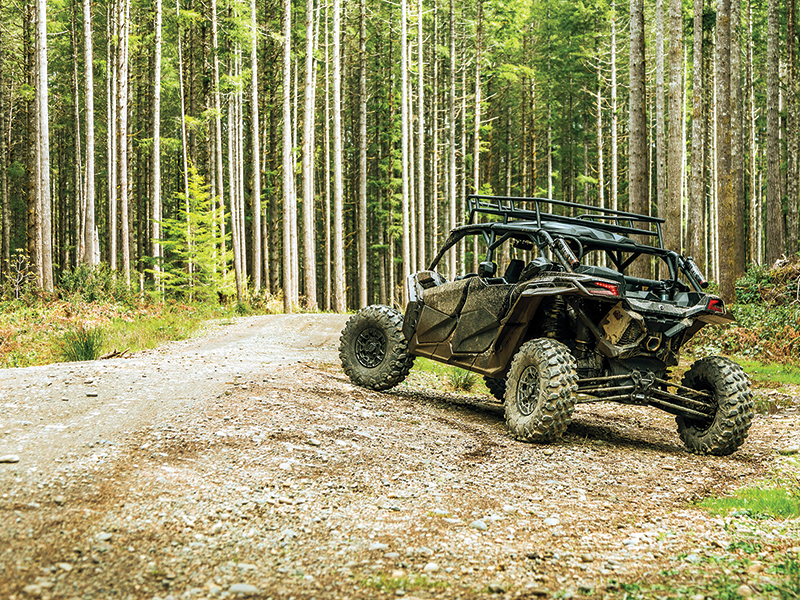
The Ellijay Police Department is putting out a friendly warning for drivers of side by side UTVs. The utility task vehicles, for which a license plate can be obtained, can only be legally driven on county roads. They are not permitted to be driven on city streets, interstates or state highways.
“State law classifies all the vehicles, and there’s a specific classification called multipurpose off-highway vehicles (MPOHVs),” said Ellijay Police Chief Edward Lacey. “They cannot ride on anything other than a road that’s part of the county road system. The general assembly of the state of Georgia wrote the law specifically that way. If we said we’re going to allow them in the city, we’d be violating state law.”
MPOHVs are defined as having the ability to transport persons, cargo or both; operating up to 65 mph, are 80 inches wide or less, designed to travel on four wheels, using a steering wheel for control, utilizing a non-straddle seat, weighing less than 4,000 pounds and able to carry a minimum of 350 pounds of cargo, Ellijay Police noted.
To be legal on county roads, they must also be properly equipped with headlights, brake lights, taillights, a rearview mirror and safety belts. Polaris, John Deere and Honda are among the most popular UTV brands.
“The laws applying to standard automobiles also apply to MPOHVs. Such laws include seatbelt use, child restraint use, speed restrictions, reckless driving, DUI, lighting use / equipment, etc.,” Lacey said.
In Georgia, tagging and registration of the vehicles started in December 2023. Since then, more and more of them are being driven within the Ellijay city limits, Lacey noted.
“We’ve seen an increase in people riding them on the roads, especially thinking they can just drive into town and get gas and drive home. We’ve had them drive around the roundabout and to parks,” he added.
Police officers do have the authority to ticket those driving the vehicles inside the city limits, which is at the officers’ discretion, Lacey noted. Although the Ellijay PD is handling them on a case by case basis for now, the time will come when ticketing side by sides becomes the norm.
“We don’t want to be in conflict with the public. The state legislature wrote the law,” Lacey said. “It’s the owner/operator of the vehicle’s responsibility to know what the law is.”
Currently, the vehicles are subject to traffic stops by the city police, which includes “verification of registration, license and insurance” and not allowing the stopped vehicle to proceed.
“We have allowed owners to arrange for their vehicle to be trailered away, but it is well within the law for an officer to impound the vehicle at the owner’s expense and for that officer to issue all applicable citations,” Lacey said.
Aside from following state law, Lacey said there’s also a quality-of-life concern with allowing the vehicles to be driven in the city.
“When you’re out in the county, there are different rules and regulations as to what you can and can’t do on your property. The city has a different set of rules and regulations. The roadways are more congested, and people live closer together (in the city),” he said.
City limit signs are good indicators of where the vehicles can be legally driven, Lacey noted. They are authorized to legally cross highways, which are part of a municipal street system or the state highway system, according to the state law.
Lacey said another thing to be aware of is that some roads have both county and city jurisdiction.
“Legion Road (is a good example). A portion of it is county and then, all of a sudden, you’re in the city,” he added.
A listing of all Gilmer County roads can be found online at GilmerCounty-ga.gov/road-department.