
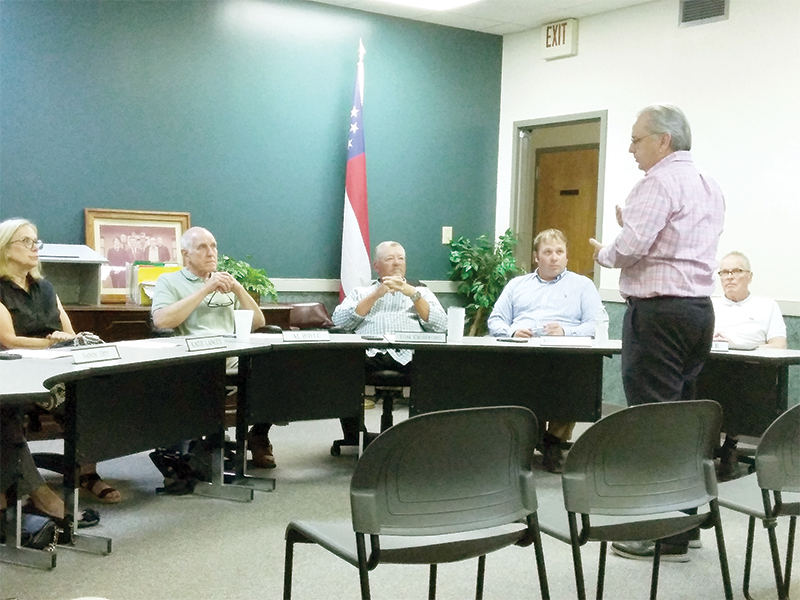
Ellijay City Councilmembers heard about plans for possible construction of a workforce housing apartment complex during a workshop that preceded the Monday, May 15, council meeting.
Kent Sanford, representing the Gilmer Initiative for Community Housing (GICH), spoke to Mayor Al Hoyle and councilmembers Sandy Ott, Tom Crawford, Katie Lancey, Al Fuller and Kevin Pritchett the parcel on Courier Street that’s already been rezoned for high density housing. The council rezoned the property to R3 in 2019, but nothing’s been built on it since then, noted Sanford.
“The investor, (who’s) from Forsyth County, has worked on plans and looked at cost estimates. Over the last four years, everything has just got more and more expensive,” he added. “Because of the cost of building units now, he was going to go more upscale with higher rent. Consequently, we were probably not going to get something that would benefit our community the way we were hoping it would (with) housing for teachers, law enforcement (and other) working class people.”
The GICH panel, which is among teams from five Georgia counties currently enrolled in the state Initiative for Community Housing program offered by the Department of Community Affairs (DCA), is looking to partner with Georgia Communities Inc., an Atlanta-based nonprofit housing development organization. The company can lower building costs by using tax credits awarded by the DCA and, in turn, charge lower rent than a private investor, who would need to seek a bigger return on investment costs, Sanford told the council. They are hoping a deal will be worked out between the development company and the current property owner so apartments can be built there.
Sanford said the company has worked with several Georgia communities, including Greene County, to have affordable housing built. He said the GICH team has contacted the Greene commission chair and talked with Habitat for Humanity representatives, who’ve previously partnered with the company for projects.
“When they go into a community, they select a nonprofit to give a gift to help fund what they’re doing. In that particular county, they selected Habitat,” said Sanford. “(We) felt like it was a good match to take this site that’s already been approved for apartments, but no activity has occurred the last four years, and match them up with developers who have experience with using tax credits to bring down the cost of construction, thereby guaranteeing they’ll bring rent rates that are actually affordable.”
If the company builds the apartments using DCA tax credits, they will be monitored and audited (also by the DCA) and must own the housing complex for at least 15 years after construction, Sanford noted.
“A private investor, as soon as they get 100 percent occupancy, they (usually) sell them. We like the tax credit program because they have to stay involved for 15 years,” he added. “This nonprofit has a history of staying involved for 30 years, and DCA will be checking to make sure they are actually delivering workforce type housing.”
The tax credit award process is competitive, with several Georgia entities applying each year. If the developer is not awarded any tax credits, they will not move forward in purchasing the Courier Street site, Sanford noted.
“If we don’t get this project, is there one that’s similar or mimics this one, or would they still go ahead with it and build the more expensive apartments?” asked Fuller.
If the developer doesn’t receive tax credits this year, they can ask for an extension on the option to purchase the property and reapply next year, Sanford said.
“This particular type of housing, the only way you can deliver it to a community is with tax credits. This is targeted to about 80-percent of the adjusted median income for Gilmer County. When you look at Section 8, they’re going all the way down to 30 percent. We’re not targeting that type of housing at the lowest end,” he added.
If the property purchase happens, the developer will be looking at a 50-unit complex with a mix of one, two and three-bedroom apartments, noted Sanford.
“In a typical year, 25-30 percent of the communities and developers who’ve partnered with communities will get tax credits. They (are) awarded a certain number of tax credits based on how well they score and how many other communities ask for the funding,” he added.
Sanford asked the council for a letter supporting the housing construction, which will help the development company in the DCA’s scoring process for the tax credits. That letter was approved during the council meeting.
“The applications have to be in this week, and it will probably be about six months before they announce the awards,” Sanford said.
In other news …
﹣ The first reading of an ordinance to increase Ellijay’s hotel/motel lodging tax was given. If approved, the tax will be increased from 5 to 8 percent.
House Bill 708, which authorizes the city to increase the tax, was recently signed by Gov. Brian Kemp, noted Hoyle. The increase will apply to rental of lodging including hotel and motel rooms and short-term rentals.
A second reading of the ordinance will follow at the next council meeting.
﹣ Councilmembers also approved: Another four-year term for Ellijay-Gilmer County Water and Sewerage Authority board member Mike Gibbs, whose current term expires at the end of June.
Six special event permits for alcohol sales at the upcoming Blue Ridge Mountains Wine and Jazz Festival.
Disposing of (by auction or sale) several pieces of surplus equipment that have been replaced and taken out of service, including two Ford pickups and two mowers.