
Sisson, Hadden recall post-presidency years

Joe Sisson vividly recalls the first time he met Jimmy Carter, the former Georgia governor and 39th president of the United States who passed away recently at age 100.
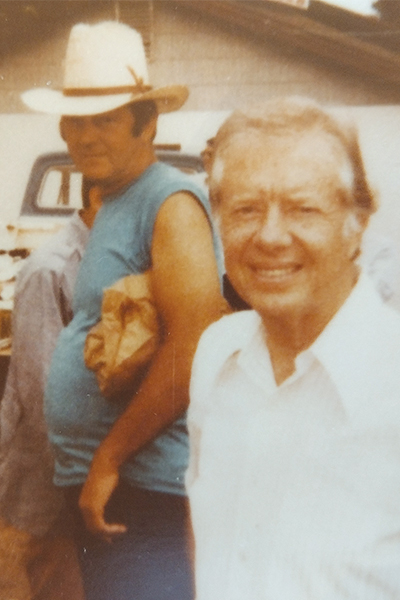
“Professionally, I met him when I was a professor at Georgia State University in Columbus,” said Sisson, who has been a custom homebuilder in the North Georgia mountains for decades. “They were having an event where he was going to honor the chief of police in Columbus … I was shy and hid in the back of the building, and lo and behold, here comes Go. Carter in the back door right where I was sitting.”
After an introduction, he said Carter remarked, “I know about you guys up in Blue Ridge, we’re going to have y’all over when we’re up there sometime, you and your wife.’ I went home and told JoAnn and she laughed and said, ‘That’s a bunch of bull and you’ll never hear from them.’ A couple of weeks later we got a call from the Carters one Friday night when they were up here, and he wanted to know what we were doing Saturday night. We went out with them, but the most interesting thing was listening to them tell about some of their visits to foreign countries.”
On one trip a king gave them a camel — a pedigreed, highly-bred camel, Sisson elaborated, and the Carter entourage had a problem with “how they were going to get that thing out of the country.”
He said he “admired” Carter for his nondiscrimination policies.
“I complimented him one time about that, and he told me about his pilot that flew him everywhere when he was running for governor,” Sisson shared. “On the last trip when they were almost home he asked that pilot, ‘You’ve done a lot for me, what can I do for you?’ And the pilot told him, ‘When you make your inaugural address, you can tell the people that the days of racial discrimination are over.’ The pilot said he wrote it on an aerial map for him, and it was in his address.”
A YouTube video appears to back up the assertion. On a short clip titled, “Excerpt from Gov. Jimmy Carter’s Inaugural Address (Carter Center)” he can be seen saying from the lectern with officials behind him, “The time for racial discrimination is over.”
Sisson said Carter also shared about traveling to Russia and meeting with the president of the Soviet Union, Mikhail Gorbachev.
“They had met until late into the night,” he said Carter told he and JoAnn. “About midnight, he returned to his quarters and no sooner got into his room than he got a call from Gorbachev who told him they’d had a good talk and could they get back together now, at bedtime? (Carter) said Gorbachev wanted to continue their talk about peace and how to make the world a better place.”
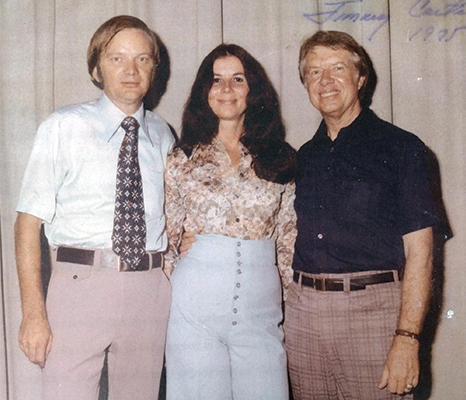
They picked their own
Since the Sissons always keep a garden during the summer, Joe said the Carters would come by when they were in the area because “they loved vegetables. We’d go to the garden with them and I’d say, ‘Now you sit here, you don’t have to pick.’ But he would always insist and say, ‘If I’m going to eat ‘em, I’m going to help pick ‘em.’”
The first time the Carters came to the Sisson home for a meal was one Saturday afternoon.
“He called and wanted to know if we were going to be home that evening, and I said sure,” Sisson remembered. “He wanted to know if they could come and have a tomato sandwich, and I told him to come on … (but) it come a storm and knocked out the power. I called him back and told him we didn’t have any electricity if he wanted to come another time. He said we’ll sit in the dark and eat tomato sandwiches. The power came back on about the time they drove up. JoAnn was out shopping and had stopped by the office to cook a meal, and we had some good eating.”
‘What … do you say?’
Melinda Hadden, whose father Bud Holloway was a first cousin to Joe Sisson, said she and her late husband, Bob Hadden, also communed with Jimmy and Rosalynn Carter over meals.
“The first time we had dinner, I thought, ‘What in the world do you say to a former president?’” she related of a dinner at The Pink Pig, her father’s restaurant in Cherry Log. “But he asked you about your family, how you were doing, he wanted to know about your job and just made you feel like we are sitting here talking.”
Hadden has several photos of her father out campaigning with Carter during his runs for governor and president.
“But more than a political ally, they actually became very good friends once they built the cabin and he started coming up here more often,” she said, explaining that John and Betty Pope were “the ones who got the Carters up here.”
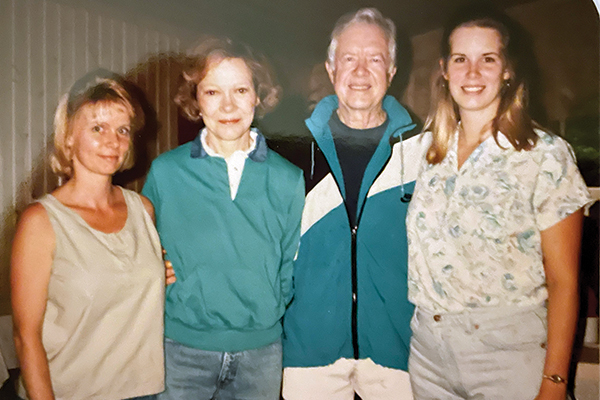
“John was involved with developing Walnut Mountain, and (the Carters) needed someplace to write their books,” Hadden continued. “So John said let’s just build a little cabin over here on Turniptown Creek, because Jimmy was an avid fly fisherman. But where they wanted to build the cabin it was like a big rock cliff, and John knew Daddy knew how to use dynamite — he did a little bit of everything.”
Those were the days when explosives were readily available.
“Back when I was 11 or 12 years old, we’d go up to the hardware store in Blue Ridge and buy dynamite off the shelf,” she said. “Because all the people that cut timber used it to get the roads in, to get back in there to get the timber out. So that’s how Jimmy and my dad met and got to become good friends. Daddy had a portable sawmill and sent Jimmy some cherry wood one time that he could use to make furniture with.”
Faith and mental health
Hadden was asked what she thought endeared people to Jimmy Carter.
“I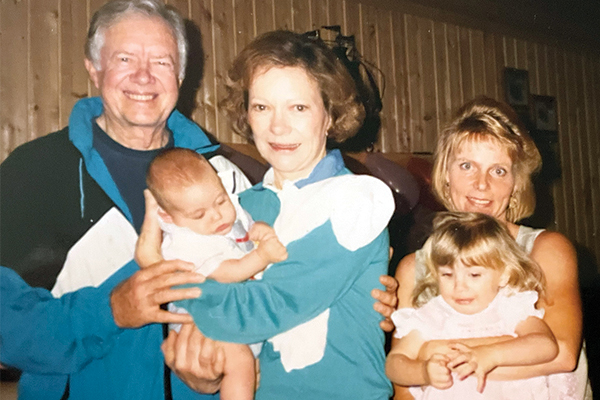 think it was his openness; he was so approachable,” she replied. “It came across that he genuinely wanted to know about your life. He was serious about promoting peace, and he taught Sunday school at Maranatha Baptist Church (in his hometown of Plains). Also, what he did with Habitat (for Humanity). I know he didn’t start it, but he was very instrumental in the awareness of it. Rosalynn’s big thing was in mental health, and bringing about an awareness that it’s a sickness, because back in the ‘80s you didn’t talk about it.”
Hadden said she learned of Carter’s wisdom in promoting international accord between nations by reading his book, “Talking Peace.”
“He had (Anwar) Sadat and (Menachim) Begin there at a meeting and he was thinking, ‘How in the world am I going to get these two men (from Egypt and Israel) talking to each other?’” she said. “So he decided to have them over for a dinner in a small setting and didn’t talk politics at all. He started asking them about their grandchildren, and got each one of them talking. And then he led into saying, ‘Don’t we owe it to our grandchildren to sign this peace treaty so they can get along?’”
And then there was the faith of Jimmy Carter.
“It was like he knew what he was meant to be doing here — and he did it,” said Hadden.