
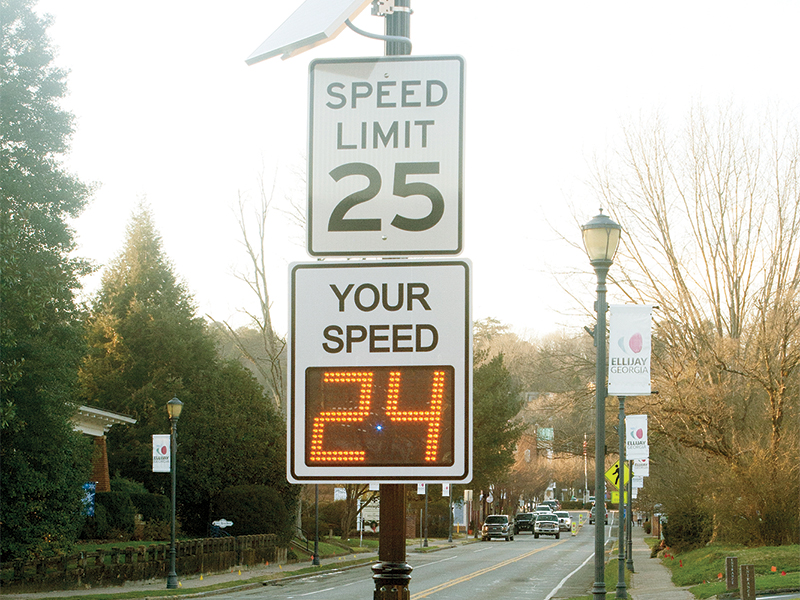
Speed detection signs that have been absent from downtown Ellijay for several weeks are back up and running.
The signs were taken down because they needed to receive some routine maintenance, confirmed Ellijay Police Chief Edward Lacey.
“We had to have some LED bulbs that had burned out replaced, and we wanted to do that before they came out of warranty,” he added.
The solar-powered signs were originally put up to help curb speeding in downtown Ellijay, which has increased with much more traffic on the narrow downtown roads. There are currently four of them, one each on South Main Street, North Main Street, Dalton Street and River Street.
Lacey said having the signs up has made a difference with them reminding drivers of their speed and when it’s time to slow down.
“All we’re looking for is voluntary compliance, and just to remind them,” he added. “Generally speaking, (those) who are speeding don’t realize it. When they see the sign, it reminds them. If they’re 10 miles over the speed limit, it will flash slow down until they achieve the speed limit.”
Each of the signs adheres to a 25 mph speed limit, but the only place the sign is located at the line of the 25 mph speed zone is South Main Street. With the others, the speed limit has already changed to 25 mph by the time the sign is reached.
“On River Street, when you get to the sign, you’re (already) inside the 25 mph speed zone. The speed limit is 25 mph starting on the east side of the bridge. When you cross onto the bridge, you should be going 25 (or under) from there,” Lacey said. “According to our data from the signs, most people are continuing to do more than 25 until they get to the speed sign, and then they’re slowing down.”
The speed signs not only provide a look at whether or not drivers are slowing down as they pass by, they can also give the police department a better idea of where to do future in-person speed checks.
“Each sign has pretty robust capabilities. We can generate reports on traffic data, volume and speed, dates and times. It actually lets us know if they’re being effective because they monitor the initial speed of a vehicle and track that speed throughout the arc of the radar. (This will) tell you whether that vehicle sped up or slowed down and how much,” Lacey said.