

A World War II veteran, who was one of the liberators of the Dachau concentration camp near Munich, Germany, was humble about that history-making effort when speaking to a crowd gathered Wednesday, Dec. 7, for the dedication of a special daffodil garden at River Park.
“There was nothing heroic about what we did. We were there out of curiosity. We looked around,” said Hilbert “Hibby” Margol, 98.
Margol and his twin brother, Howard, served in the same U.S. Army unit. They and other 42nd Infantry soldiers were clearing the way for the unit and its equipment to proceed along a two-lane country road about 10 miles north of Munich on April 29, 1945.
The soldiers smelled an “extremely strong odor” coming from nearby, which reminded Howard of when their mother used to burn the fat off a fresh chicken, Margol remembered.
“You couldn’t miss it,” he said. “One of our Jeep drivers thought it must be a chemical factory on the other side of the woods. My brother came over and said, ‘We don’t think that’s the case.’”
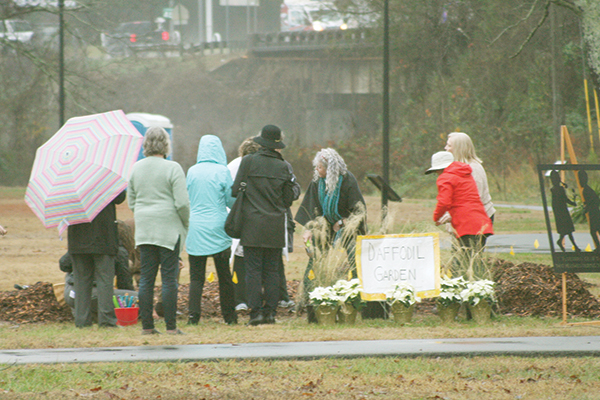
Margol, of Dunwoody, was invited to speak at the dedication event held at the county park on National Pearl Harbor Remembrance Day. Despite persistent rain, a crowd of almost 60 gathered beneath a tent to recognize the newest Daffodil Project memorial garden.
The Daffodil Project is an Atlanta-based nonprofit, which plants daffodil bulbs worldwide in remembrance of the over 1.5 million children who died during the Holocaust and children suffering in modern-day humanitarian crises.
The new Ellijay garden is part of the Foothills of Remembrance, which includes six other north Georgia sites along Highway 515, Mike Weinroth, Daffodil Project ambassador, told dedication attendees.
“We already have gardens in Jasper, Blue Ridge, Blairsville, Young Harris and Hiawassee,” said Weinroth. “I am so proud of Gilmer County. The goodness of the people of this community came out, and I’m really proud (of that).”
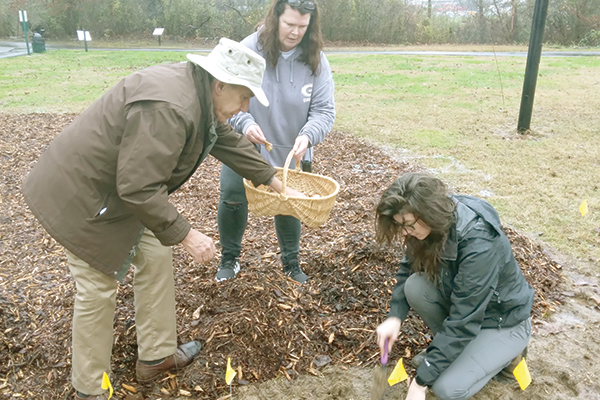
One thousand bulbs were planted inside the lower loop of River Park’s walking path. Most were planted by members of the Gilmer County Master Gardener Extension Volunteers. Several who attended the ceremony also planted bulbs in memory of children whose short lives were described on fliers inside the event programs.
The Master Gardeners will help attend to the garden as time goes on, confirmed Debbie Rupp, group member.
“The garden should be completed over the next few weeks, and the idea is to have it be super low maintenance,” she added. “We’ll be asking the Garden Club and maybe one other organization to help us freshen the mulch or trim the muhly grass annually.”
Rupp said the project came together through several local entities and groups working together.
“It would’ve been impossible without support from Tammy McClure and the staff at Gilmer County Parks and Recreation. Also, donations were received from Earthkeepers Landscape and Tree City, both in Blue Ridge, and a gorgeous art piece was designed and donated by Artful MetalWorx,” she added.
The flowers blooming for the first time next year and each year thereafter will symbolize many things, noted David Feldman, Daffodil Project vice president. “Why daffodils? The shape and color represent the yellow stars that Jews were forced to wear during the Holocaust, (and) yellow is the color of remembrance,” he said. “Daffodils represent our hope for the future. They are resilient and return with a burst of color each spring, honoring the memory of the children. The Daffodil Project symbolizes the strength and resiliency of the human spirit and makes us face, head on, the obligation we each have to uphold justice. This is especially important in light of recent hate crimes, racism and antisemitism occurring around the world today.”
Feldman said the Daffodil Project started in fall 2010 with an initial planting of 1,800 bulbs. To date, 758,000 bulbs have been planted in more than 372 locations worldwide.
“This year, we’ll be adding an additional 100,000 daffodils at 200 locations,” said Feldman.
Gilmer County Commission Chairman Charlie Paris said he appreciates one of the gardens coming to this county.
“It is my hope that, as we see these daffodils blooming and see their beauty, we will then remember the beauty of those million and a half young souls we lost (back then), and that they will never be forgotten,” said Paris at the dedication.
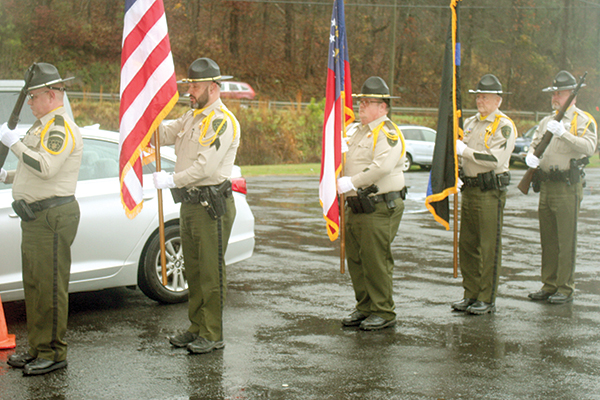
In his remarks, Margol shared lasting memories of the day he and his fellow infantrymen happened upon the Nazis’ first and longest operating concentration camp.
“We were there early that Sunday morning. The official surrender took place about 2:30 that afternoon,” he said. “We found out that there were over 32,000 prisoners in the barracks … men and some women. No children.”
Approaching the electric-fenced camp by railroad track, one of their first gruesome discoveries was the Death Train, a long chain of boxcars filled with the remains of many who died while imprisoned in Hitler’s concentration camps.
“We opened some of the sliding doors. Every boxcar we witnessed was filled completely with dead bodies. They were packed in there like sardines. We learned that there was only one living person,” Margol remembered.
Many years later, Margol asked representatives of the U.S. Holocaust Memorial Museum in Washington, D.C., about why the troops saw no children at Dachau that day. He then learned another grim statistic — that very few children survived after being forced into the camps.
“That’s the connection I have with the Daffodil Project, knowing the fate of all those children,” Margol said.