
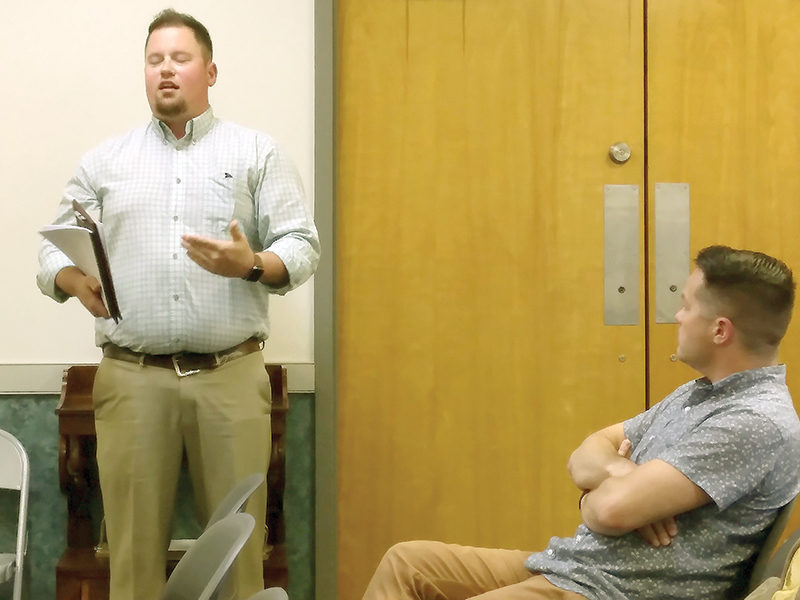
Discussion of the county’s housing shortage and participation in a state housing plan development program became heated at times as the Ellijay Downtown Development Authority (DDA) heard comments from a concerned citizen and personal stories from local professionals at City Hall last Tuesday.
The DDA recently pledged its support of Gilmer County’s participation in the Georgia Initiative for Community Housing (GICH). In the three-year program led by the state Department of Community Affairs and University of Georgia, selected communities work toward developing their own plans to address different housing issues. Rabun, Baldwin, Chattooga and Towns are the other four counties currently participating in the GICH program.
A goal of Gilmer County’s GICH participants is finding out how more workforce housing can be built here.
“Workforce housing could mean apartments, townhouses, tiny homes duplexes, triplexes, trailers and more. The inventory mix is broad,” said Reece Sanford, DDA chairman.
Sanford said the county hasn’t fully recovered from the “Great Recession” that began more than a decade ago. People have kept moving here despite little new housing construction, he noted.
“That has driven up prices. Most of our population comes from retirees, and we welcome them. The economic activity from tourism is a blessing, but it does present challenges. Tourists and retirees create a demand for local services such as law enforcement, EMS, restaurants, retail, etc.,” Sanford continued.
“As (housing) inventory becomes unattainable, our workers and young professionals leave for Jasper, Dawsonville, Canton and other communities that are more open-minded toward housing,” he added.
Kimberly Reckles, who identified herself as a staunch Republican who’s taken online seminars to understand how GICH works, told the DDA members she’s opposed to the county’s involvement in the state community housing initiative.
“I feel like you have some really good concepts here ... but I’m never going to get behind GICH,” she said.
Reckles called GICH a national agenda to move the city into rural communities.
“(It’s) a program of a national organization, the National League of Cities. They are very closely tied to the American Recovery Plan. You move the federal government and its programs into this community, I guarantee very quickly we will be a purple county, then a blue one,” she added.
Sanford called the housing shortage “a nonpartisan issue.” He asked those in attendance to raise their hands if they’ve ever lived in an apartment, townhouse, tiny home or mobile home, then to raise their hand if, while living there, they’d been recruited to join the Communist Party.
“We at the DDA deal in facts, not conspiracy theories,” he said.
Melinda Hadden, a member of the Ellijay DDA who’s also currently on Gilmer’s GICH panel of representatives, said she’s been working on trying to get Gilmer accepted into the housing initiative for several years, and it’s not about moving the federal government into the county.
“This is not something that started with Joe Biden’s administration. Don’t try to turn this into something that happened the last two-to-three years,” she told Reckles.
Reckles told the DDA board that high-density housing should be built closer to the city area, not out in the county.
“What we’re seeing, instead, is higher density in subdivisions being built on the outskirts. What you’re doing is creating a necessity for micro-communities in your rural areas of the county,” she said.
Hadden said that isn’t true.
“If you’re in agriculture, you have to have a 3-acre minimum, and that’s going to change to 5 acres in June. Your agricultural areas are going to be protected from being turned into micro-communities,” she added.
‘Not a new problem’
Local insurance agents Chris Wang and Brett Cantrell, Gilmer Chamber communications manager Caitlin Neal and professional homebuilder Devell Frady were among those who spoke about their personal experiences with housing in the county, including how the shortage has affected their businesses or day-to-day lives.
Cantrell, who said his family roots here date back to the Cherokee Land Lottery, told DDA members he sees and hears daily about young people being unable to find an affordable place to live.
“I see it with my generation especially, people my age (30s) and a little younger who have nowhere to go in Gilmer County,” he added.
Cantrell said many younger people today aren’t looking for big homes with acreage, but instead apartment or community-style living.
“I don’t think the solution to the problem is necessarily as hard as some people might think it is as far as the quality of the houses,” he added. “I’m not saying slums, but more community and multifamily housing. Not 10-story skyscraper apartment buildings, but one- or two-story townhomes and apartments.”
Frady offered a view of the local housing market from a builder’s perspective.
“There’s no builders out there. In 2008, there were builders everywhere. Now there’s not a handful around,” he said. “They lost their ability to continue in 2009 and ‘10. A lot of them died, and there’s (not a lot) of young people stepping up to do that. There’s no help for the builders who are out there. There’s no labor force.”
An adverse effect of the younger generation not being able to find affordable housing in the county is the school system’s enrollment numbers will continue to decline, Frady noted.
“That’s not a healthy society. What happens when we’re all over 65 and there’s no teachers here? Continuous growth doesn’t need to be one-sided. We need to invite young people into our school system so it continues to grow or at least maintains,” he added.
Neal said the current housing situation in Gilmer County is not a new problem. She described she and her husband trying to find a home they could afford to rent or buy in 2016 as an almost impossible task.
“Both of us had college degrees and good jobs. (In) 2016, (it was) a completely different purchasing market in Gilmer County. There was nothing available that was suitable for just two people with no kids. Everything was for a price point and home size for grown adults with children,” she said.
They finally found a home to buy in 2019, but it would be way out of their price range in the current housing market, Neal noted.
“I know people my age who are putting off getting married because they live in their parents’ basement. They are teachers and people with great jobs,” she added. “It doesn’t matter how much you can afford if there’s nothing for you to rent. It doesn’t matter how much you can buy if there’s nothing available that’s in an affordable range. Affordable is one thing, but then there’s reasonable. Two people who don’t have any kids don’t need a palatial home. That’s just not reasonable.”
Wang, owner of Chris Wang State Farm Insurance, said he’s had friends in the Atlanta area who’ve considered moving to Gilmer, but when they started looking at houses, the prices weren’t that much different. He noted, as a tourist city, Ellijay is at a crossroads in continuing to provide services as its number of workers declines.
“If we can’t find those staff (employees), our people are going to suffer and not get the same treatment they would other places,” he added.
Hadden said tourism is such a big part of the economy here because no other industry looks at Gilmer County.
“The first thing they do is look at your housing and your workforce. We have neither one, so Gilmer is never considered for any other industry,” she added.
Sanford noted there could eventually be broader consequences of no affordable housing for the county’s workers.
“Things like quality of service in restaurants declining will happen, but another thing is you’ll call an ambulance and there’s a decline of time to get there. If there’s no one to drive the ambulances, you’re going to be looking at longer response times. If you start talking about who’s going to police your streets and drive your ambulances, that impacts everyone,” he said. “I think that points to we all need each other in a local community, and we need policies that are more inclusive.”
The Ellijay DDA will continue to support the county’s involvement in the GICH program, Sanford noted.
“Gilmer County has always been a blue collar town, and I hope the DDA can play a role in ensuring that’s what we remain,” he added.