
Group of 10 moves on to EMT education, training

The first class of recruits in a new on-the-job training program at Gilmer Fire and Rescue (GFR) have successfully passed the halfway point in training to become certified firefighter/EMTs.
All 10 recruits enrolled in GFR’s “noncert” training program recently attained their Firefighter 1 and Firefighter 2 certifications after taking written and practical (hands-on) exams.
“They (recently) completed their 18th 40-hour work week, which gives them 720 hours of NPQ (National Professional Qualifications) firefighter training,” said Fire Chief Daniel Kauffman.
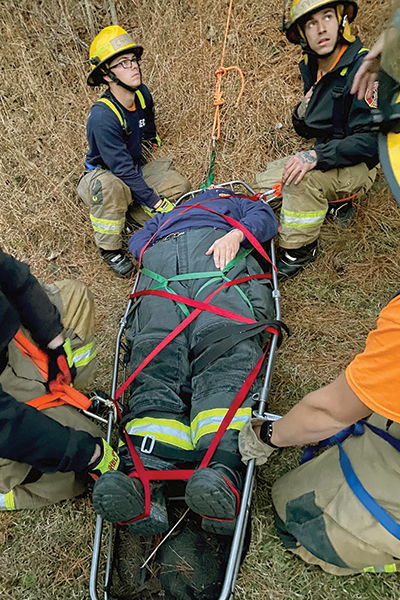
Jason Bryant, a GFR battalion chief and class instructor for the firefighter training, said all 10 members of Class 22-1 have also attained several other certifications in addition to Firefighter 1 and Firefighter 2.
“They’re coming out of fire school with seven national and state certifications (including) Hazmat Awareness, Hazmat Operations, Structural Fire Control, Pressurized Container Fire Control and Flammable Liquids Fire Control. They have all those,” he added.
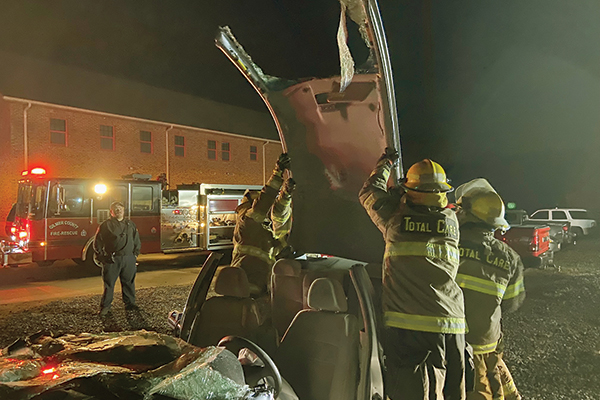
Just before Thanksgiving, all recruits also successfully underwent a “superdrill,” said Kauffman. The scenario-based drill put their training to the test by mirroring demands of a busy 24-hour shift.
“They ran 19 calls in a 24-hour shift, and they were totally in the dark as to what that shift was going to look like. We kept it really close to the vest so they didn’t know what would be coming or when it would be coming,” said Kauffman.
“They were divided into two engine companies with five in each company, and assigned to an engine with a driver. (They were dispatched to respond to) anything from a lost child, CPR calls, fire calls, a lost hiker, somebody down an embankment and a vehicle extrication where they had to cut the doors and the roof off a car.”
Bryant said the superdrill was designed in-house and added to the training program on top of the mandatory practical and written exams.
“We put it together as a training group to put them in situations and let them flourish. The point was to try to get them operating with as little supervision as possible using what they’d learned over the previous 18 weeks,” he added. “Stressful situations is typically what we operate in, anyway. You have to operate in the dark, when it’s wet and when you’re tired. We tried to recreate that with the drill, and they all did a really good job.”
With two levels of firefighter certification and other credentials now under their belts, all 10 recruits can now respond to fire calls.
“When they’re (not in) EMT school, they’re able to work on a firetruck on weekends. They are certified and able to respond to a fire and dress out and participate,” said Kauffman.
“They have to be with an officer,” added Bryant. “They worked on my shift Saturday, and we had pretty a busy shift all the way to about 9 or 10 at night. We ran some really interesting calls, and they did fantastic.”
The EMT portion of the comprehensive training program started a little over a week ago. The Basic EMT class is expected to wrap by the end of January, while Advanced EMT will last into April, said Lt. Terence Evans, EMT class instructor.
The EMT Basic class includes 232 hours of formative and summative education, as well as clinical rotation where the student recruits practice skills they’ve learned using an ambulance, Evans noted.
“(It) gives them the basic foundation for what we call ‘operation,’ including the legalities of what we do, how to safely operate an ambulance, practicing due regard, etc.,” he added. “From there, they’ll go into anatomy and physiology, which is learning about the human body and how it works, and pathophysiology, which is disease processes and how they affect the body. From there, they’ll learn treatments for basic trauma stuff — how to splint injuries, stop bleeding and things of that nature.”
The Advanced EMT class will include another 250 educational hours and more than 100 clinical hours of training.
“In that part, they’ll get a lot deeper into (what they’ve learned) and have higher treatment modalities — giving medication, controlling airways, etc.,” said Evans.
“They’ll also have lab days where they’ve done the education portion, then take that and apply it in a controlled environment that simulates a sick or injured patient,” he added. “(This could include things like) chest pain, difficulty breathing, falls, car wrecks or diabetic issues. I think, for most of us, that’s the best part about it — every day is different.”
Kauffman described the entire recruit class as “10 very solid men and women” who are very qualified to do the job.
“They’ve been trained very well, and we are very proud of the progress they’ve made. This has been a long, but very worthwhile process. Our instructors have put a lot of time and effort into it. I think the positive payoff we’re going to get from it is just amazing,” he said.