
State and federal agencies typically conduct burns through spring
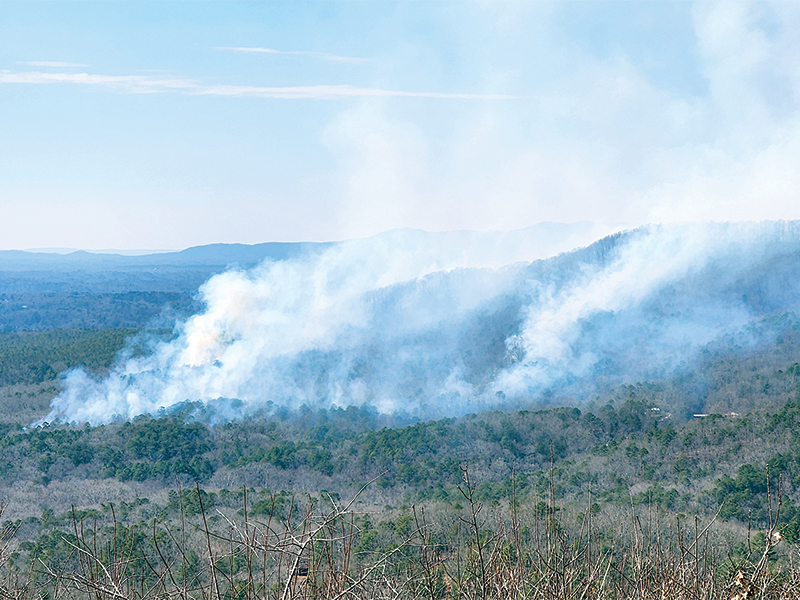
Smoke that drifted into lower lying areas of Gilmer County last week was likely from a prescribed, controlled burn in the Owltown Mountain area.
As happens almost every fall and spring, when controlled burns are normally done by several state and federal agencies, last week’s burning caught the attention of local residents, several of whom contacted the fire department to report the drifting smoke.
“We had lots of people calling wanting to know what was going on,” said Jason Bryant, Gilmer’s deputy fire chief. “Our dispatch was filtering those (calls) for us and informing the public when they called. We also fielded lots of calls to the fire stations.”
The controlled burn that was done last Tuesday by the Blue Ridge Ranger District of the U.S. Forest Service and the Georgia Department of Natural Resources (DNR), was for the purposes of improving wildlife habitat in the Rich Mountain Wildlife Management Area. The prescribed burn unit measured approximately 245 acres, according to the forest service.
Charlie Gray, fire management officer for the Blue Ridge Ranger District headquartered in Blairsville, said the burn went as planned. The heaviest smoke was on Tuesday, but smoke was still present the following days as burnt debris smoldered.
“(Because) there might be some logs smoldering or debris burning, we always go back the next day or several times over the course of the week to make sure our lines are still secure,” said Gray. “The DNR went and checked the burn (on Wednesday) and said there was still some (debris) smoldering.”
Goals of controlled burning include enhancing forest health and removing potential fire fuels like fallen leaves, dead vegetation and debris, Gray noted.
“When we do prescribed burns, we’re trying to meet our objectives. Hazardous fuel (removal) is one of the main goals,” he added. “For wildlife, different species have different needs, but we’re always trying to eliminate some of the understory that doesn’t really benefit them and encourage some daylight. With burning, one thing you’re doing is eliminating competition for resources in the soil like water and nutrients. You’re also releasing nutrients in the plants that are burning, which is almost like a fertilizer. It also opens up the seed bank for some of these species that may have laid dormant like certain flowers or grasses.”
When a small amount of wind is present, it can help the flames move in the intended direction, while also helping to reduce rising heat. Gray said the forest service is “always worried about smoke management and smoke impacts,” and takes that part of it very seriously.
“It could be a perfect burn day, but if the smoke isn’t going to do what we want it to, or it will have too much impact, we won’t burn,” he added. “Before we burn, we have to get a spot weather index from the National Weather Service. They have fire weather forecasters who run all these models and everything for us, which helps us make a more informed decision.”
Multiple state and federal agencies including the forest service, Georgia DNR, Georgia Forestry Commission and U.S. Army Corps of Engineers normally conduct prescribed burns across various government-controlled woodlands in spring and fall. The spring season for controlled burning is just getting underway
“It’s something natural we need to do every year in specific locations under controlled conditions. What it does is restore the vegetation to natural habitat, clears out the brush and weeds and dead leaves and allows for new plants that wildlife needs to eat to grow,” said Stephen Bekkerus, of the U.S. Forest Service. “It also opens up the canopy a bit by getting rid of some of the smaller trees so bigger trees can grow and produce things like acorns and nuts. It’s the little sprout trees (that are burned). We’re trying to eliminate the competition so the bigger trees, which are very well fire adapted, can get more water.”
Mason Turner, chief ranger for Georgia Forestry Commission offices in Pickens and Gilmer County, said that agency has a list of areas that could be future controlled burn sites, but, at this time, they don’t have any spring controlled burns planned for Gilmer.
Gray said he didn’t know of any other Gilmer County burns that will soon be required by the ranger district. The agency also did some controlled burning in Union County last week, he noted.
The public can sign up to receive burn alerts on the U.S. Forest Service webpage (FS.USDA.gov/main/conf/fire). An email is sent out before controlled burns are started. The Gilmer County Sheriff’s Office and U.S. Forest Service of the Chattahoochee-Oconee National Forests also normally post announcements of nearby controlled burns on their Facebook pages.
“We always post our burn information on the Burn Alerts website, which people can subscribe to,” Gray said.
Bryant said the public should call 911 if they see smoke and suspect a fire-related emergency.
“If they call the (fire) station for an emergency, that station could be out on another emergency call, thus delaying care or response. We also do not give out information over the phone about emergency calls,” he added.