

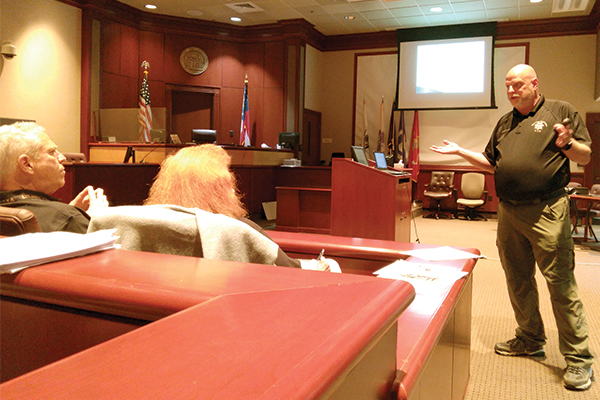
Participants in the Gilmer Sheriff’s Office Citizens’ Law Enforcement Academy learned how real-life criminal investigations don’t usually mirror TV shows like “CSI” when hearing in-depth presentations from members of the county’s CID (Criminal Investigations Division) team at the past two weekly sessions of the program.
Class members heard from Gilmer CID Commander Capt. Brian Shepard and Sgt. Kirk Champion Tuesday, May 16, and Cpl. Dan Farnham, Sgt. Lessie Sippel and Cpl. David Ridings the following week. Class topics included searches and seizures, property and evidence collection, warrants and case law.
Lot of capabilities with limited staff
In 2022, Gilmer CID opened 326 new investigations and closed 204 investigations, while many other existing investigations remained ongoing.
“We stay pretty dadgum busy. We have a lot of capabilities with a limited staff,” Shepard told the class. “We are responsible for looking over all the family violence reports. Anybody that gets arrested for family violence or any family violence report that gets done, we have to make sure that meets the state criteria and make sure all the steps are taken that are required by law. Any theft case with any solvability, any robbery or burglary or anything like that with solvability, gets handled through us, as well as any crimes against persons (like) aggravated assault and murders. Anything of that nature comes to us, too.”
Of the 326 new investigations opened last year, 62 were death-related, 46 were for crimes against children, 21 were adult sex crimes, 49 were thefts and two were murder cases.
Sippel, who handles evidence collection and storage for the sheriff’s department, discussed how evidence was collected in some recent cases, as well as methods used to search for and locate pieces of evidence and identify human remains.
“Identifying people is not like you see on TV. That’s (what we call) the ‘CSI effect,’” she told the class.
An example of how long it can actually take to identify human remains was seen in the case of Terry Cantrell. The 50-year-old Gilmer County man went missing in June 2021. His skeletal remains were found by a power line crew in Feb. 2022 and identified earlier this year.
“We’ve caught a lot of negative attention because of that, but it’s not for lack of trying on our end,” said Sippel about the months-long search for Cantrell. “I can’t tell you how many miles we covered. We had drones. We were in the rivers. We had cadaver dogs. When you’re doing an investigation on a missing person, you can’t make up scenarios or what-ifs. You have to follow what the evidence is. Ultimately, we were told that he was off fishing, catching turtles, looking for spring lizards (and that) he was stealing copper out of old, abandoned, knocked-down houses.”
It was determined that Cantrell was electrocuted trying to remove copper from power lines off Hudson Martin Road, Sippel noted. His remains were finally identified by grinding one of his teeth down to match a sample already in the state DNA database.
“We were working with probably a football-size crime scene. The only thing on this entire scene, other than we could identify the boots he wore, was a very worn piece of mail in a bag that had his name on it. But that wasn’t enough to identify him,” Sippel said. “We (had to wait) for identification.”
Sippel said there are two cold cases in Gilmer County where people’s remains have yet to be identified.
“(They are) a female on 52 East who was found years ago and was never identified and a gentleman (found) off of Old Highway 5 who was never identified. The medical examiner still holds their remains,” she said. “If your DNA or your family’s DNA is not in the database, they can’t identify you without a known (DNA sample).”
Fentanyl in everything
When discussing drug cases, Sippel said Fentanyl has been a constant in recent drug activity investigated by the department, especially meth.
“In the last year and five months, I have not tested methamphetamines that did not have Fentanyl in them,” she added. “If you have anyone in your family who is using drugs, it’s becoming an even more dangerous game. It was dangerous before, but now it’s out of control (because) there’s Fentanyl in everything. It’s not just in Gilmer County. It’s all over.”
Last year, several Gilmer sheriff’s deputies and EMS personnel were exposed to the synthetic opioid at the site of a single vehicle accident near the intersection of Boardtown and Whitepath Road. All seven were hospitalized and eventually released. After the accident, the roadway was shut down until the vehicle could be cleared and processed by a HAZMAT team.
Proper handling of Fentanyl by authorities requires such protective gear as Tyvek suits, glasses and masks, noted Sippel. “We can’t just take that stuff loose to a lab. One, it will knock us out, and two, it’s a danger to everyone else,” she said.
Sippel also gave examples of how direct evidence from a crime scene can be used against a defendant in court. In one local case where this was done, the defendants were parents who’d kept their children locked in dog cages in the home.
“When it came time for that trial, they set the dog cages in the courtroom for the whole thing. That’s the most damning thing you can do, putting somebody’s evidence in front of the jury,” she said.
When in doubt, write it out
Class members were presented with multiple scenarios involving case law and search/seizure and search warrant protocols.
When discussing searches and seizures with the class, Champion said there’s a simple, but effective rule to follow when determining whether or not a warrant is needed.
“When in doubt, write it out,” he said. “If you don’t, anything you get from an illegal search is fruit of the poisonous tree. That means anything you get as a result cannot be used in court.”
Today, the search warrant request process is much quicker with such technology as FaceTime, which can be used to talk to whichever judge is on call when a warrant is needed, noted Champion.
“We do this online now. When we pull it up, it tells you who’s on call, their phone number, (etc.),” he added.
“The first time I wrote a search warrant, it probably took me four hours to write it,” said Farnham. “It takes 20-30 minutes now.”
As an example, Champion discussed the robbery of the Ideal Mart convenience store on Highway 515 earlier this year. In that case, a male suspect entered the convenience store and used a firearm to demand money from the clerk, while a female suspect remained in a car outside the store.
It took about 15-20 minutes to get a search warrant for the vehicle, said Champion.
“The lady had already been arrested and taken away, so we decided it would be better to write a search warrant for the car than write a vehicle impound sheet or anything like that,” he added. “It was about four sentences long, and said something like we got a 911 call to an armed robbery. We got there and realized an armed robbery had happened. This is the car they brought to the armed robbery, and we believe it to be part of the crime scene.”
The origin of the Miranda Warning was among case laws discussed by Farnham, which have shaped criminal investigation procedures in the U.S. over time.
When asked by a class member how many suspects actually talk to Gilmer law enforcement after being read their Miranda Rights, which include the right to remain silent, Farnham said “a very large percentage” do talk.
“I can count a handful of times when people have actually said, ‘I don’t want to talk to you.’ Most people want to talk,” he said.
CLEA continues next year
Lt. George Ellis, CLEA program manager, said next year’s Citizens’ Law Enforcement Academy is already being planned.
“We are now accepting applications,” he added.
The current class has three more weekly sessions to go before they graduate out of the program June 20.