
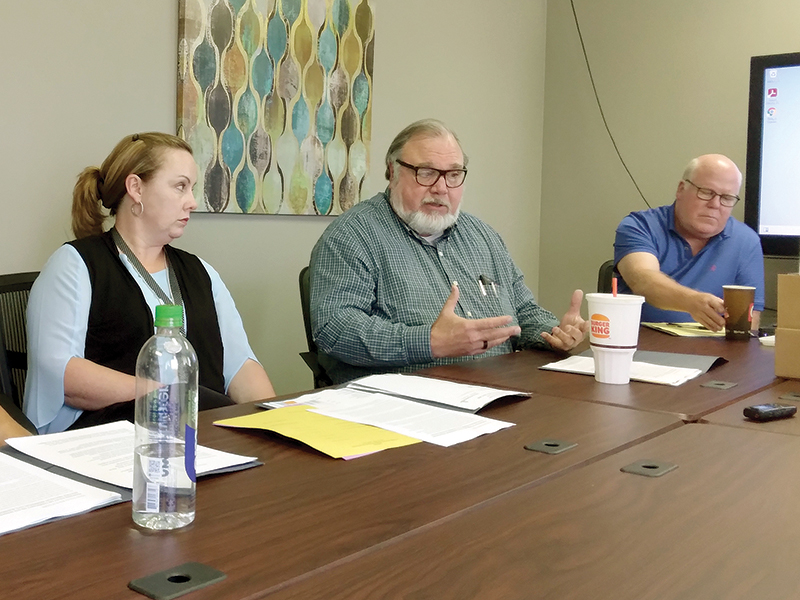
Gilmer County Board of Health members Charlie Paris, Lex Rainey, Dr. Brian Ridley, Tracy Wells and Curtis Kingsley approved a policy aimed at developers or property owners who seek to build sewage disposal systems that would occupy multiple properties when meeting Tuesday, June 14, at the local health department.
Those wanting to install systems where sewage is generated on one property, but transferred to another where a drain field or other stopping point is located, must first get approval from the Board of Health before that type of system can be built.
District Environmental Health Director Ray King said those types of sewage systems have been big headaches at times for the district’s environmental health departments.
“I can tell you several problems I’ve encountered in the past where we had cabins and chalets and all this, and it all went to a common drain field. In some places, the actual drain field crossed property lines back and forth,” he said.
“If a developer has a piece of property and they want to dispose of sewage on that property that they own, that’s fine up to 10,000 gallons a day. After that amount, the EPD takes over for those kind of systems. This is really to help environmental health so they don’t have to fight this battle so much with people coming in and wanting to do off-site disposal of sewage,” King added.
“This doesn’t say these systems cannot be built. It’s if someone wants to build one, they have to get approval by the board,” added Dr Zachary Taylor, North Georgia Health District director.
King said he doesn’t want to close the door completely on multiproperty sewage disposal, as there could be circumstances where that option is what’s needed.
“(For example), a property owner has a house and they have a failing system, but there’s no way to repair it anywhere on their property,” he added. “In that case, a homeowner could come to you at a meeting like this and say ‘I want to put it on this other property that I own, but it doesn’t border this (other) property.”
The main reason the multiproperty systems can turn into problem areas is they require maintenance, which is often neglected, King noted.
“The real problem with these kind of multiowner properties is operations and maintenance, repairs in other words. Who’s responsible?” he continued. “There are a lot of reasons why we really don’t want these on a large scale. You, as a board of health, have the authority to allow off-site (disposal), but we don’t recommend it.”
Gilmer Environmental Health Manager Andrea Martin said, if board members wish to do so, they can set specific parameters for future off-site sewage disposal permitting.
“For less than 10,000 gallons a day, it could be four homes (instead of 10),” she added.
King said the environmental health office has drafted a document that explains the reasons for the new policy.
“This is not rules and regulation. It’s just a policy that clarifies and will help Andrea when she runs into this situation. It says if you want to do this, it requires a variance from the board, not us,” he added.