
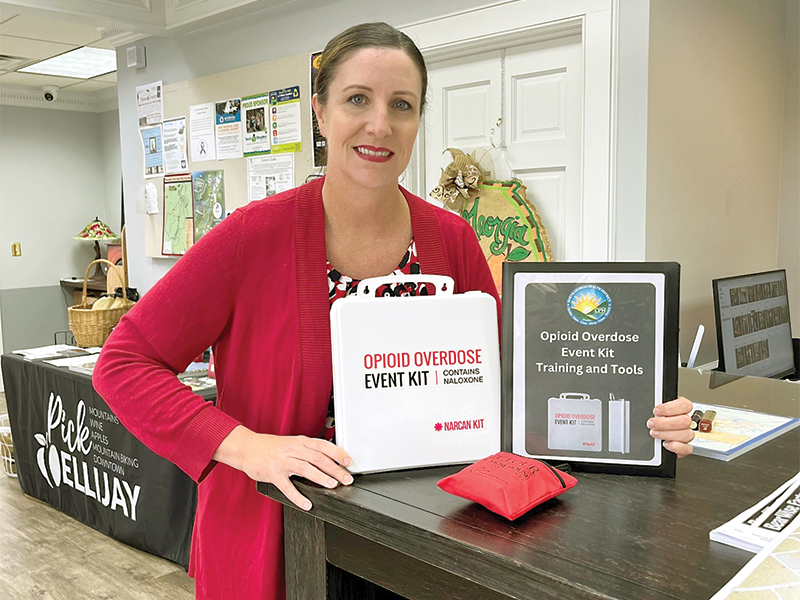
Members of the Gilmer County Board of Health heard, during their June 13 quarterly meeting, about a program in the North Georgia Health District (NGHD) that provides resources to deal with opioid abuse in the six-county region.
Brittney Carmichael, NGHD public health analyst, said the Opioid and Substance Misuse Response Program started in 2019 in cooperation with the Centers for Disease Control (CDC) and is funded through the CDC’s Overdose Data to Action (OD2A) initiative.
When discussing 2022 drug overdose statistics in the six NGHD counties (Gilmer, Pickens, Cherokee, Whitfield, Fannin and Murray), Carmichael said Gilmer had eight drug overdose deaths, six of which were opioid related. Also in 2022, there were 76 suspected drug overdoses here that required EMS response and 30 overdoses that required an ER visit or hospitalization. Of those 30 overdoses, 24 were opioid related.
Carmichael said the CDC predicted there would be at least 2,598 drug overdose deaths in Georgia during 2022, although “clear death totals” aren’t yet available for comparison. Of those predicted deaths, 1,800 were predicted to stem from opioid misuse and 1,600 involving synthetic opioids like fentanyl or methadone.
“Because these are lives lost, to counteract those figures, the state has several projects they have charged RPHAs (regional public health authorities) with,” said Carmichael.
In one of those programs, the Naloxone Access Project, opioid overdose response kits are being donated to several businesses and facilities in the NGHD region. The kits include naloxone (Narcan) nasal spray, which can be used to curb the effects of an opioid overdose.
The Gilmer Chamber is among four businesses that have received the kits thus far, Carmichael noted. “They expressed that they had a gentleman who was unresponsive in their parking lot, so we gave them one (of these kits),” she added.
Fentanyl test strips and Narkit carrying pouches are also being distributed through the NGHD abuse/misuse program. The test strips can be used to test for the presence of fentanyl, the synthetic opioid that’s become a powerful and often lethal additive, as well as an increasingly addictive stand-alone substance. The Narkit pouches allow police officers to carry a vial of Narcan on their person, Carmichael noted.
“This gives them a tool to immediately respond,” she added. “We were given 510 fentanyl test strip kits. We’ve distributed more than 400 and have purchased an additional 1,200 kits that will be distributed soon.”
With the emergence of fentanyl as an addictive substance, an additive called xylazine is making the synthetic drug even deadlier. Also known as “tranq,” it’s a nonopioid animal tranquilizer that’s becoming increasingly more common in street drugs that contain fentanyl.
“Narcan isn’t working against it. It’s not being tested by the GBI. I don’t think the medical examiners are testing for it,” Carmichael said.
Xylazine test strips are also being made available as part of the NGHD’s proactive efforts. Like the fentanyl test strips, they can be used by both substance users and first responders.
“It’s really important that we get these test strips out there so not only drug users are informed, but first responders know what this (drug) looks like,” Carmichael said.
Among the digital tools being used to keep track of drug overdose rates in several Georgia counties is ODMAP, (Overdose Detection Mapping Application Program). The app provides almost real-time data pertaining to suspected overdoses. Carmichael said ODMAP is only available to public safety, public health and healthcare professionals, and only three NGHD counties (Pickens, Whitfield and Cherokee) are currently signed up to use it.
“It’s a little difficult to get buy-in sometimes. Folks might see it as an additional burden to have to report, but just being aware (of the statistics) is one of our goals,” she added.
To make resources more available to the public, the NGHD team is currently repurposing newspaper boxes to be used as resource hubs in which harm reduction kits are stocked. The kits usually include such items as fentanyl and xylazine test strips, bandages, alcohol pads, condoms and health risk-related pamphlets. Carmichael said resource hubs are now up at the Highland Rivers Health locations in Gilmer, Pickens, Whitfield and Cherokee.
The initial round of funding for the Opioid and Substance Misuse Response Program ends in August, but the public health office has applied for additional funding through the CDC. If received, it will be used to continue the program for another five years.