

Two young aspiring beekeepers are getting hands-on experience tending hives with guidance from a local beekeeping club.
The Beekeepers of Gilmer County recently adopted their first family as part of the club’s effort to interest younger generations in beekeeping.
“Since we are an educational nonprofit organization, our new treasurer, Russ Ginger, came up with the idea for us to adopt a family to mentor,” said Bill Emery, the club’s vice president.
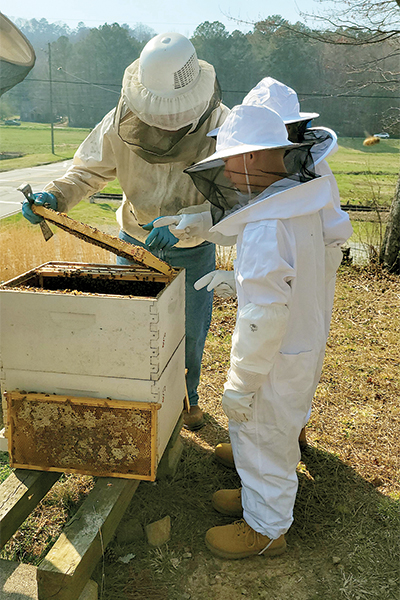
Brothers Attila and Vajc Atkinson are the bee club’s first two adoptees. The 11 and 13-year-old brothers already had some experience with the environmentally beneficial insects. Their mother, Anna, started keeping bees shortly after the family moved here in 2009.
“They didn’t help me so much with the hive, but when we got honey, they would get involved,” said Anna Atkinson. “(Even though) they had some familiarity with bees, I was kind of surprised they said they wanted to get involved with the club. It’s just sort of mushroomed from there.”
As part of the youth program, the boys now have their own bees, hives and protective equipment, all of which was recently presented to them by the beekeepers. They’ll keep the hives at their home, where they’ll receive ongoing mentoring from club members, confirmed Emery.
“They are full-fledged members of the club now, and they are going to do everything the adult members do,” he added. “They’re both smart as whips, and we’re hoping they do good.”
The new hives come with specific instructions and responsibilities their young keepers must follow.
“They should not be getting in the hives unless a club member is there to mentor them,” Emery said. “When we’re there helping them, and they get into (the hives), we’ll be saying ‘OK, what is this? What are you doing, and why are you doing it?’”
The boys are two weeks into the program right now, Emery noted. One of their first lessons was receiving a nuc (or nucleus colony), which Emery described as a “mini-hive” of bees, then introducing it to the larger hive structure.
“They’ll be taking care of it, feeding it and, as they need resources, we will help them with those resources. We’ll also be making sure the bees don’t swarm and things like that,” said Emery. “As the hive grows, you’ve got to put more resources on there so the queen doesn’t say, ‘It’s too crowded. I’m leaving!’”
Another introductory lesson was how to find and identify the queen on a hive frame. The two swiftly passed that test, Emery noted.
“They did good at that, and it’s really hard to do. Sometimes I have trouble finding the queen on a frame, but they spotted it right away,” he added.
Atkinson said she kept bees for about three years before deciding to give it a rest after losing so much of the colony each winter.
“I really enjoyed the first year with my bees, but unfortunately I can’t get them to winter through. I took it as such a personal loss the last time the bees died out. It broke my heart, because they become your friends,” she said.
Many of its members tend their own personal hives, but the club also maintains a group apiary, where hives are kept and educational lessons are given. Winter loss has been a pretty common problem among the local beekeepers, confirmed Emery.
“This (last) winter kind of devastated us. We lost most our hives,” he added. “We’ve reintroduced bees to the hives, and we have four or five going. Hopefully they’ll survive. Bees are bees. It could be weather. It could be mites. It could be anything. They do what they want to do.”
The youth initiative is also part of a regrouping effort for the bee club, which is looking to introduce some new programs following a period of uncertainty during the COVID-19 pandemic.
“Ever since the pandemic, we kind of faded off because meetings were slim and things like that. We hope to make this a yearly thing and adopt one family a year as long as we have the resources to do it,” Emery said.
The Beekeepers of Gilmer County formed 10 years ago to create more awareness about how important bees are to the ecosystem and share their knowledge with the local community. They meet the second Monday of each month, and their current meeting place is the Burger King in East Ellijay.
All meetings are open to the public, particularly for those eager to learn more about bees or beekeeping, noted Emery.
“It’s encouraging for those of us who are not (highly experienced),” said Atkinson. “It’s definitely a nice place to go and ask questions. You realize that everybody is still learning.”