
Family recalls husband, father who died in Air Force crash
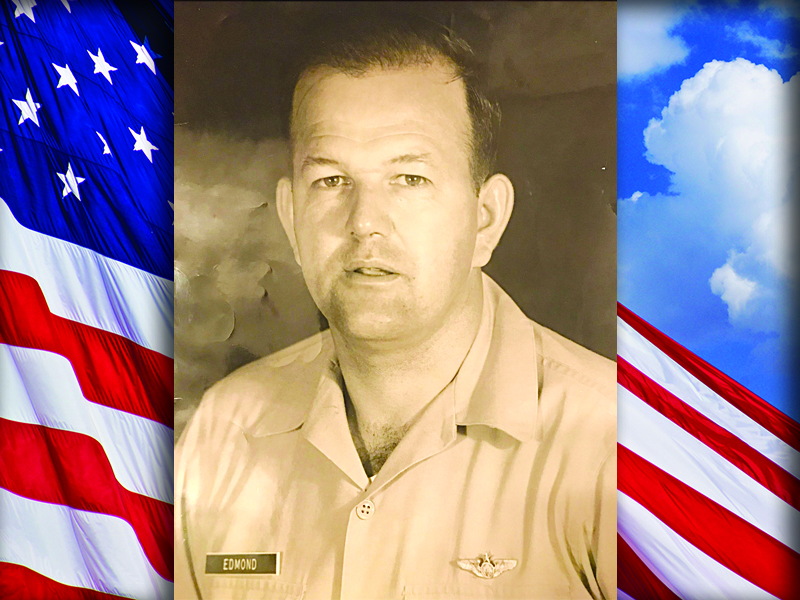
Billy Edmond shared his love of baseball with his two oldest sons, Charlie and Eric. In their first game on Okinawa, where the family was settling into life at an Air Force duty station, Charlie hit a home run on the first pitch of the game. Eric socked a homer on the second pitch.
They couldn’t wait to get home and tell their father, who had volunteered to take another man’s place on a flight to Taiwan.
“The hardest thing I’ve ever done in my life was to tell them that their daddy wouldn’t be coming home,” recalled their mother, Nancy.
U.S. Air Force Tech Sergeant Billy Edmond died along with the whole crew of a C-130 Hercules transport plane when it went down soon after taking off from Naha Air Force Base on April 10, 1970. The aircraft had a fire on board before taking flight, but was too far down the runway to stop. The plan was to turn as soon as possible and come back to base.
Their younger brother, Darrin, who had arrived with his older brothers and mother just days earlier on April 1, turned 4 the day after his father died. Though he was too young to remember his dad and his 4th birthday party, Darrin learned later what happened.
“The other families (in his father’s unit) knew that and baked me a birthday cake and had a birthday party for me, even though it was a very sad day,” he said. “In less than a week, we flew back to the States and met the family at the Nashville airport.”
Early years and a dream
Billy met Nancy Wilson on Hamilton Street when teenagers used to “drag Main” in Dalton. Nancy grew up in Varnell, and Billy hailed from the mountains around Talking Rock. He was just 2 years old when his father, Charles, was killed in a sawmill accident. A piece of lumber flew off the saw blade, striking him in the mouth. The blow knocked out the grandfather that the boys — and their father Billy — never knew, and he strangled to death on his blood and teeth. Charles Edmond was 38, and walked over half-a-dozen miles just to work at the sawmill that may have been located in southwestern Gilmer County. At age 17 with a 10th-grade education, Billy quit school and joined the Air Force, eventually becoming a loadmaster on the workhorse C-130.
Before being stationed in Okinawa, he flew TDY (temporary duty assignment) flights in Vietnam. When the Viet Cong were rebuilding the Ho Chi Minh Trail at night, the C-130s would open up the back hatch and have a guy like Billy — strapped in — kick flares out the back to light up the trail so they could drop bombs on it. In 1970, Billy got new orders cut for Naha Air Base in Okinawa and took his family with him. But before they left, he shared a recent dream with one of his sisters while visiting her in lower Whitfield County.
“When he was telling her bye, he said, ‘Louise, I had a dream that I’m going to die in a plane crash,’” Nancy remembered. “And she told him she had dreamed the same thing. When we got to California to fly to Okinawa, he asked that he not fly on the same plane as his family. And that had to do with the dream. We got there two or three days before he did.”
Only a week after arriving in Naha, Billy volunteered to take another man’s seat on the ill-fated flight.
“There was a guy in the squadron who had not had an anniversary with his wife in around five years,” said Darrin, who is retired from the Air Force. “So Dad was new to the squad, and the guy asked him if he could take this flight for him. So Dad said yeah, I can do that.
“The runway at the end of Okinawa at Naha Air Base ends at the water,” he continued. “They get in the plane on April 10 (1970) and get halfway down the runway. At that time, there was an oxygen valve on the C-130 that would go bad sometimes, and they were going too fast to stop and turn around after they started getting smoke — because a fire was going even in the cabin in the back. So they were going to (take off) and turn around and come back. They get up and out about 2 of 3 miles and are going to bank left — you always turn to the left — and they lose the number one engine on the far left. By the time they go to bank, the number two engine dies off, and they just roll over and take a nose dive (into the sea).
“That’s roughly close to the (extremely deep) Marianas Trench.”
A letter from the commander of Naha, Col. Noble Greenhill, states, “The depth of the water at the point of ditching varies from approximately 1,800 to 2,400 feet; it is very unlikely that your son’s body will be recovered.”
Growing up without a dad
Eric remembers after the baseball game his father’s friends in the unit were there to pick them up.
“We got to the house, and there were five or six black or dark blue cars, and when you walk in the room, you know what has happened — something’s not right,” he said. “I think I went and hid under my bed for a full day.”
“You both went to your rooms,” Nancy said. “I remember that night praying. I don’t think we had a family prayer that night, I think I went to each one of you individually and prayed.”
Eric said the pain of losing his father at age 10 “never goes away.”
“On April 10, it’s a tough day for every one of us,” he said, becoming emotional. “I missed him when I was growing up. Without a dad, every day is tough. You’re standing out on the football field on Fathers and Sons Day, and your dad’s not there. You just have good memories. I think about him more the older I get. People don’t realize how tough it was. You just gotta be strong for your mom, and make sure she’s OK — and just try to figure out life. If you don’t have a dad guiding you through your younger years, you kinda get lost.”
Darrin noted growing up without a father has been “kinda challenging.”
“It was a constant reminder every year on my birthday — it’s never been a joyous occasion,” he revealed. “As I was growing up, when you would have different school events or something like that, like Father’s Day, for me it was like ‘I don’t have a dad.’”
Nancy confessed, “It hurt me to watch three little boys who just idolized their daddy grow up without him. I remember one time Darrin said, ‘I wish God would let Dad out of that old heaven.’ And I thought, ‘Oh, what have I done? I’ve made him think that heaven is jail!’ Just out of my head I said, ‘Honey, people don’t get out of heaven. We’ll just have to get another daddy sometime,’ not thinking I would ever (remarry). And he looked at me and said, ‘Well, let’s go get him right now — I want a daddy!’ That cut to the core. What’s so sad about all of these wars is that they ruin families.”
Eric believes his mother bore much of the burden.
“When you hear your mom crying in the middle of the night and just saying your dad’s name, that’s pretty tough,” he said. “You don’t want to go in there and disturb her at 12 or 1 o’clock, and she’s thinking about her husband and he’s not there anymore … Dad believed in the Vietnam War, in defeating Communism. He didn’t support the death of human beings, but knew the downfalls and pitfalls of Communism. He was trying to save the good people in Vietnam, he was one of many. That’s what he signed up for, and that’s what he was trying to do.”
Darrin is philosophical about his father’s life.
“I honestly believe God puts his hand on our lives at different times and leads us in different ways, and still takes care of us,” he said. “My dad’s story ends in tragedy, but it is a story of overcoming the challenges and hardships of life and making the best out of those.”
Accolades for Tech. Sgt. Billy Edmond include the Distinguished Flying Cross, awarded for persons who “distinguish themselves by single acts of heroism or extraordinary achievement while participating in aerial flight,” according to the Air Force. He also earned a certificate for logging 5,000 flight hours in the C-130 Hercules.