
People change after going through accountability programs
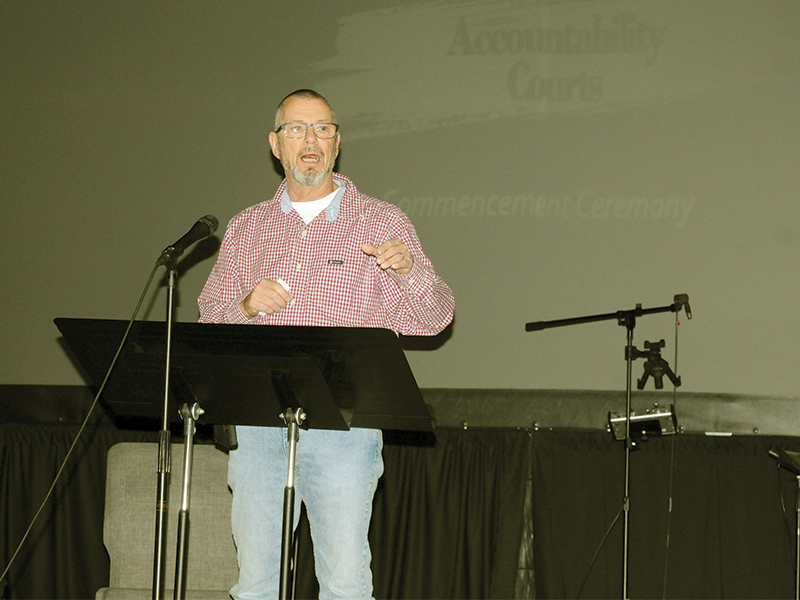
Tony Davis was once an addict. Now he’s a pastor and serves on the Jasper city council.
“My prayer for everyone in here this day is that God will break your heart for those who are still broken, hurting and undone,” he said in a speech at the Appalachian Judicial Circuit’s Accountability Court Graduation, Friday, Jan. 16.
When Davis started treatment in the Veterans Court, he was homeless.
“My worst time with God and with my wife is better than my best time in my addiction,” he said.
He encouraged other drug court graduates to keep persevering as they work to get better.
“Resolve in yourself that you’re not going back there,” he said.
Statistics for drug addiction and crime are often disheartening.
According to the Council of State Governments, 27 percent of people leaving prison in 2019 were in prison again three years later.
But, in the Appalachian Judicial Circuit, accountability courts offer a far better chance for people trying to leave crime behind.
These successes have earned the courts a Model Courts designation by the Council of Accountability Court Judges.
“I’m surprised every day, whether it be good or bad,” Veterans Court Coordinator Chris Holt said. “But a lot of times, I’m surprised for good.”
The Model Courts designation is for courts that have met and exceeded Georgia standards on several different metrics.
When criminals don’t offend again, it benefits the entire community, the Appalachian Judicial Circuit announced in a press release.
The success of the accountability courts starts with the judges, Holt said. Judge Brenda Weaver played a key role in starting them in 2002. Since then, these programs have helped countless people turn their lives around from addiction.
Veterans Treatment Court accepts veterans with mental illnesses, substance abuse issues or post-traumatic stress disorder who have been charged with a criminal offense.
Two years after graduating from Veterans Court, veterans with felony offenses have only a 3 percent recidivism rate. For misdemeanor offenses, they have a 7 percent recidivism rate.
Even those who don’t graduate the program have lower recidivism rates, at 18 percent for felony offenses and 12 percent for misdemeanor offenses.
“These outcomes are especially significant given the complex challenges many veterans face, including service-related trauma, substance use disorders and mental health concerns,” the court said in a press release.
The court has achieved great results by working together with treatment providers, case management, mentors and judicial supervision.
The Felony Drug Court has also beat the odds in helping people begin a new life.
This court supervises defendants who struggle with drug addiction.
After two years, the program had a 12 percent felony recidivism rate and a 5 percent recidivism rate for misdemeanors after two years.
The program also positively impacted those terminated from it. People terminated from the program had recidivism rates of 24 percent for felonies and 17 percent for misdemeanors.
Mental Health Court supervises defendants who were involved with criminal courts based on actions that were related to undiagnosed and untreated mental disorders.
This court had a recidivism rate of 6 percent for felonies and 3 percent for misdemeanors.
For those terminated from the program, felony recidivism rates were 28 percent and misdemeanor recidivism rates were at 24 percent.
“The success of the Appalachian Judicial Circuit’s Accountability Courts underscores the value of evidence-based alternatives to incarceration,” the press release stated.