
World War I casualty from Gilmer honored

As around three dozen people gathered on a sultry afternoon in the cemetery of a country church last week, the thought had to cross a few minds of what was going on in Army Private Ira Denton Cochran’s world 106 years earlier.
Cochran was only 16 years old when he enlisted and 17 when he was killed in World War I on May 22, 1918, the first of 17 men from Gilmer County who died in combat during “the war to end all wars.” Last Wednesday on May 22 — in 1918, the date was also on a Wednesday — Cochran was remembered and honored with a monument at the head of his final resting place at New Liberty Baptist Church in the Big Creek community.
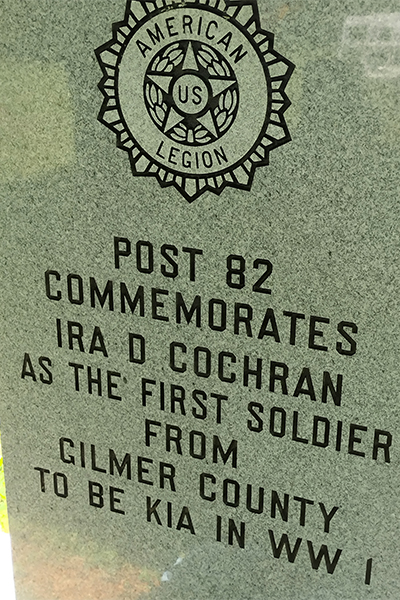
The commemoration included American Legion and Auxiliary members, the American Legion Riders, Gilmer County Genealogical Society, Daughters of the American Revolution members and others. After an invocation, Katlin Martin sang “God Bless America.”
Legion member Wade Youmans commented on the “full 106 years” since Cochran was killed, and noted a total of 207 men from Gilmer County served in the war, primarily in the Army.
“In Ira Cochran’s era there were men still alive who had served in the Spanish-American War and even the Civil War,” he said. “Perhaps he may have been thoughtful enough in his youth to take note that the actual start of the war coincided with his 14th birthday — 4 August 1914 — that very day being the day Great Britain declared war on Germany. On 6 April 1917 Gilmer County, with characteristic mountain stolidity, received news that the nation declared war against Germany.”
Youmans noted the commemoration emphasized “at this proper and meaningful point in time, in our here and now, (we’re here) to honor his memory and commemorate his sacrifice. He did not survive the war and thus did not return home to the victory that was so desperately fought for and finally won.”
According to military and historical sources, Ira D. Cochran was a member of Company L, 28th Infantry Regiment, 1st Division of the American Expeditionary Forces in France. The Germans had spent most of May 1918 bombarding the division with high explosives and gas, yet after enduring the prolonged shelling the 1st Division was ordered to take Cantigny, a German-held French village some 70 miles north of Paris.
The Battle of Cantigny was America’s most significant battle and first offensive of World War I. The town was captured on the first day of the assault with the 28th Infantry taking the lead. There were 1,603 casualties while taking Caligny, with 199 of that number killed. Although a local operation, it boosted Allied morale to see the American Expeditionary Forces taking the offensive.
Ira Cochran was killed in the days leading up to the Battle of Cantigny. He was originally interred in the American Cemetery at Villers-Tournelles in Somme, France and was later moved to New Liberty Cemetery in Gilmer County.
According to research by local historians Barbara Murray and Jennifer Anderson, Cochran’s body was disinterred on May 25, 1921 in France and shipped from Antwerp, Belgium to Hoboken, New Jersey on June 23, 1921. The body was then shipped to his brother, Jonathan Cochran, on July 22, 1921 in Protection, Ga., which is an erstwhile community in Gilmer County 10 miles due east of Ellijay.
The Gilmer County Sheriff’s Office Honor Guard was on hand to display the colors and fire a 21-gun salute, and Deputy Bill Hall concluded the ceremony with a solemn rendition of “Taps.”
Historical sources: Find A Grave, Familysearch.com, American Battlefield Monuments Commission (abmc.gov).