
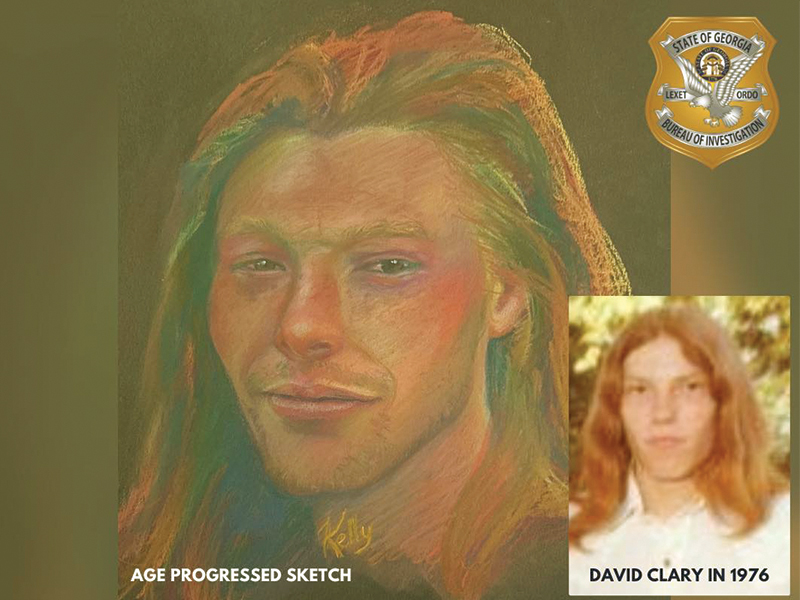
Nearly 40 years ago, a man’s remains were found in Gilmer County. Now, investigators have identified him using DNA testing, marking a major breakthrough in a homicide case that was once believed to be cold.
The Georgia Bureau of Investigation (GBI) and FBI identified the remains, found in August 1986, as David Clary.
Hunters found his remains in the woods south of Ellijay along Appalachian Highway, according to Times-Courier archives. At the time, the Gilmer County Sheriff’s Office reported that the body had been decomposing for two to three months.
GCSO asked GBI for assistance in the case. An autopsy ruled his manner of death as a homicide. Both agencies investigated numerous leads, but could not identify him, GBI stated.
The case went cold for decades until February 2024, when agents partnered with the Criminal Justice Coordinating Council and Othram Inc., a company that specializes in forensic-grade genome sequencing, and used genetic technology to correctly identify Clary. That’s according to an Othram press release.
“Being able to identify the body is half the battle in finding out what happened,” GCSO Sheriff Stacy Nicholson said. “Hopefully, something will come from that.”
GBI stated that Clary grew up in the Charlotte area, and made frequent trips to metro Atlanta and north Georgia. His last known location was in Gwinnett County. He was in his late 20s when he was killed, Othram mentioned.
Clary’s family was notified in February of this year about the discovery. Identifying him was a collaborative effort by Othram, GBI intelligence analysts, FBI Atlanta and their Gainesville Resident Agency.
The GBI Cold Case Unit, within its Office of Special Investigations, was just established within the past two years, under the Coleman-Baker Act, to review and reinvestigate cold murders.
The legislation established 10 special agents within the unit across the state. They’re currently working through 45 cold cases, Special Agent Brian Whidby reported. Since the unit’s inception, they’ve been able to correctly identify four people’s remains.
Whidby is the agent in charge of Clary’s case. “With the creation of the Cold Case Unit, GBI has more resources, more agents, to really concentrate on unsolved death investigations,” he said.
The unit is working to determine if they can collect enough DNA, from all unidentified remains GBI has preserved, to utilize newer genetic technology to identify them and investigate the case to today’s standards.
“That’s what identified Clary, we were able to obtain DNA from his remains,” Whidby noted. “So depending on the state of the remains when they were found, how much remains were found and whether that DNA degraded over time is also what we’re looking at as well.”
GBI is continuing their search for answers surrounding Clary’s death. Anyone with information should reach out to GCSO at 706-635-4646. Anonymous tips can be submitted to GBI’s tip line at 800-597-8477.
“We will work with GBI, in conjunction with them and the Cold Case Unit, with any leads or tips that come in,” Nicholson added.
To his knowledge, there has been only one other cold case in the county. In 1992, when he was a rookie officer, the remains of a woman were found and her death was ruled a homicide. She hasn’t been identified, even after Nicholson said they revisited her case when he was a detective.
“I’m hoping the cold case unit will revisit that case as well, but I certainly commend the efforts that they’re doing and [utilizing] all the new technology that is available,” he voiced.
Whidby confirmed they are taking a look at the woman’s unidentified remains to see if genetic genealogy would help advance their investigation.
Under the Coleman-Baker Act, GBI is always taking applications from families of victims to review cold cases that were originally investigated by their agents. That can be located on their website.