
Gilmer County Fire and Rescue prepares to deploy new bikes
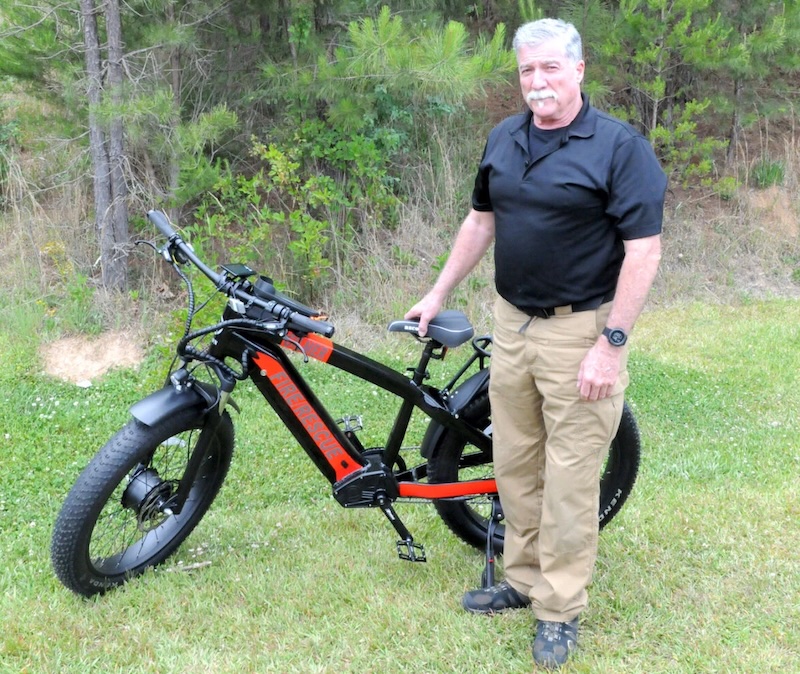
New electric bikes will give Gilmer County Fire and Rescue (GCFR) an effective tool for many situations.
“There’s a lot of uses for them in the future,” said Special Operations Division Chief Jeff Statham.
GCFR bought the two new bikes from RECON Power Bikes with a grant of about $10,000.
They greatly expand the GCFR’s capacities.
Many places in Gilmer can be hard to navigate for conventional emergency vehicles.
Crowds at the Georgia Apple Festival are often too thick to maneuver an ambulance. And most vehicles can’t navigate steep hiking trails.
Everyone in the GCFR knows what it means to carry a stretcher into the woods, pick up a 200-pound injured person and bring them back to somewhere with transportation.
“We’ve all got Springer Mountain stories,” Statham said.
The bikes will be especially helpful for GCFR because the Appalachian Trail starts in Gilmer County.
Often, people come to Gilmer hoping to begin the famous trail, but soon discover they aren’t skilled or strong enough to hike it.
“We’ve had people with too much gear on who step between two rocks and fall,” he said. “The extra gear acts as a lever as they’re falling and snaps their ankle.”
Biking in to help with an injury like this means that EMTs can arrive fresh and ready to provide good care.
“When you walk some of these trails for two or three miles to get to a patient, you’re a little bit exhausted,” he said.
The ability to ride a bike in and out greatly decreases the physical burden on first responders in most cases.
Statham estimates that the bikes can get up to eight miles per hour on trails, nearly three times as fast as a walking pace.
Even when the bikes can only manage a walking pace, it will mean that EMS personnel will arrive less exhausted.
The new electric-powered bukes have a top speed of 48 miles per hour and an all-wheel drive. They’re built for military, public safety and law enforcement.
Electric engines mean they’re legally allowed in the Chattahoochee-Oconee National Forest. The electric mode is also quiet enough that first responders can hear someone calling for help while riding the bikes.
The bikes can also carry wheeled stretchers behind them.
“They won’t cover us on every search we do or every trail we go to,” Statham said of the bikes. “But they’re going to fit in as an extra tool that we’ll utilize.”
Given the high speed the bikes are capable of, GCFR personnel will spend roughly two more weeks training with them before they get deployed.
“There’s a lot of uses in the future I think that the bike will come into play with,” Statham said. “Right now, we’re just in the learning phase with them.