
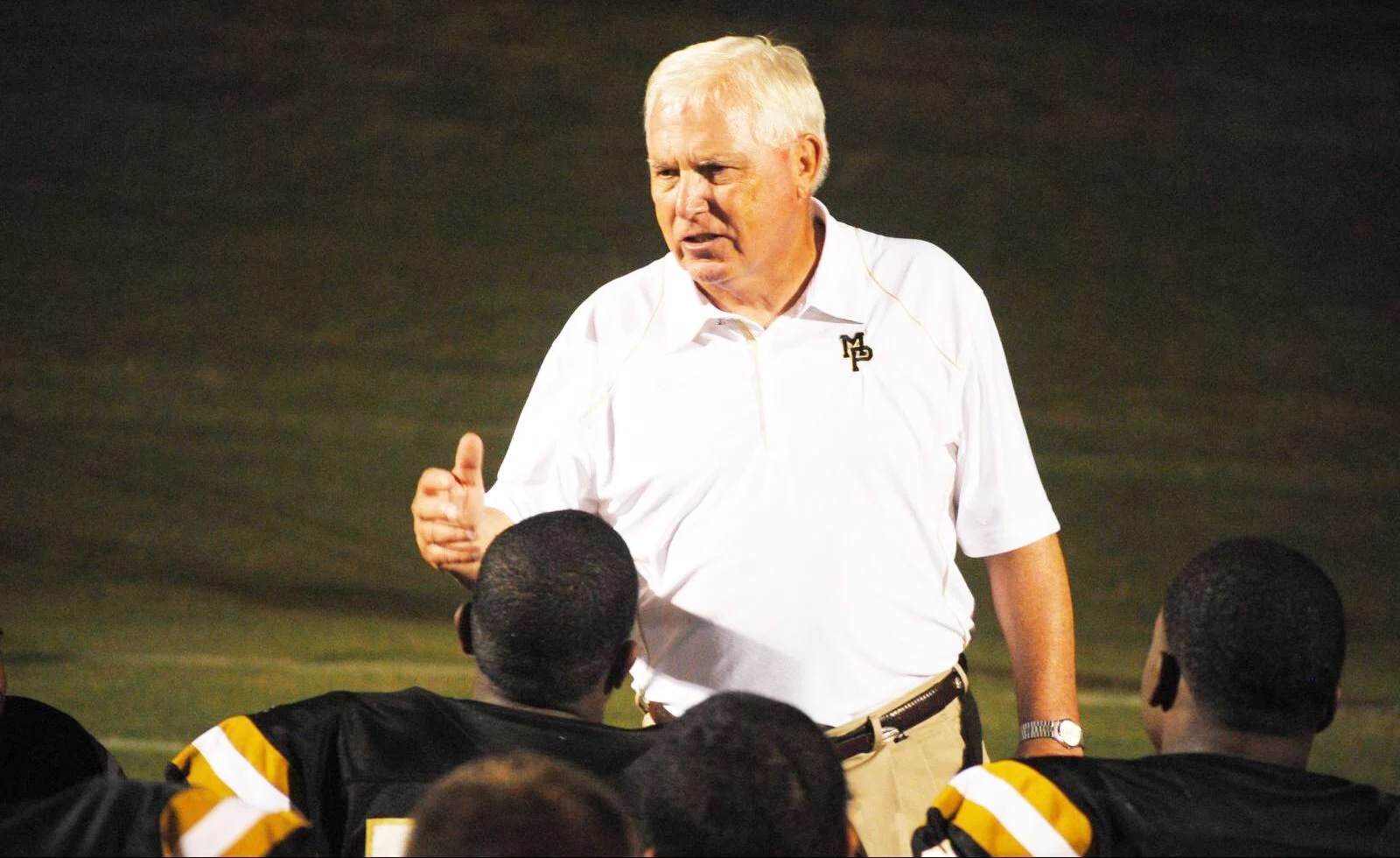
Rodney Walker left a trail of memories for his former players and assistants over a career that spanned 40 years.
Walker passed away May 9 at the age of 79. His wife of 58 years, Adecia, was joined by hundreds in attendance who paid their final respects in Fairburn seven days later. Daughter Leigh spoke of Walker as a father off the football field, while son Chip talked about the man on it.
Before his state championship and 10 region titles, Walker arrived in Ellijay in the spring of 1975 as a young, fiery coach. Those who knew him shared tales of his hard-nosed, no-nonsense approach. Former players revealed him off the field as someone who cared deeply about them and their development beyond athletics.
Walker’s first season at GHS was his fifth as a football head coach. He installed elevated standards backed by discipline and organization. The Bobcats were in tough times in those days, winning just nine games combined over the previous four years. The Cats had also endured six losing seasons in a row.
Morale both within the program and the community was on life support when Walker arrived at 408 Bobcat Trail.
“Coach Walker changed the culture of everything. Not just the Xs and Os, but the mindset and drive and discipline,” said Mark West, a 1977 GHS alum who later became a coach at multiple schools including Gilmer.
Up to that point, a singular universal machine encompassed Gilmer’s entire weight program. That soon changed as the Cats’ weight room expanded to include benches, bars, squat racks and dumbbells. Coach Doug Davenport ran the weight room in those days, and the level of commitment demanded coincided with Walker’s on-field expectations.
“I don’t remember lifting weights in a weight room with a bench and free weights until he got here,” West said. “We didn’t do weight training or training of any kind. But then we didn’t just work out during school, but they built the new weight room in the field house.
“He established a mindset and level of discipline we had never seen before and some people couldn’t take it. It was harder than they wanted to work.”
Walker also brought the game’s basics, which the Bobcats were seriously lacking at the time.
“(Previously) if we played a team that changed their defense on us, we had to call a timeout to figure out who to block,” said Ronald Watkins, GHS class of 1978. “When Coach Walker got here and started talking about ‘blocking rules,’ we didn’t know what he was talking about.”
Lex Rainey is a former GHS teacher, principal and superintendent. He had a stint on the sideline and coached with Walker during his final season at Villa Rica. Rainey joined Walker when he made the move to Gilmer.
“Rodney set the tone when he got here with high energy and expectations from the kids, and there was no changing that,” Rainey said.
He noted the first season was “rough,” but added, “After that, the kids bought into the program and we had a few more players come out by then. Rodney upped the tempo with the staff and with the players. Not to knock anybody, but he turned the program around.”
The Cats went 1-8-1 in Walker’s first season. One point of pride for the Cats was their performance against Cartersville. A year prior, the Canes throttled GHS, 60-0. West played the second half at quarterback, and Watkins played the entire game in the defensive backfield as a freshman. Both shared stories of talk swirling around Cartersville with the Canes eyeing the state scoring record.
What Cartersville found when it arrived at Huff-Mosley Memorial Stadium was a feisty group of Bobcats. GHS was down 7-0 at halftime, and the Canes went on to win, 20-0.
“We were the only region team (along with Murray County) to hold them to only 20 points, and we felt like we won that ballgame. We were supposed to get blown out. We were much more competitive and lost some close games that year,” Watkins said.
“It was a much more respectable game and we competed,” said West. “We made good strides coming off the year before, and we were playing a lot of sophomores.”
Walker also coached girls basketball, and the Lady Cats achieved a rare accomplishment for the time. In his first season on their sideline, GHS reached the state tournament with a senior-laden team led by Anita Middleton Withrow.
Withrow was the first Lady Cat to score 1,000 points. At the conclusion of her GHS career, she set six program records and went on to play at Berry College. Even during her collegiate days, Walker still kept up with her and attended games.
“The year before in 1974, we had our first winning season (13-10) in a really long time, and we built on that,” Withrow said. “But previously, we had not been very good at all. My sophomore year, we were getting beat by 30. We worked really hard to get where we were.
“Coach Walker was an old-school coach who didn’t sugarcoat things. He didn’t treat us any differently because we were girls. That was the first time we made it to state since probably the 50s.”
Back on the gridiron, the Bobcats improved to 5-5 in Walker’s second season. GHS was 7-3 in 1977 with losses by seven points to both Pickens and Cartersville and a 14-0 defeat versus White County.
The Cats posted an 8-3 record in 1978. They held eight opponents to seven points or less, which included six shutouts. Gilmer smashed Pickens (38-0) and Fannin County (20-0), and the Cats’ season ended in the region playoffs versus Commerce.
“The program was continuously built upon,” West said. “It takes a few years to build that culture and confidence back up in the players who had been beat down for years. Not only the players, but the community, nobody had confidence that Gilmer could win anything.
“It’s not a whole lot different from what we went through when (current head coach) Paul (Standard) came and took over the program when it was probably at its lowest point ever (in 2021).”
Walker was known for taking a keen interest in his players off the field. He was making the rounds during his first year at GHS checking grades during midterm. That’s when he discovered Watkins was not passing “any classes.” Though, Watkins claims that was not exactly true.
“I told him, ‘I’m passing driver's ed,’” Watkins remembered with a chuckle. Walker quickly shot back, “Passing driver’s ed?!”
Watkins had a new seat for the remainder of his time at GHS. His days on the back row were over.
“He moved me to the front in every class,” Watkins said. “Coach Walker got me through high school, that man did. I have so much appreciation for him. If it wasn’t for him, I wouldn’t have made it through high school. While I did get into a lot of trouble with him, I just took it and went on.”
Walker played an instrumental role in landing Watkins a roster spot on Jacksonville State’s football team as a preferred walk on.
“He was a big influence on my life, and I think a lot of him,” Watkins said. “When we got him to come back and be athletic director, I was really proud to see him back here.”
Walker was Gilmer’s county athletic director in the three years prior to Standard’s arrival. This followed a 40-year head coaching career that ended in 2011. His 300 wins in Georgia ranks 15th all-time. When son Chip won a state title at Sandy Creek in 2010, they became the first father-son head coaching duo in Georgia to achieve the feat.
Standard got his start as an assistant 41 years ago, and Walker won his state championship at West Rome in 1984. They frequently crossed paths at coaching clinics. Walker’s top assistant visited St. Pius in 2010 when Standard was its head coach as Walker wanted some insight into the offense.
“I was very honored that Coach Walker would have any interest in anything that the team I was coaching was doing,” Standard said.
Walker and Standard became closer over the next 16 years, which left an impact on Standard, much like many others in the football fraternity.
“Coach Walker was ultra successful,” Standard said. “He was so well connected in every area of the state because of his success and involvement with the GHSA. He knew I was interested in getting back into the public sector and called and asked if I would have any interest in the Gilmer job. And I said, ‘Absolutely.’
“He was always a great resource and sounding board. I considered him a friend. Even though I’m old too, I thought of him as a father figure in a lot of ways.
“He was a great man and great friend and loved Gilmer County and this community.”