
State attorney general’s office advises
Approaches may vary, but there’s something phone, mail and online scams need to be successful.
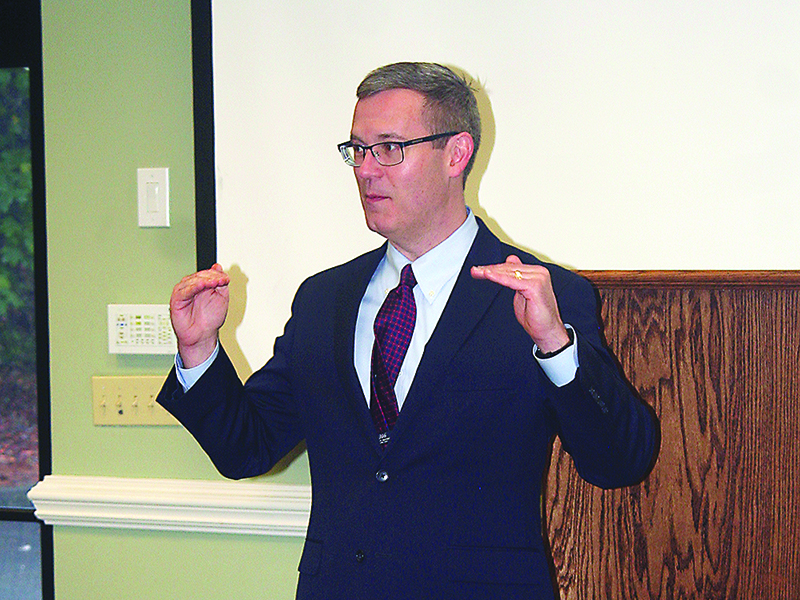
That shared element is a victim who wants to believe, a representative from the Georgia Attorney General’s Office told attendees at a collaborative workshop led by Gilmer Family Connection last Wednesday.
“They want to trust. They want to believe it’s real,” said Shawn Conroy, Communications and Outreach Coordinator for the Georgia Attorney General’s Consumer Protection Division, about why so many people fall for the vast array of false scenarios presented by scammers.
‘A number of different scenarios’
Conroy outlined some of the common and not-so- common scam approaches his agency has encountered during the meeting at the Piedmont Community Center that focused on issues pertinent to senior citizens.
“The Better Business Bureau’s study for business scams (showed) these types of scams often develop in different countries. Romania is a big source for scams and also Nigeria. We’ve all heard about the Nigerian prince letter,” he said.
“Often they are overseas, but about three weeks ago there was a couple in south Georgia who were arrested. They were making phone calls out to Los Angeles County. I think their scenario was a jury duty scam where (someone is told they’ve) missed jury duty and they need to wire money.”
The internet is the primary resource scammers use to obtain personal information, even unlisted phone numbers, Conroy noted.
“I work from the assumption that my personal information is out there somewhere on the internet or the dark web. Maybe your Facebook account is blocked, but phone numbers and other information (scammers) can gather is out there. We have to play a lot of defense to be careful because of all the (security) breaches that have occurred,” he said.
Easy access to such information allows scammers to localize their approach in attempts to “hook” more victims.
“Anybody with a phone can do this and they’re getting very local. They know what county you live in or they’re going to use the name of a local financial institution. They’ve done a little research,” Conroy said.
One phone scam that’s made the rounds in Gilmer County involves a party receiving a call in which they’re told a family member is in danger or has been arrested and immediate payment is required.
“It could be a very threatening scam like we have your loved one and we’re going to hurt them if you don’t send money or, ‘This is your grandson. I’m stuck at the train station and I need $100.’ It could be a small (amount like that). If I get a call like this at 3 in the morning, I’m going to step back and say, ‘Is my child OK? Is my wife OK?’ They’re going to try to catch you off guard and use some high pressure tactics,” said Conroy.
Other scams involve a false promise to fix common problems like low credit scores or computer issues.
“We had a conference call with Microsoft not too long ago where they described how many people are being tricked into a computer scam (where they are) emailed or called and told their Microsoft service is out of date. There’s a problem with their computer’s security and (this company) can fix it. The next thing they know, the citizen is on the phone and asked to go to a specific website where a computer has taken over. Sometimes, ransomware can be involved that locks down the person’s computer. This is happening to cities and towns across the country. It happened to the City of Atlanta,” Conroy said.
“There are a number of different scenarios. It could be something as simple as we fixed your computer, now there’s a $300 charge for that and we need your credit card information. Or you could be (asked) to subscribe to a monthly service, which is also fraudulent.”
The Internal Revenue Service (IRS) and Social Security Administration (SSA) are two common governmental aliases scammers use to intimidate and demand money from people who probably don’t owe anything, Conroy noted.
“The con artist will use the elements of surprise and high pressure. Something horrible is gong to happen and you have to do something now,” he added.
“With the IRS scam, they lie to you and say you’re going to go to jail if you don’t send money. We refer these matters to the IRS. There are special treasury department agents who actively investigate these matters. With the Social Security (scam), they may call and say if you don’t act now, you’ll lose your benefits. Last year, the IRS (scammers) started using people’s Social Security numbers.”
Marie Wyrosdick, of Tax Consultants of North Georgia, spoke to the audience and emphasized that the IRS typically does not start out cold calling taxpayers who owe.
Standard practice is to first notify them by mail, she said.
“They’re very intimidating and don’t want to let you off the phone until you pay,” she said about the IRS scam approach.
“The IRS always sends a mail notice,” Wyrosdick confirmed. “You usually get three to four notices (before they will call). They’re not just going to call you out of the blue. I have at least two or three clients who come to me terrified each year because they’ve gotten (one of these) calls. If you haven’t gotten a notice about it, the IRS has a number you can call to report the fraud. They can tell you that you do not owe this.”
Open with caution
It always pays to use caution with suspicious emails, even if they include the logo of a recognizable company or the name of someone you know, Conroy advised.
“You have to be very careful what you click on and very careful about opening up (email) pictures and documents. It’s very easy to copy and paste logos into emails. They can embed information into pictures and know your location,” he said.
A recent wave of email scams involved messages that appeared to be from churches the email recipients attend.
“We had an example of a (scam) targeting Catholic churches. They were getting the names of priests and creating an email address that looks like it’s from ‘Father Sam,’ (for example). Sometimes they obtain the names of the congregation members and send a message that may say something like, ‘This is father so-and-so. My niece’s birthday is this afternoon and I forgot to get her a gift. Will you get me a gift card at the store and tell me what the numbers are?’ or ‘We have a family in dire need of help. Can you send us a gift card?’ They use different tactics to tug on people’s heart strings,” Conroy said.
Then there are scams that promise something for nothing, such as those that offer fake sweepstakes checks.
“With the holidays coming up, I encourage you to talk to others about the various sweepstakes scams that are out there,” Conroy told those who attended the function.
“You get a message in your email or through the mail with the claim that you’ve won a prize, but there’s a tax for it. Or a fake check is involved that looks very real and you’re asked to deposit the check,” he added. “Under federal law, you have to be granted access to those funds within a few days, but it may take the financial institution more than a few days to figure out it’s not a real check. (When they do), they’re going to come back to the person who deposited the check to be responsible, which is what these crooks rely on.”
Again, what’s needed for the scam to work is a check recipient who wants to believe.
“Fake checks are also used in employment scams where people are offered jobs,” Conroy said. “People get hooked because (the expense may be something) as small as $20. They’re relying on the fact that we all want something for nothing. We all want to win the lottery. We want to believe it’s real.”
The objectives may not change that much, but the approaches scammers use are constantly being tweaked, Conroy noted. Some involve multiple callers or emailers.
“They will do a tag team, like in wrestling, where one person will call the victim. While they’re on the phone, someone else will call. One call will be, for example, ‘This is the police and your ID is being used in a stolen car case in Texas.’ The next call you get is someone saying they’re from the FBI and working on the same case. They’re really creative when working together. If they put their minds to good use, they could probably have a good living,” Conroy explained.
“Since a lot of these (scams) are coming from overseas, we rely on our federal partners to help. We don’t have the ability to go take action against someone in a different country without the help of our federal partners.”
The state consumer protection division offers services and resources for people who believe they’ve been victimized by a scam.
“We have counselors available and we can be contacted by phone, mail or fax. If not us, contact the local sheriff,” Conroy said.
“We rely on consumer complaints and people to tell us about what’s happening out there. That’s the primary source where cases start. If a charity or business is doing something wrong, we may not know unless somebody tells us.”