
Area of reservoir with highest earthen dam in East steeped in history

When Wayne Anderson was helping build Carters Dam fresh out of high school in 1965, he quickly found out that his youth made him the beneficiary of many practical jokes.
“They picked on me ‘cause I was just a kid, and they were always doin’ something,” he said during an interview in his pickup truck, parked just below the dam and powerhouse.

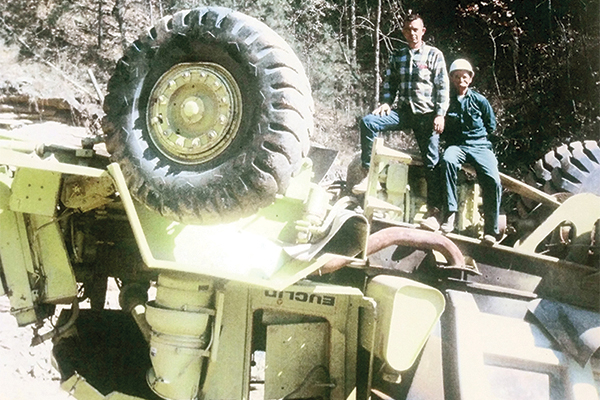
Anderson, who owns a construction grading business and lives in the Long Swamp Church community, has worked on many projects in Gilmer County and throughout north Georgia. He noted there were plenty of venomous snakes around the dam site in warmer months back in the day. On one occasion, he was told to crawl inside the levee under construction — now the tallest earthen dam east of the Mississippi River — to make a repair.
“There’s a strip of clay right through the middle of that dam, and when they hauled clay, it was just as hard as anything,” he recalled. “We broke a cable one night up there in that clay pit, and I was under that thang about 2 o’clock in the morning. Rattlesnakes was awful around there. Hugh Sneed, the Corps of Engineer man, cut a piece of trip cable and taped a jar fly to it. And I was up under that shovel, laying in that dirt trying to get that big cable back through there. Well, he threw that piece of cable in there with that jar fly a-buzzing, and I thought I was laying on a rattlesnake! My heart about beat out of my chest getting out of there! I told him, ‘I’ll get even with you!’”
Hired on as an oiler during the night shift, it was Anderson’s duty to make sure the big mechanized shovels and other earth-moving machinery stayed lubricated. When the operators took a break, he climbed the “boom,” or big arm of the shovel, and used a lube cylinder to grease the fittings. He made $2.50 an hour, and was responsible for two 988 wheel loaders with 8-yard buckets, and five shovels with 5-yard buckets. Sometimes he also operated the shovels and bulldozers. It was a union job with the United Mine Workers.
The dam was completed in 1977 and soon began generating electrical power after the reservoir was filled. These days, Carters Lake “embraces a spectacular tract of foothills scenery in the Blue Ridge Mountains of Northwest Georgia. Its sparkling waters and rugged shoreline provide a beautiful surrounding for a variety of recreational opportunities, which include camping, fishing, picnicking, boating, hiking and bird-watching,” according to the Explore Georgia website.
Carters Lake has 3,200 surface acres and is more than 450 feet deep at the dam, and the levee is the tallest earthen dam east of the Mississippi River. The reservoir has no private docks or development along 62 miles of natural shoreline, yet has a privately run, full-service marina offering boat docks, cabins rentals and boat rentals. Amenities include parking on site, boat launches, lodging on site, picnic areas and shelters, public rest rooms, rentals available and maps and brochures, the site adds.
While these resources and activities are well-documented and easy to find online, less is publicized about the history of Carters, the community where the dam was constructed. The lake is named after Farrish Carter, who owned property nearby in the 1800s, Explore Georgia notes. There were also two separate tribes of American Indians who lived in that area of southeast Murray County in different eras before white settlers arrived.
‘Richest man in Georgia’
As a surveyor in north Georgia, David Glass noted someone in his line of work has to be “somewhat of a historian” as they go about their work. He posted on the Facebook page for “Cohutta Wilderness” recently that he was able to recover a bit of history on a retracement survey that re-establishes original boundaries of a parcel.
“This property was purchased from Judge John Martin, the treasurer of the Cherokee Nation, in 1832 by Farish Carter,” he began. “Carter was probably the richest man in Georgia at one time; he started making his wealth by being an arms supplier in the war of 1812 to the Georgia Militia.”
Carter eventually owned around 45,000 acres in several counties in north Georgia back when Murray and Gilmer were just two of several counties that were part of Cherokee County. The 14,000 acres in present-day Murray County included the large house where Judge Martin lived — prior to the removal of the Cherokee by Federal troops — that Carter purchased and built the working plantation that came to be known as “Carters Quarters.”
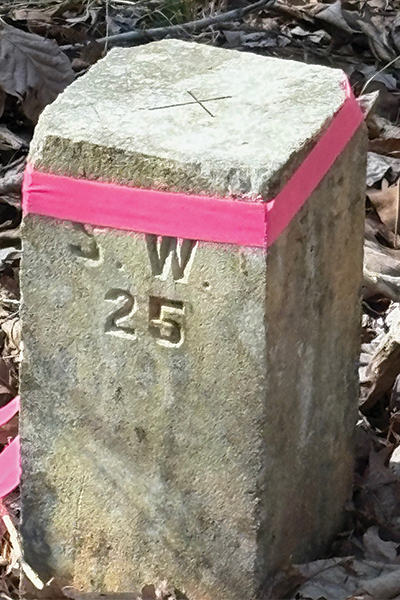
“He had roughly 430 slaves working to farm the fields at Coosawattee (the community),” said Glass. “The nearby city of Cartersville was named after him. He owned several businesses, including marble quarries, where he had these original marble monuments crafted, bearing the land lot numbers on each respective corner. His workers helped the state surveyors to survey some of the original land lot system in 1832, and they erected all the corner monuments on his plantation, most of which are still standing.”
He pointed out that Carter was acknowledged as a “renowned authority” on the location of the land lot corners. Carter also appeared to be rather wily when it came to attaining additional property.
“Whenever someone would come to him for directions to their recently-acquired land lot, he would readily agree to take them and show them the property,” Glass continued. “But when he would come out of his house with blankets wrapped around his legs, they would question him about it. His response was, ‘I will be glad to show you the land — but that property is infested with rattlesnakes.’ Most of the time, they would sell the land lot to him at a low price, sight unseen.”
The farm was spared from being destroyed during the Civil War, and most of the buildings are still standing, he said, adding, “I have had the pleasure to survey much of the property.” The “Carters Quarters” estate is still owned by descendants of the family today.
Getting even
Wayne Anderson knew the late Walker brothers, Ronald (“Hoss”) and Donald (“Duck”), and Jim Walker, all of Ellijay, as well as Jack Adams from Cherry Log. Jim Rittenberg of Pickens County worked on one of the mechanical shovels.
“Duck and Jim and Hoss and Jack had all got out of the (military) service, and I went in after they got out,” he said. “They all stayed on for the whole job. The pay was good at the time, and I made more when I got to operate a bulldozer. We’d work a 12-hour shift and get four hours of overtime — it wasn’t no 40-hour week. If we got rained out, we lost part of the week. But whatever kind of day we had, we still had that much overtime every day. Average pay back then — like at Georgia Marble over there where I lived — was just $1 an hour.
“But if you messed up (and got fired), there’d be 25 people day and night sitting there waitin’ on a job.”
Anderson affirmed at times practical joking meant he was also sent to get a can of striped paint or a left-handed wrench, both phony items meant to trick a young person into scouring a job site in search of them. However, he did find an opportunity to get back at Hugh Sneed.
“He was an inspector, and it was about 3 o’clock in the morning,” he began. “I wasn’t busy all the time, so I rolled down in there and saw him asleep in his truck. I got a flashlight and went down on the river and caught a big frog. It was summertime, and he had the window about half down, and I hit him right in the side of the head with that frog — and you couldn’t have told him from that frog, they was both going around and around!”
“But working on the dam was a good job, a big part of my life, and it was a heckuva project.” ⊂
Sources: Explore Georgia, U.S. Army Corps of Engineers, murraycountymuseum.com