
Forestry agencies, fire department urge caution when burning
With weeks of daytime temperature in the 90-degree range, it’s not tough to imagine the summer and early fall of 2019 in Georgia going down as — if not one of the hottest — one of the driest periods in recent memory.
“It’s been more than three years since Atlanta hit triple-digit temperatures, but that streak ended Tuesday. The city hit 100 degrees for the first time since June 25, 2016, tying a record for the date in the process. The original record was set in 2007,” reported the Atlanta-Journal Constitution in August.
Ongoing dry conditions contributed to a high number of fires statewide last month, said a representative from the Georgia Forestry Commission (GFC).
“In 2016, during the month of September, we had about 350 fires statewide. During the same month in 2019, we had almost 600 fires statewide,” confirmed the GFC’s Keith Moss.
Educational team formed
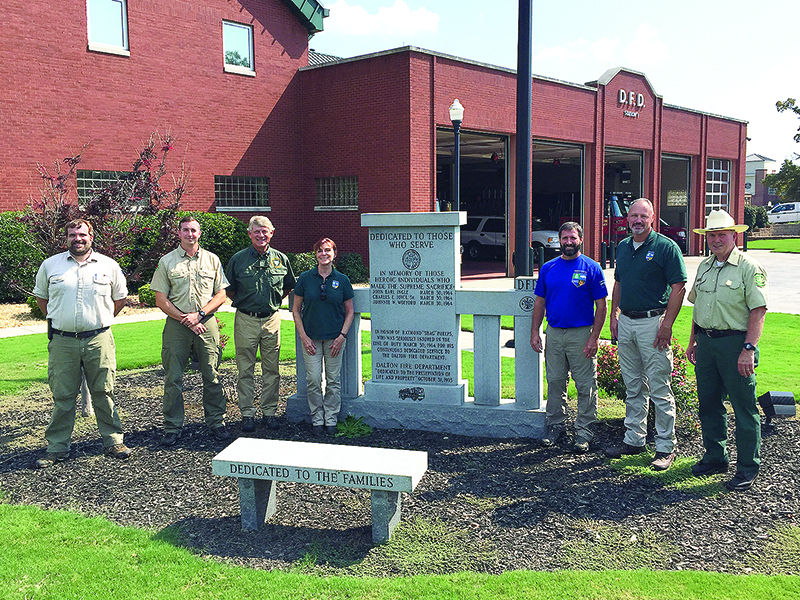
Moss is among the GFC and U.S. Forestry Service personnel on a team recently formed to educate communities north of metro Atlanta about the high potential for fires starting or getting out of control during the extended drought.
“We want to get the word out for people to be cautious and take extra steps. This team is working north of Atlanta, from the west to the east, hitting mostly counties that border National Forest lands and also other counties toward Alabama that don’t border National Forests like Haralson and Polk where we’ve had some issues with fires,” Moss said.
“So far, we’ve hit Whitfield, Murray, Dade, Gordon, Bartow, Polk, Haralson, Paulding, Pickens, Fannin and Gilmer.”
The team has been setting up at festivals and shopping areas to answer questions and give fire prevention tips.
“We’re going to try to hit all the counties as we go across this part of the state. Some of these counties don’t have the avenue of media with radio or different festivals going on,” Moss said.
“Last weekend, we were at the Cabela’s stores in Fort Oglethorpe and Acworth, as well as the Home Depot stores in Calhoun and Dalton. This weekend, we’ll be going to an arts festival in Blue Ridge. We’ll also be going to the Georgia Mountain Fair in Towns County and (possibly one of the festivals) in Gilmer.”
Little to no rainfall during the summer and early fall has contributed to an additional layer of “fire fuel” being formed, Moss noted.
According to the University of Georgia Environmental Monitoring Network, only 5.19 inches of cumulative rainfall had been measured in Ellijay between Aug. 1 and Oct. 13.
“In drought conditions, you normally have two layers of litter or fuel, as we call it. You have twigs, leaves and other debris on the top layer. Then you have partially decomposed litter next to the soil that’s called a duff layer. What we’re seeing now is that duff layer is just as dry as the layer on top of it. So when a fire burns it burns very deep and very intense, which makes it harder to control,” he explained.
Low fuel moisture and a drought index that’s higher this year than it was in September and October of 2016 create the perfect setting for the type of wildfires that raged across the state three years ago, Moss noted.
“We had those large 1,000 and 2,000-acre fires in parts of U.S. Forest Service land. We’ve been lucky this year that the ignition sources haven’t been in the right places to cause (the kind of widespread fires) we saw in 2016. Because of the catastrophic fires we had during that time, like the ones in the Cohuttas, we’re trying to look ahead. The same weather pattern (we had then) is holding true,” he added.
Keep a close eye
One of the main things people can do to lessen the potential for wildfires is limit unnecessary burning.
If outdoor burning is done, a close eye should be kept to make sure debris fires don’t get out of control, Moss advised. This type of outdoor burning is the number one cause of fires statewide, he added.
“In Georgia, 90 percent of fires are caused by debris burning. People let a campfire or a yard fire, leaves for example, escape. We’re encouraging people to be cautious because any little spark can start a fire. Embers from a fire can travel up to mile. A spark or ember could land on someone’s roof and burn their house down,” Moss said.
“If you have a fire in your fireplace or cabin, make absolutely sure the fire and ashes are fully put out. The same thing goes with grills. Make sure it’s in a safe, cleaned-out area and make sure the coals aren’t falling out. In Haralson County, there was a fire that was started by coals dropping out from holes in the bottom of someone’s grill.”
Ways that a fire can start or spread are even more plentiful in current conditions where the ground is dry and there hasn’t been enough rainfall to lessen the hazard.
“Folks pulling trailers up the road and their chains dragging is one way. Folks pulling off into dry grass or a field and their catalytic converters, or even the heat of their exhaust, can also start a fire,” said Moss.
“(There’s even been instances where) the blade on a lawnmower will hit a rock and a fire starts,” said fire prevention team member Shawn Alexander, of the U.S. Forest Service.
Moss and Alexander noted the value of Firewise practices, which recommend removing dry debris from around the perimeter of one’s home.
“Things that homeowners can do include having a space that’s 30-50 feet where they’ve cleared the leaves and dry foliage and have no leaves or needles touching the foundation of their house, as well as moving such flammable shrubs as junipers away from their house,” Moss said.
“Where the woods and the urban interface meet, that’s where there are often issues with fires coming out from the woods and approaching homes.”
EPD burn ban lifted
A 54-county burn ban instituted by the Georgia Environmental Protection Division (EPD) this past summer was lifted Oct. 1. Counties that were under the expired EPD ban include Gilmer and Pickens, as well as metro Atlanta areas like Forsyth, Fulton, Cobb and Gwinnett.
Though a fire deterrent, EPD burn bans have nothing to do with dryness or drought conditions, said Alexander.
“The EPD (initiates) burn bans because of air quality,” he said.
Moss said burn permits can still be applied for through the forestry commission, but availability of the permits varies from county to county depending on conditions.
“The forestry commission has the ability to turn on and turn off burning permits, such as (the ones for) debris burning and silt burning. The permits were turned off in Pickens County as of yesterday, but in Gilmer County they were turned on. If it’s a warming fire, a cooking fire or a campfire, the forestry commission doesn’t permit those types of burns,” Moss said.
“People can visit GATrees.org or call 1-800-GA-TREES (428-7337) and get to their particular forestry commission office. They can tell you if burning is permitted that day or not.”
Gilmer, along with almost 10 other north Georgia counties, is currently in the severe drought (D2) category, whereas Pickens, Cherokee and several other counties to the south and southeast are in extreme or D3 drought conditions, according to the most recent Georgia Drought Monitor data.
Gilmer County Fire Chief Daniel Kauffman said a county-wide burn ban has not been put in place yet, but the local fire and rescue agency is monitoring the situation.
“We haven’t issued a burn ban from our end, but everybody does need to use caution when doing any kind of outside burning. Have a water hose (handy) and don’t leave anything unattended,” he added.
“If the drought index gets high enough combined with sustained winds and low humidity, (that) would be a weather-driven situation that could dictate a burn ban. If (the forestry agencies) were to come out and recommend a burn ban, we’d take that into consideration and work with them on that.”
Kauffman said the county fire department hasn’t had a problem with large fires caused by drought conditions this summer and fall.
“We haven’t had any that have created issues (as far as) them growing in size before we arrived on the scene and having to call in additional resources. Everything has been manageable up to this point,” he added.
Though it’s when cooler air typically starts filtering in, October tends to be the driest month of the year in Georgia, Alexander said.
Per UGA Environmental Monitoring data, only .18 inches of rainfall has been measured at the university’s Ellijay weather station since this month began.
“The small amount of rain we’ve had is not nearly enough. It was already dry two months prior to now and we weren’t getting any rain then, either,” Moss said.
“There’s no particular set amount of rain (that would offset things), but a 1-2 inch rainfall over a few days — slow, soaking rain — would be much better. It would go a long way not toward alleviating the problem, but just slowing it down. The few showers we’ve got the last couple of weeks will just have a short term-effect and then you’re back in the same situation in a few days,” he added.