
Mark Wiles
By Monday afternoon, messages were appearing on mobile phones advising users that flash flooding was possible when the remnants of Hurricane Zeta rake the region. For the fourth time this hurricane season, a storm has slammed the Gulf states and will slice northeast on a beeline toward the Appalachian mountains.
Still, foresters and other wildfire officials warn, because of the season’s low relative humidity, we could dry out in a matter of days. In a wetter-than-normal year, however, it’s unlikely southern states will experience the rampant blazes that marked the autumn of 2016.
It doesn’t mean professional wildfire watchers are taking a breather, however. Also on Monday, four of them took part in a Zoom call to advise Times-Courier readers what to expect in the next few weeks before humidity levels begin to rise again.
Frank Riley, who serves on the Chestatee-Chattahoochee Resource Conservation & Development Council, is part of the Firewise liaison team under contract with the Georgia Forestry Commission (GFC) to help coordinate the Firewise program around the state, coordinated the call. Firewise helps residents ensure their homes and properties are resistant to wildfires.
Austin Roland, GFC chief ranger with the Gilmer-Pickens unit, said currently the area is seeing “a normal fire season.”
“We had our first fire of the year last week,” he reported. “It was a ‘spotover’ (when an ember may come out of a brush fire and land in a nearby fuel bed) from a brush burn. A guy was doing some land clearing and the fire was maybe a quarter-acre in size. It was easy to contain — there wasn’t high flame lengths to it, maybe 2 to 4 inches — and there was still a lot of moisture in the ground. As long as we get some of this rain once a week or once every two weeks, I think we’ll be fine.”
Roland said with moisture in the ground he “typically doesn’t worry that much” about allowing mandatory outdoor burning permits to be issued.
“If we do have a fire, it’s going to be easy to contain by the weather we’ve been having,” he said.
Anthony Englishis is a GFC wildland urban interface specialist for northeast Georgia, and also a firefighter and ranger.
“The weather plays a big part in our fire season,” he noted. “Even though we’ve gotten, quantity wise, a ton of rain here lately through the different hurricanes and tropical storms, the consistency of our rain hasn’t been that great. With our quantity, our fuels have stayed plenty moist, but if we go several weeks in between rains, then we have those opportunities for fires … we just haven’t seen the weather patterns that dictate wildfires yet. They always could change.”
English said Monday that currently there’s only a 15 percent chance of “worst-case scenario” such as the wildfires that scorched the Southeast in the autumn of 2016.
An ‘empowerment’ program
Mark Wiles, a wildfire prevention specialist who works with the GFC, is a big advocate of the Firewise program.
“It’s an empowerment program for homeowners,” he said. “It has tools to help people know what to do to prevent loss in event of a wildfire. Cleaning fuels out from around the home is great — kind of a firebreak from that natural environment where a wildfire can burn. It’s important.”
Riley pointed out that taking action through a Firewise prevention program is “an ongoing process, not something you can just do one time and walk away.”
“Those leaves need to be taken out of gutters, and you need to blow the top of the roof off at least twice a year,” he advised. “Around the structure itself, you have leaf fall that forms a continuous fuel bed right up to the foundation. And if you live in a wooden structure, the possibility of having a fire and it making it to your house is pretty high.”
Wiles added, “We’ve had a really wet spring, and good rain all summer long — which has done nothing but cause more vegetation and more leaves. So it’s kind of a double-edged sword. You’ve got good rainfall, which is keeping the fires down, but it’s creating a lot more fuel … so when it does dry out, we’re going to have a lot of fuel out there that could be a problem if we have a wildfire.”
“And it will dry out quickly this time of year,” Riley said. “Just because we had a rain today, I mean, we could have a fire tomorrow or the next day.”
Wiles has recently worked with the states of Maine and New Hampshire where drought is currently an issue.
“I think we estimated that about 1 inch of rain is good for three days in a drought situation … you can get an inch of rain and be right back to where you were before you started, epecially in a drought situation,” he noted. “I think the relative humidity is the key. When you get a very low relative humidity, you can have tremendous problems when it comes to wildfires. Embers can drift as much as a mile to advance a fire. It depends on how strong the wind’s blowing, and start setting fires a mile out beyond where you’re working (to put one out).
“You can imagine in the west what they’re dealing with those Santa Ana winds and (very low) humidities … I mean, it’s just total chaos every day in the west when it’s dry.”
No burn permit? Think again
Roland was asked if not getting a burn permit before burning is a problem in the district.
“We don’t see it as much as we used to, because it’s so easy to get a permit now,” he replied.” One of the problems we run into is people call and get a permit, then leave their fire unattended. If that unattended fire gets away, it may be one or two hours before somebody sees it or notices smoke and we’re notified. People are going about getting the permit the right way, but are not staying with the fire and babysitting it like they should. It’s also supposed to be out by dark.”
Roland said developers who start “machine fires” with land-clearing equipment sometimes have fires so large they cannot be put out before nightfall. They are asked to cut firebreaks and have someone stay on site through the night and watch it, even if they stay in a camper or their truck.
“I just don’t want them to burn their neighbor’s house down,” he said. “In the state of Georgia, you’re responsible for your fire, and you’re responsible for your smoke, and that’s just how it is.
“It’s important to remember, too, that if you don’t have a burn permit and your fire gets out of control, you’re responsible for the cost of the suppression of that fire — which can run into tens of thousands of dollars.”
“If they bring in an air tanker, you could pay for it,” Riley added. “You’re responsible. This is Firewise —‚ if you take care of your house, and Austin takes care of his house, and Anthony takes care of his house, you’ve got protection if one (wildfire) does get out. That’s the whole purpose, that we clear our own areas so that wildfire goes somewhere else.”
The U.S. Forest Service has released its Southern Area Wildfire Risk Assessment for fall 2020. It reads, in part:
“The majority of the geographic area should observe normal wildfire severity and conditions through the fall ... normal La Nino impacts have been moderated with several waves of tropical moisture events across the geographic area … (there is a) greater chance for warmer-than-normal temperatures when you look at the winter months combined (this doesn’t mean portions of the south won’t see cold temperatures at all, though).”
How to be ‘Firewise’
Firewise USA is a voluntary program that “provides a framework to help neighbors get organized, find direction and take action to increase the iginition resistance of their homes and communities,” according to Firewise.org. Also, the sponsoring Naitonal Fire Protection Association website, nfpa.org, has other educational programs, including how emergency managers are addressing large-scale natural disasters when they run headlong into the COVID-19 pandemic.
Getting a burn permit
Call 1-877-OK2-BURN (652-2876), or go to the GaTrees.org website; look for the tab ‘Burn Permits’ on the right side of the webpage. Permits are good only for the day they are issued.
Forester: ‘Increased potential for wildfire’
By Mark Wiles
The temperatures are beginning to drop and autumn is quickly beginning to show her colors. Gilmer County is in the midst of the fall foliage season, which will bring tourists to the area for a much-needed break from the new COVID-19 “lifestyle” that we all have been experiencing.
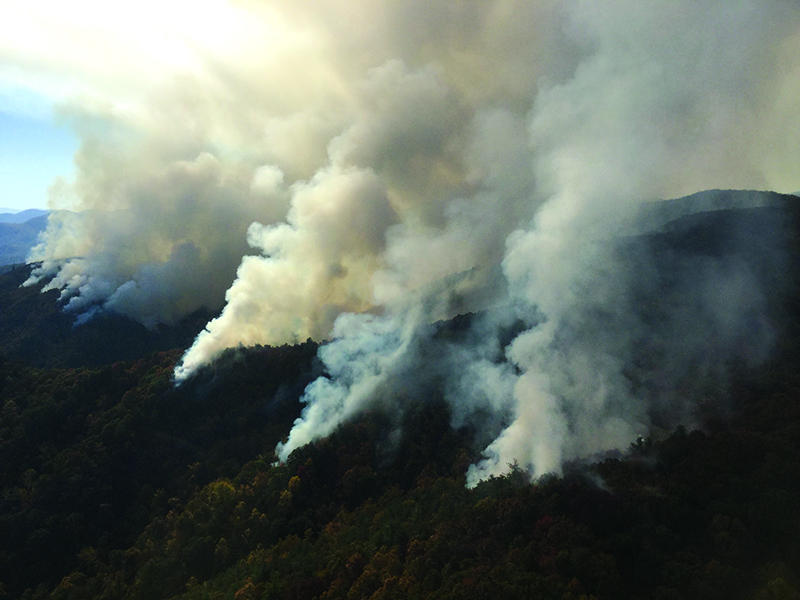
The number of visitors to the Chattahoochee and Oconee National Forests is on the rise and will likely exceed visitor numbers seen in recent fall foliage seasons. Combine the number of leaf lookers, with the influx of hunters, and there are a very large number of people enjoying Gilmer County’s forests. With the increased number of people, there is an increased potential for wildfire.
Roughly 90 percent of the wildfires in Georgia are started by people who are careless. That could be the result of an abandoned or unattended campfire, carelessness while burning leaves or yard debris, or some people who simply set fires purposely. These are only a few of the types of “human-caused” wildfires we experience.
This time of year for the North Georgia Wildland Firefighter brings a busy season, from smoke complaints to wildfire suppression. The job of a wildland firefighter can be daunting during the autumn season. The greatest concern is putting our wildland firefighters in harm’s way to suppress these fires. The cost associated with these suppression efforts can be staggering, so preventing these fires is a must.
Remember you are a visitor to the forest. Campfires should never be left unattended, and should be completely out at your departure. If you decide to burn leaves or limbs, obtain a burning permit from the Georgia Forestry Commission before you burn. I encourage each of you to report careless fire use to the proper authorities.
We have been lucky to receive a plentiful amount of rainfall this year in Gilmer County, and hopefully this trend will continue. The folks in the western states continue to struggle with wildfire devastation; hopefully the fire season will soon end and our firefighters can get some much-needed rest.
I recently visited the National Geographic website and found a very interesting article on frontline wildland firefighters in the west. It is an interesting read and sheds light on the seemingly-endless battles these young men and women face as frontline wildland firefighters. I also learned that the Ron Howard documentary “Rebuilding Paradise” will air with no commercial interruptions on the Nat Geo channel Nov. 8 at 9 p.m.This documentary chronicles the rebuilding of the town of Paradise, Calif., after its destruction two years ago from wildfire.
Mark Wiles, a registered forester and certified arborist, is the owner/operator of Wiles Forest Management in Elberton. His email address is wilesforestmanagement@gmail.com.