
July 27, 1953 was end of Korean War
When Jesse Westbrook was deployed to South Korea in 1952, he stayed until the end of the war on July 27, 1953. Though it might be said hostilities were winding down in that last year, Westbrook and his unit were still supporting combat missions while dodging bullets and mortar shells.
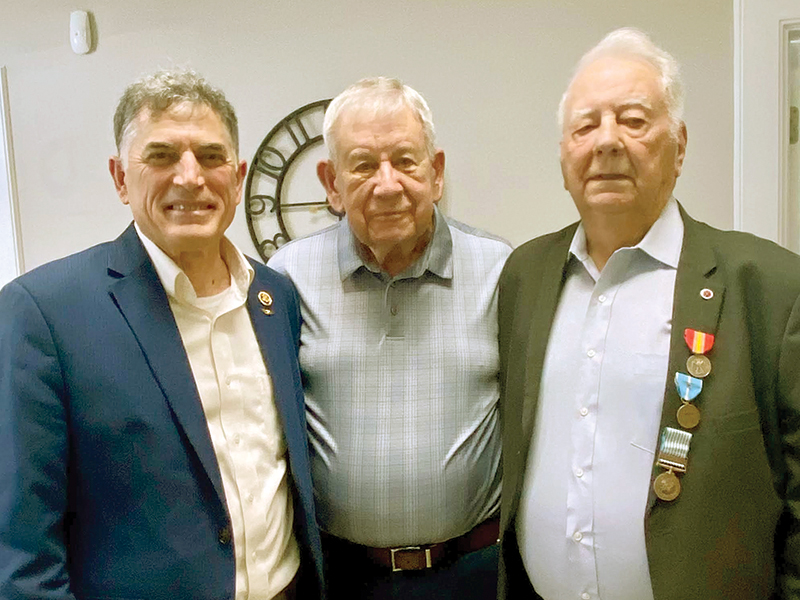
Last month, Westbrook received three long-overdue medals from the war — the Korean Service Medal, United Nations Service Medal and the National Defense Medal — during a presentation at Ellijay’s United Community Bank. U.S. Rep. Andrew Clyde helped procure the medals through a request originated by Westbrook’s longtime friend, Ralph Cox.
It has been 71 years since Westbrook, 94, served in Korea. He was born and raised in Marion County, Ala., and graduated from Winfield High School in 1948. After growing up in a sharecropping farm family, he saw no future in the region 90 miles northwest of Birmingham for his young wife, Jean, and himself.
“The only thing to do down there was coal mining or working in a sawmill, and I knew there was a better way to make a living than that,” he said. “So we moved to Atlanta in 1950 or ‘51, and from there I got drafted into the Army in 1952.”
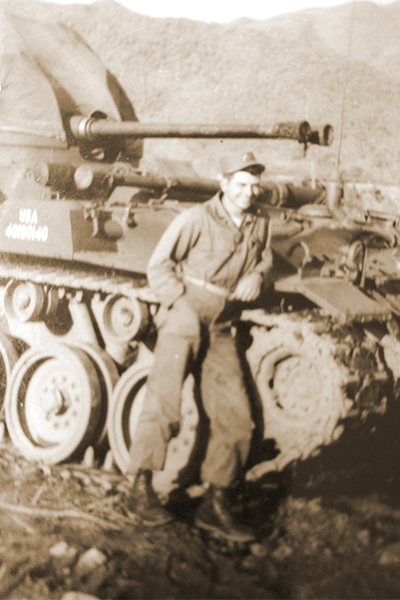
After basic training, Westbrook learned to work on jeeps and trucks at Fort Chaffee, Ark., then it was on to Fort Sill, Okla., to add tracked vehicles like tanks — and big guns mounted on tracks — to his military résumé.
“I was a replacement and didn’t go overseas with my unit; it had already shipped out of Fort Hood, Texas, when I was finishing school,” he explained. “I shipped out to Korea with the 7th Infantry Division, 15th Anti-Aircraft Artillery/Automatic Weapons Battalion.”
Early on, Westbrook noticed the political nature of the Korean War.
“We weren’t allowed to fire on an (enemy) aircraft unless we saw it commit a hostile act,” he said. “What they used us for was to ‘plug’ a valley, or we’d make a push with the quad-50s or twin-40s (anti-aircraft guns) mounted on half-tracks (vehicles). Down at the foot of Papasan Mountain was where our battery headquarters was located, and we had vehicles online (in combat situations) just about all the time. They would put 50 percent online and 50 percent in reserve.”
Several photos Westbrook shared with a reporter showed troops in heavy winter gear like parkas. He was asked about the winters there.
“It was cold,” he replied. “You’d pick up a wrench, and it would stick to your hands — bitter cold.”
Some of Westbrook’s duties were to “pull maintenance” on the vehicles while they were in combat situations.
“Those tanks had a low side of the transmission and a high side,” he noted. “One tank driver was coming down the mountain and didn’t put it in the low side and got to going too fast and pulled it into a bank (to stop it). One of the tracks went up under the tank, and the other flew back up the mountain, and we had to go up there and retrieve it and put the tracks back on it to get it out of there. We would call ordnance, and they would send a guy with a lift to pick up those tracks and drag them down and help us put them on.”
‘They couldn’t get out’
His unit also took orders to fire the guns they maintained in support of troops.
“The infantry would go out on patrols at night along the ridge,” Westbrook recalled. “Then if they got pinned down, they would request fire missions. Sometimes they’d get pinned down all night and the next day and couldn’t move or they’d get shot or killed. So they’d hunker down the best they could and call in fire.
“Sometimes we’d get them out of there, and sometimes they couldn’t get out.”
There were also defensive tactics to try and keep men and equipment safe.
“We would pull up on top of a hill where we had good vision and get an order to build a bunker, and they flew in those big heavy timbers with a Huey helicopter,” remembered Westbrook. “We’d pull the tanks and tracks inside those bunkers and then sandbag them, then we’d build a personnel bunker with sandbags beside the tank bunker. That protected us against mortars and small-arms fire.”
Before his deployment to the Korean Peninsula, part of Westbrook’s unit had been involved in the legendary retreat of American troops from the “frozen” Chosin Reservoir with its epic cold weather in 1950. The joint Chinese and North Korean entrapment killed around 2,500 U.S. Marines and soldiers — many of whom froze to death.
“That was before my time,” Westbrook reiterated. “(Gen. Douglas) McArthur pulled the 7th (Infantry Division) and the 1st Cav of the 2nd Division (of the Army) and the 1st Marines … (and) as they were going up, everybody was happy and greeting them when they were going through those little villages and towns. Then they got up there, and the Chinese came through the Manchurian border and cut them off and killed thousands of them. They had to abandon all the equipment and just find a way out of there to the ships that were to pick them up.
“But when they came back out, those same people were hostile and didn’t offer any help at all then. So it was a mistake in one regard, but that was part of it. McArthur thought he would surprise them, and he did, but he didn’t count on those Chinese coming across the border.”
In his own unit, men were wounded and killed.
“A lieutenant in one of our platoons got shrapnel up on the main line,” he continued. “We’d got mortars in on us that night and, he got hit in the hip.”
Did he ever discern his own life was in danger?
“Oh, yeah. When we went online, we had areas where we were exposed, such as roads where we had to go to those positions,” Westbrook said. “We had camouflage wire hung up with camouflage woven into it to hide the movement of our traffic back and forth. We had a motor sergeant that got killed when he was driving a jeep with the windshield down to cut down on reflection, and we got mortar rounds in there where we had the camouflage up. They started out to leave that position where they were pulling maintenance, and one of the little wires come down across the road, and it cut (the sergeant’s) head off. Because of those mortar rounds, he was in a hurry and driving fast and never saw that wire hanging down.”
‘Nothing spectacular or heroic’
After he returned to the states, Westbrook served in an Army Reserve unit for six years at Fort McPherson outside Atlanta. He also went back to work to try and make a living for his growing family.
“I had a job at Kroger in the warehouse, but didn’t like it,” he said. “So East Point was opening up a new fire station, and I took the test and passed, and was hired by the city of East Point as a firefighter. I stayed there till I retired in 1982.”
What brought Jesse and Jean Westbrook to Ellijay?
“We used to come up here in the summertime on vacation and liked the mountains and the people,” he said. “So we moved up here.”
After Jean passed in 2005, Westbrook married Lee Sales. He was asked about belatedly receiving his war medals.
“(The Army) just never did bother to give them to me when I got out,” he said. “Ralph Cox is the one that initiated it. If it hadn’t been for him, I’d have never got them. He had the connection with Andrew Clyde, and said something or other to Clyde’s go-to guy and they arranged it. I’ve been friends with Ralph for years and years. I first met him when we had kids in the band together — for us it was a grandchild — being chaperones to Virginia Beach and Panama City and all that. We just became good friends and stayed that way.”
Westbrook said through the years he “never thought about the medals.”
“I was proud to get them, of course,” he affirmed. “But I’d lived 72 years without them, so it wasn’t a must-do thing. That was a time back then that we weren’t ready for another war after World War II — and they didn’t even call it the Korean War for a long time, they called it a ‘police action.’ That was kinda bad, and back at Camp Chaffee, we were out there at the bus stop and they had a sign that said, ‘Dogs and GIs Stay Off the Grass.’ That didn’t make you feel too proud, and then too, when we came back, there wasn’t no parades or anything like that. When we were discharged, they told us to just blend back in to your job and keep it low key and continue on living.”
And another thing: “The American people didn’t like not winning. When you got back, it felt like you didn’t fit in at some places. But the medals have helped make up for that, they sure did.”
‘With honor and distinction’
A lifetime member of the Veterans of Foreign Wars (VFW), Westbrook added, “I don’t deserve nothing special or anything like that. Any person would serve if they were called upon. But I did nothing spectacular or heroic or of that nature, I just done what I was supposed to do at the time.”
Cox, an Air Force veteran, said Westbrook never mentioned serving in the war until Jean brought it up.
“Over the years, I found Jesse to be one of the most humble and patriotic men I have ever known,” he said. “Like so many great Americans, when his country called, he answered and served with honor and distinction. And when the war was over, he resumed his role as a common citizen and continued to serve his community throughout his life. To see Congressman Clyde pin those medals he’d earned on his chest was a very moving experience, and a memory I will treasure always. The medals are just a small token of appreciation — after all this time — to a man who never expected any medals or accolades for doing his duty.”
Westbrook will turn 95 on Oct. 21, and the latter years have brought times of reflection.
“I have been blessed many times over and had a good life — I’ve got to do so many diversified things till it just seems like I’ve lived different lives at different times,” he said with a chuckle.