
Bench honoring Cherokee Indians dedicated

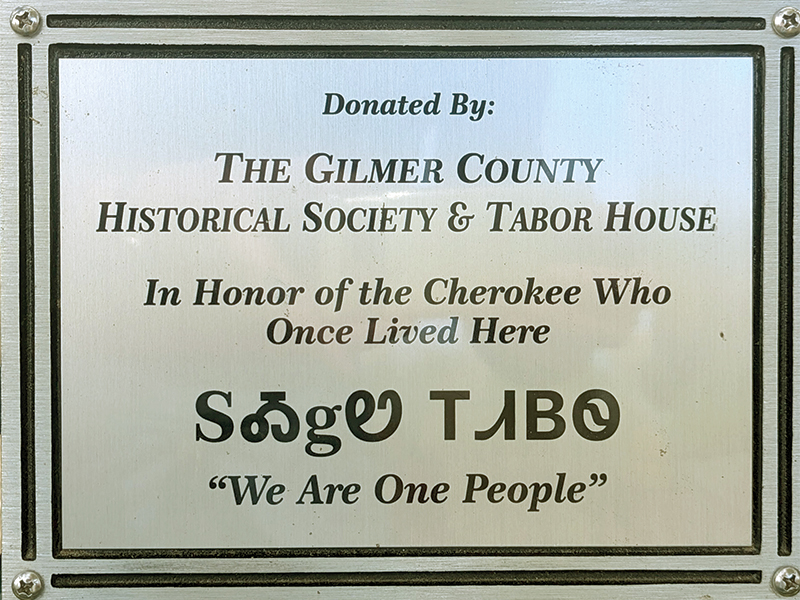
The plaque dedicating the park bench
When seeking an appropriate phrase to inscribe on a commemorative bench honoring the Native Americans who once lived in the Ellijay area, Karen Vitelli went straight to the top —the Eastern Tribe of Cherokee Indians in Cherokee, N.C.
“I called Chief (Michell) Hicks and told him, ‘I want to honor you by you telling me what (inscription) you want on this bench,’” said Vitelli, a member of the Gilmer County Historical Society. “So this is the Cherokee writing and it means ‘We are all one.’ To me it means all has been forgiven — we’re all one.”
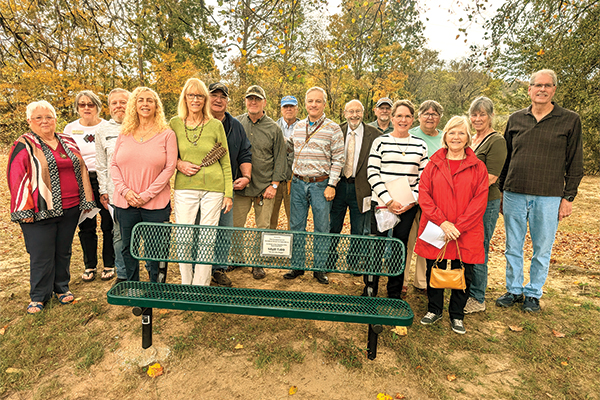
At a simple ceremony last week, the green metal bench, with that phrase in the Cherokee language and its translation into English, became the newest addition to River Park, Ellijay’s popular walking area beside the Coosawattee River. The bench sits between two 100-year-old hardwood trees.
Tom Cox, a tour director at the Tabor House Museum, said the Cherokee would have called them “grandfather trees” as a sign of endurance.
“This light rain reminds us of the tears of the Cherokee on the infamous Trail of Tears,” he said of intermittent rainfall on Wednesday morning of last week. “It is a time of sorrow, in a way, because we remember the fact that they were shamefully taken out of their homes, leaving everything behind … But we remember them, that’s what we’re here for. The sorrow is now over, (and) we’re remembering the Cherokee people and what they had around here.”
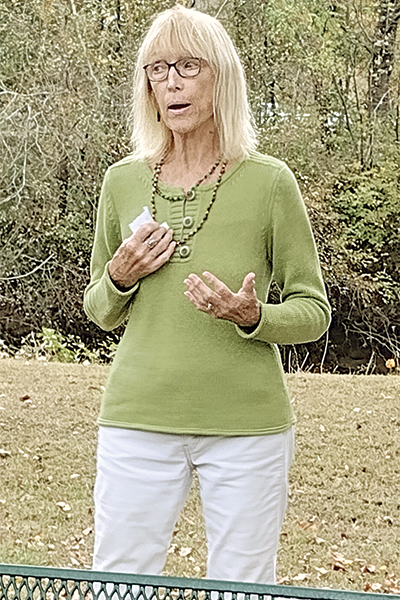
Cox noted the bench “was put here because Karen had a dream and wanted it to become a reality.”
“It is on the river that gave them life,” he continued. “They camped beside it, they took fish from it, they swam in it. All of these things are important, and all this land around here was occupied by the Cherokee. The first Indian town of Ellijay is where the Dairy Queen is now.”
Vitelli said the bench, purchased by the historical society, received the hearty approval of both Commission Chairman Charlie Paris and Parks and Rec Director Jody Cantrell. The reflective sitting spot is near the Ellijay Lions Club Barn facing the saddle club arena, and will be lit at night by an “old-fashioned gas light,” she added.
Vitelli pointed out that more than 1,000 Cherokee were herded into Fort Hetzel, which sat on the corner of Highway 515 and First Avenue in East Ellijay, near Parkway Conoco. A small memorial marks the site.
“Many never left (the fort), dying of disease, lack of blankets and rancid food,” she said of the lead-up to the Trail of Tears.
There are differing estimates by historians about how many Native Americans traveled and died on the forced march to Oklahoma during the unusually severe winter of 1837-38. Both Vitelli and Cox said 4,000 of the 10,000-plus participants died along the way.
Doug Piette, the current president of the historical society, loaded a video onto YouTube under ‘Cherokee Bench Dedication’ and also created a blog on the website (gilmercountyhistoricalsociety.org).