
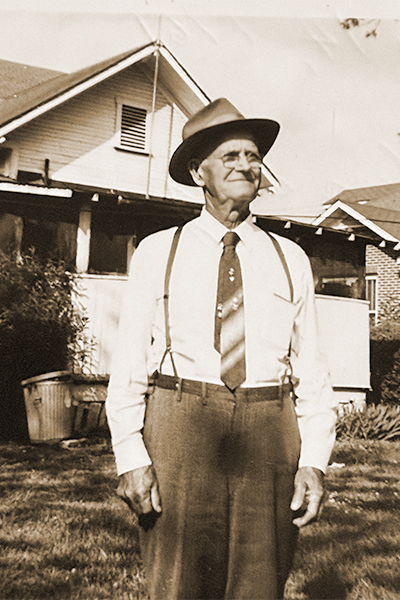
Twenty years before the construction of Carters Dam began in earnest, a man born in the 1880s in Ellijay was advocating for the levee and a resulting reservoir. S.O. Penland Sr., who served in the Georgia House of Representatives in the 1920s, had made friends with several legislators and persistently wrote them in letters going back to at least 1947.
Two of those compatriots he corresponded with were late Jasper attorney Phil Landrum, who at one time served in the U.S. House of Representatives representing the north central mountain district of Georgia, and Dalton attorney Erwin Mitchell, a House member who hailed from Northwest Georgia.
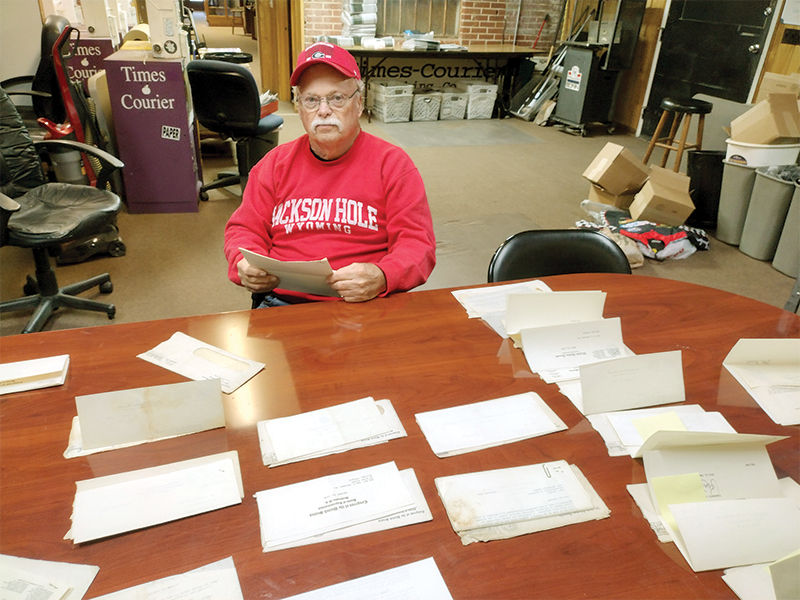
S.O. Penland’s grandson, Sam Penland, looked over the letters 20 years ago after getting them out of an old safe at the family store on River Street, then reviewed them again after stories about Carters Dam were published in the Times-Courier and Pickens County Progress in recent years. The home of two distinct Native American tribes and early settlers in the area now hosts thousands of visitors to Carters Lake and its recreational features that include boating, fishing, camping, hiking and scenic vistas. A visitors center near the dam spotlights history, construction of the edifice and the teeming flora and fauna in the region.
“He served in the legislature so he knew (U.S. Sen. Richard) Russell and (Senator and Governor) Herman Talmadge, and stayed connected and delivered apples to them in Atlanta,” said Penland.
“I don’t know who put the idea in his head about a dam being built with a lake; but I do know at one time two lakes were planned, with one of them being on Tails Creek,” said Penland. However, one missive in the trove of more than two dozen letters mentions downstream flooding from the Coosawattee River in Calhoun and even Rome.
“Dick Russell came to Ellijay a lot back then,” Penland noted. “Talmadge and Russell wanted to get the dam for the region too.”
S.O. Penland also pushed for getting Tails Creek Road (now Highway 282) — a major thoroughfare from Ellijay through lower Murray County to Dalton — paved many decades ago.
“Back then Tails Creek Road ended at the Murray County line,” said Penland. “You then had to take an old rough road over Blood Town Gap that the moonshiners used. We would go out there to see the falls on the Coosawattee, and the road eventually came out on Old Federal Road north of where they built the dam.”
Penland said the Army Corps of Engineers “couldn’t have picked a better spot for the dam where the two mountains end with the gap between them.”
“A lot of people knew how long Granddaddy advocated for the dam and some of them wanted to name it after him, but he and our family didn’t want that,” he said. “Granddaddy thought it should be named after something that had to do with that area. Needless to say, there was a lot of politics involved in getting the dam built. In fact, it turned my own daddy (S.O. Junior) off from politics. I remember he used to say there’s two things we don’t talk about in this store — politics and religion.”
Penland’s store was a mainstay. Sam Penland remembers growing up in Ellijay where the store was a big part of his life. It opened in 1914.
“It became Penland Brothers in 1946 with my father (S.O. Junior) and his brother Jack taking over,” he said. “Then it went back to just Penland’s when I bought Uncle Jack out in 1980 and ran it with my dad. The bricks for the store were made at the brickyard on Boardtown Road. There was not much cash back then, but there was lots of barter.
“We had produce and fur hides — racoon, rabbit, mink, beaver, fox and civic (civet) cat — almost anything you could skin. Beaver was not worth much. Produce and fur hides were a big operation in town at that period of time. We bought ginseng too; I bought it up to 15 years ago even after selling the store.”
A special time in Sam and his wife Marcie’s lives together was when the Rich’s store in Atlanta bought and cut the huge evergreen on River Street next to the store for their annual Christmas tree lighting. Sam had pulled the tree up from the middle of the Coosawattee River decades earlier where some dirt on a rock had allowed it to flourish in the middle of the old falls, before they were covered by the filling of Carters Lake.
The couple and their children, Nicole, Tiffany and Samuel, were invited to watch the lighting in 1996 and go live on the air, and Sam’s mother Yvonne also attended with them. When told by former WSB-TV news anchor Monica Kaufman that he looked a little nervous, Penland replied, “Well, I’ve not been on TV too many times.”
Letters show persistence, dedication
Before S.O. Penland Sr. wrote to legislators about what would become known as Carters Dam being constructed, he corresponded with them about a road being built. The advocacy letters began almost 80 years ago, and also depict a more genial period between legislators who were friends. Following are excerpts from some of them.
﹣ November 1947 — From U.S. Senator Richard B. Russell (Ga.), expressing interest in the desire for “the citizens of Gilmer and Murray counties in seeing the Tailor (Tails) Creek Road made a part of the state highway system.”
“Granddaddy pretty much saw that done, but he died before the road was completed and the dam built,” said grandson Sam Penland. “There are very few native Gilmer Countians who remember all this.”
﹣ March 1954 — A letter from a Corps of Engineers official to Russell notes Penland’s sending of a newspaper clipping titled, “U.S. to Study Calhoun Plea for Flood Control” along the Oostanaula River (formed from the Coosawattee and Conasauga rivers). “No funds have been made available to this office for studies of the ultimate plan …” the district engineer notes.
﹣ March 1954 — U.S. Rep. Henderson Lanham (Ga.) of Rome was rather pointed in his observations to Penland about a dam: “It will be impossible for us to get even planning money while the Republican regime (of President Eisenhower) is in control … they are not appropriating money for surveys of any work that has not already been started due to the extremely high cost of our military preparedness program and their efforts to balance the budget … (and) they will not be very favorable toward doing anything for the South even if they were appropriating any money for new projects.”
﹣ May 1953 — Lanham wrote to the editor of The Atlanta Journal (of which Penland received a copy) — possibly after a newspaper editorial — stating “within 15 years atomic energy would be used in the production of electric power and by that time the federal government would probably have quit building dams except under unusual circumstances.” He added later, “I was asked what I thought of the possibility of getting funds for (the dam). I tried to give a frank and straightforward answer … (and said) the present Administration (Eisenhower) was making no starts, except in rare instances.”
Still, Penland was not deterred and continued to fire off letters.
﹣ May 1950 — Colonel W.E. Potter of the Corps of Engineers posited that “our studies … considered the development of the Coosawattee River by two dams or by one high dam. The site of the high dam, Tails Creek, which appears to be most feasible, is in Gilmer County.”
﹣ September 1950 — Georgia First Lady Betty Talmadge wrote thanking S.O. Penland for a crate of apples that “the children and I are enjoying very much. It was mighty nice of you to be so thoughtful, and I want you to come and see us whenever you are in Atlanta.”
﹣ March 1954 — U.S. Rep. Phil Landrum of Jasper wrote Penland, “In consideration of this matter we must be candid and tell you the chances for any immediate action are remote, to say the least.” However, their amiability is apparent: “When I come to Georgia again, which will probably be during the Easter recess, I shall be glad to see you and our other friends from Ellijay.”
﹣ May 1959 — Russell wrote to Penland with “regret” about the bureaucratic delays of getting the plan for a dam approved through several federal agencies, and then finding appropriations. A newspaper article in the Journal in February 1961 estimates the 400-foot high dam — 200 feet higher than dams at (Lake) Allatoona and Buford (Lake Lanier) — would cost $38 million to build.
﹣ September 1959 — U.S. Rep. Erwin Mitchell, also a Dalton attorney, shared with Penland a lengthy “Order Issuing Preliminary Permit” document regarding the dam that noted, in part, “(it) would have some adverse effect on wildlife resources but would increase the fishery and recreational potential of the area affected … (and that) the Carters site shows a need for flood control and power.”
In 1960, U.S. Senator Herman Talmadge copied Penland on a letter he wrote to the chairman of the state highway board about finishing “Sam’s road” which was being “tremendously handicapped” for lack of funds.
﹣ September 1960 — Russell thanks his Ellijay friend for the “Penland Red” apples and is pleased to inform him “we were able to get the appropriation for the dam and, of course, understand you are anxious to see the road to your family home place completed … (that has) been in your family for five generations. I must say it is hard to believe you were born in 1882.”
Sam Penland believes his grandfather’s persistence made a difference in getting Carters Dam built.
“I’m sure Granddaddy moved the project along; you might say he aggravated them about it until the day he died,” he said with a chuckle. “He wouldn’t have kept writing if he didn’t think someone was listening.”
And don’t discount the influence of tasty apples.