
Burkhardt served two tours in Vietnam

As an Air Force “brat” who followed his father’s career around the world, Joe Burkhardt has seen a lot of military bases. However, it was his own pilgrimage in the U.S. Army that saw him serve two tours in Vietnam more than 50 years ago, one in artillery and the other as a helicopter pilot. There were close contacts with the enemy in both fields for a young man who was born in Patterson, N.J., and then graduated high school across the country in Mountain Home, Idaho.
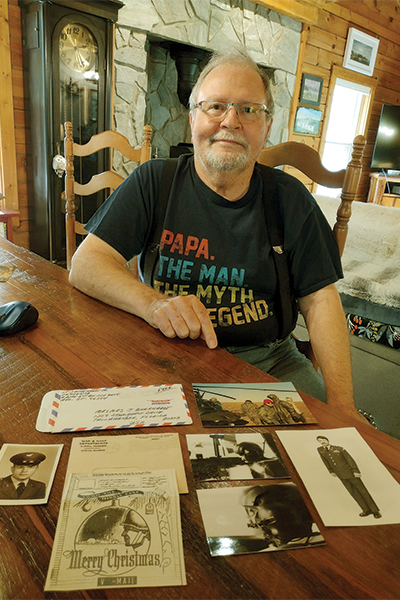
His journeys also saw him brush against some high-profile personalities — or nearly so. After his high school graduation in 1962, Burkhardt headed to California to make a living in the construction industry. At one point, he helped build Disneyland on the West Coast and actually met its creator.
“Walt Disney was selling popcorn on the street there!” Burkhardt recalled. “I just walked right up and met him, and we had a conversation.”
Back in Idaho, he received a letter from the Selective Service. But before being drafted, Burkhardt enlisted in the Army in 1966, just as the Vietnam War was beginning to expand in operations for U.S. troops. At Fort Polk, La., for basic training, his recruit cadre was supposed to include a draftee who was well-known — champion heavyweight boxer Cassius Clay, later known as Muhammad Ali.
“Our drill sergeants were chomping at the bit to get him there, but it got all loosey goosey after he refused to be drafted,” said Burkhardt.
After boot camp, he completed artillery training at Fort Sill, Okla., then went on to Fort Irwin, Calif., where his unit was being formed for deployment to Vietnam. The troops at Irwin were almost sent to help quell the nearby Watts riots in Los Angeles in the mid-1960s.
‘A very scary place’
The troops were trasported by ship, the USS Upshur, into Vietnam’s Quy Nhon harbor. It was Christmas Eve of 1967, and Burkhardt’s artillery unit soon boarded trucks for An Khê, the base camp of First Cavalry Division. An imposing Hong Kong Mountain stood in the middle of the compound.
Burkhardt said it was “demoralizing” to hear Hanoi Hannah, a radio propagandist for the North Vietnamese, welcome his unit — the 5/22 Field Artillery Battalion of the 52nd Field Artillery Group — to Vietnam and name their officers. And not only that, she offered $50,000 to “any VC (Viet Cong) that knocked out one of our (artillery) guns.”
“So we’re saying, ‘Where’s our intelligence? Do we have spies in our unit?’” Burkhardt said in looking back.
When the First Cav left the base camp at An Khê, the artillery unit stayed behind.
“Charlie (the name for enemy troops) had never been on the mountain before when the 1st Cav was there, but when they pulled out, Charlie was in there the very next day,” said Burkhardt. “From then on, An Khê was a very scary place to be because Charlie would always work at night. The officers’ mess would be satchel charged (an explosive device) because they were inside the compound.”
The unit then moved to the east of Pleiku and set up a fire support base with an air cavalry unit. From there, the 175mm guns could reach targets on the Ho Chi Minh Trail, a conduit for enemy supplies.
Learning to fly
Back in the states after his first deployment was completed, 1st Lieutenant Burkhardt was given command of a Basic Training Company at Fort Gordon (Ga.) and then promoted to captain before applying for flight school. After graduating, he opted to fly the “workhorse” Chinook helicopters when given a choice between it and the Cobra, a gunship that protected both Chinooks and Hueys (troop transporters).
He was asked if he had a choice about returning to Southeast Asia.
“Everyone knew they were going back to Vietnam after flight school,” he replied. “When I came back to the states following my first tour, I landed in Seattle and was shunned (by American citizens) like everybody talks about in those days during the war — you’d be sitting at a bar and people would turn their heads and backs to us because we were still in uniform.”
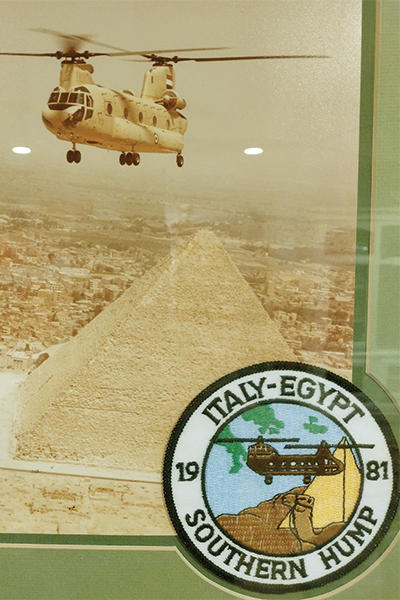
Back in ‘Nam in January of 1971 at Tuy Hoa Air Force Base in the central highlands of Vietnam where II Corps was based, the Air Force left and Army Air moved in to use the living quarters and landing strips.
“So I’m in the same area I was in three years earlier, and I’m learning a lot more about it because I’m up in the air looking at it in a Chinook,” he said of being in the 180th Assault Support Helicopter Company, known as the “Big Windy.”
One of the unit’s primary missions was to support the two infantry divisions from the Republic of Korea (South Korea, a U.S. ally) with supplies, and also go with them on combat missions when needed.
“We got to know the ROKs pretty well,” said Burkhardt. “When they swept a village (cleared of enemy resistance), it was swept … and with the Koreans, if you fall asleep on guard duty, you’re shot at reveille the next morning before a firing squad. They’re tough. I’ve seen colonels call sergeants to attention and knock ‘em out (with their fist), and I’ve seen generals knock out a colonel.”
Whatever the mission, there were risks when flying near or over enemy territory.
“Several times we had bullet holes in the fuselage, and lost some passengers along the way, but we didn’t lose a soul killed in action in the 180th the year I was there,” he noted.
Rescue mission
During one sortie, or flight mission, his air crew was hauling supplies in a Chinook and got a radio call from a unit at a hot LZ (landing zone under enemy fire).
“They said they had five wounded (U.S.) soldiers down there, and so we discussed it as a crew and said we gotta go get ‘em,” Burkhardt remembered. “So we went in there, and it was hot. I actually flew us in and landed, and we got shot up. We barely got off the ground — we were just supposed to hold 33 people and we got out of there with 45 — and several of them were wounded and on stretchers.”
The crew was told specifically by their superiors “not to go there.”
“When we got back, we figured we’d get chewed out or worse than that,” he said. “Our crew aircraft commander was awarded a Distinguished Flying Cross, and me and the crew members received an Air Medal with a ‘V’ (for valor). Some of the crew members also received Soldier Medals because they performed lifesaving duties while the wounded were on board, and we were transporting them back to base camp.”
Remarkably, the crew was later chewed out during a morning formation.
Burkhardt was awarded a total of 14 Air Medals during his second tour as a helicopter pilot. These days, he still works as a consultant with the Federal Aviation Administration (FAA). He was asked how he feels about his service in the military and his time in Vietnam.
“The first time I saw the (Vietnam Veterans Memorial) Wall, I was beside myself,” he revealed. “When I was still in the Army, a good friend of mine and I were at FAA headquarters in Washington, D.C., and one evening we walked around the corner and there was The Wall. I got down on my knees on the end where it’s still low to the ground and immediately started looking for names. I was shaken to the core when I recognized how many lives were lost.”