
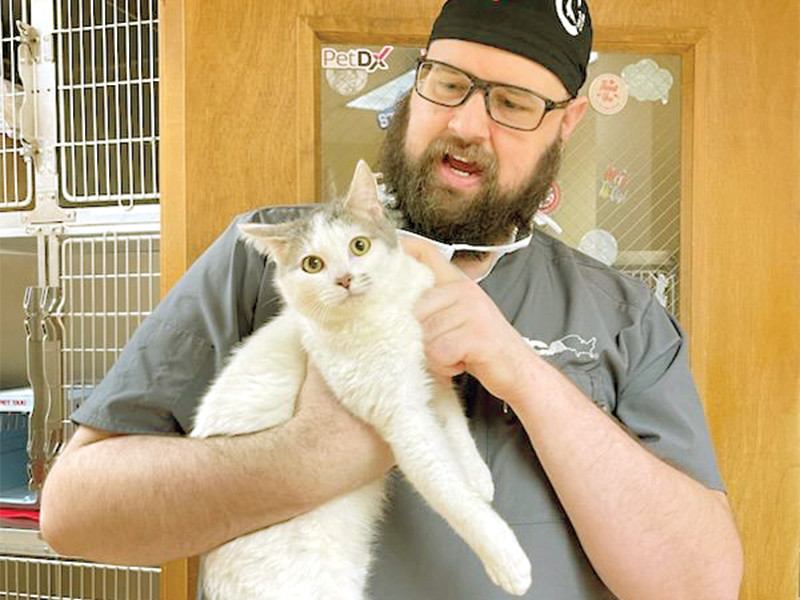
Friends of the Gilmer Animal Shelter (FOGAS) are teaming up with a local veterinary clinic in hopes of reducing the number of feral cats in the county.
A trap, neuter and release (TNR) program for feral cats had previously been offered directly by the Gilmer Animal Shelter. In that program, animal control trapped the cats after being contacted by a property owner. After being spayed or neutered, the person whose property the cats were on could either take them back and release them or surrender the cats to the shelter.
The surrenders greatly outnumbered the take-backs, noted Sylvia Harris, FOGAS representative. “The shelter was getting overloaded,” she said.
A support group for the local animal shelter, FOGAS will now offer the TNR program on a case-by-case basis, but with a few changes to how it was previously done by animal control.
East Ellijay’s VCA Appalachian Animal Hospital has agreed to provide the spay and neuter services, noted Harris.
“If they’re feral cats, the procedure is done free of charge. They also get a rabies vaccine at no additional charge,” she added. “We’re making sure everything that goes back out has a rabies shot.”
One difference in the FOGAS TNR program is that the people who have the feral cats on their property must trap the cats themselves and, after surgery, take them back and release them. Harris said FOGAS has some live traps that can be loaned out and used to catch the cats.
“The shelter is not accepting them, and we don’t have anywhere to send the cats,” she added. “They have to be willing to trap the cats and take them to VCA Appalachian Animal Hospital, and the cats have to be released back where they came from. That’s the requirements for our program.”
Harris said, when the animal shelter was doing the program, it wasn’t that unusual for someone to call with 20 or more feral cats on their property. With the new program, the veterinarians are limited to how many they can fit in at one time.
“We are limited because they’ll need surgery dates. It may be slow getting them all done because they can only do so many at a time,” said Harris. “We usually tell people it’s two to three (cats) at a time. They take them in the morning and pick them up that afternoon. We do ask that they keep them contained for a few days thereafter, particularly females, so they can heal.”
Judy Filipiak, Appalachian Animal Hospital manager, said the clinic got involved to help with something positive in the community that will help to reduce the unwanted animal population.
“We’ve started to work with more of the shelter groups like FOGAS and Paws in Need. It’s been a slowly developing thing, but it’s just doing what we can do to help give back to the community,” she added. “The (number of) feral cats is a problem in Gilmer County. They (FOGAS) didn’t have anyone else that was willing to address it, so they came to us and we’re seeing what we can work out. It really is a lot to work out, but we’re working through it and trying to get things going so we can get the feral cat population under control.”
While fixing the feral cats won’t necessarily result in the animals finding permanent homes, it will reduce the number of kittens born into the wild. “Hopefully we can at least make a dent,” said Harris.
“We don’t like seeing all these animals sitting in a shelter, and (while) we can’t get them adopted out, we can stop them from reproducing. That’s the goal,” said Filipiak.
Oftentimes, cats become feral after being abandoned by owners who’ve moved away, Harris noted.
“It’s sad, but people abandon them all the time,” she added. “The major complaints we hear from people are the cats are coming in their yards and spraying their (belongings) and fighting with their personal cats.”
The first group of cats to be treated under the new TNR program was a colony of nine, and FOGAS has already had calls from more people with the same problem.
“People are calling with a lot of cats,” said Harris. “Initially (the first person to bring feral cats in to be fixed) had started feeding one or two and enjoyed their company. Before long, they had doubled, then doubled again. The cats, most of which were males, were getting to be a nuisance.”
Filipiak said there are a few ways to determine if a cat is feral without catching them.
“Usually, they’re the ones that are kind of stalking around the neighborhood and (seem to be) nobody’s cat. They are usually pretty rough looking, and it’s not uncommon for them to have scars because they’re out there fending for themselves,” she said. “The males, especially, will come in with torn-up ears or scars where they’ve gotten into it with other (animals). They’re not going to be your shiny, healthy looking cats. It’s going to be obvious they don’t get a lot of care.”
Feral cats that are fixed through this particular program will be easier to recognize. At first, the clinic started with small tattoos, a common procedure used to mark fixed cats. Now, the cats that have been spayed or neutered will have the outer tip of an ear snipped instead.
This will make it easier to identify them, noted Filipiak.
“When they’re feral, you can’t always catch them and turn them over to see if they’ve been tattooed, which is (usually done) near the incision area,” she added. “By snipping their ears, if they get trapped again, animal control will recognize that they’ve been spayed or neutered. We’re working with animal control as part of this (program), too, so this is an easy indication and considered to be the most humane thing we can do to give that mark,” she added.
For questions about the trap, neuter and release program, contact FOGAS members Sylvia Harris (706-273-2005, harris.sylvia@comcast.net) or Ernie Taylor (810-623-2214, ectaylor37@gmail.com).