
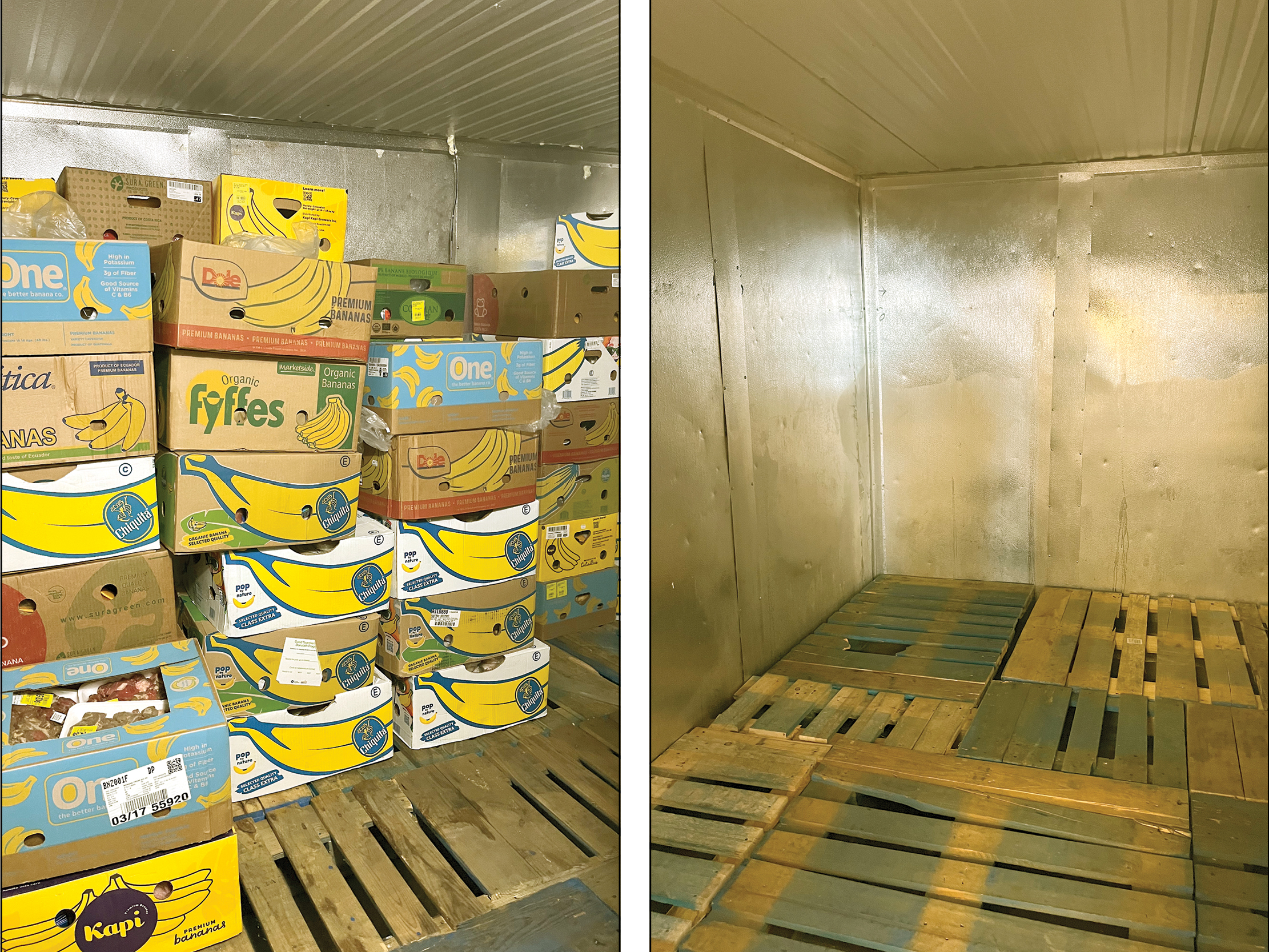
A freezer malfunction has caused the Gilmer Community Food Pantry to lose more than 8,000 pounds of frozen meat they needed to feed hungry families, a supply that took months to accumulate.
On Monday, March 24, their walk-in freezer’s mechanical clock that regulates the defrost and freezing cycle times malfunctioned. This caused the freezer to go into defrost mode. By the time they caught it, a good bit of the frozen meat started to defrost and the freezer couldn’t hold a safe temperature.
“We rescued 40 percent of that food, but the rest we had to haul to a dump,” Allen Triebel, executive director of the food pantry, said.
Food the pantry is able to provide community members is acquired through individual donations, free products given to them by retailers like Walmart or Aldi and products they purchase at retail or subsidized values. He said 70 percent of their food is bought from the Chattanooga area food bank that is run by the federal organization Feeding America.
“Anything you get from the federal government, you have to follow all their rules and regulations,” he explained. “We had to make a decision because we have no place to put that food once it starts melting.”
The government regulations state meat that starts to thaw can’t be refrozen due to safety concerns. The food pantry doesn’t have a backup freezer for salvageable meat. He said they couldn’t cook it because they aren’t licensed as a soup kitchen.
The vendor working on the freezer when it malfunctioned was able to fix the clock and cooling system, which also broke about five or six years ago, and since they quickly removed the meat before it spoiled, they prevented it from ruining the freezer box.
However, Triebel noted their freezer is nearly 30 years old, made up of mismatched parts and on its last legs. They’ve applied for a grant through the Chattanooga food bank to fund a new freezer. They’ll find out in May if they were accepted and how much money they will get.
“It will take weeks, if not months, to get our freezer full,” he voiced. “Hopefully, the freezer will last, and hopefully, we will get the grant where we can buy a new one so that the pantry will have a secure system for the next 10 years. Our freezer that we have now will not last.”
They are owed by their insurance company what it would cost to replace the lost meat. However, he said they do not know how much they’ll get, and it’s extremely difficult to determine the food’s worth.
“We buy food at retail cost from places like Food Lion, we buy from the federal government … we get food for free,” he said. “Our food doesn’t have a specific cost value … so it’s very hard to determine how much we actually lost.”
Through an in-house analysis, they estimated that it is an excess of $40,000 worth of food. He noted they can’t just go out and purchase enough meat to stock their freezer to what it was right away, with monetary donations or their insurance claim.
“We give out more than we get each week, so we buy it in bulk when we can and always have that freezer at least half full,” Triebel added. “But, say I get $15,000 [from insurance] for food spoilage, I have no place where I can spend $15,000. I can’t call Walmart up and say ‘I’d like $6,000 worth of hamburger and $4,000 worth of chicken,’ because they do not have control of their supply chain.”
The Gilmer Community Food Pantry has been feeding people since 2001 and is made up entirely of volunteers. In 2024, they served nearly 5,000 families and gave out 645,844 pounds of food, according to Triebel.
Since they have to ration their meat, a family of four that may have been able to get 10 to 15 pounds of frozen meat for the week, now might only be given a pound, he said.
“We will figure out a way to get from point A to point B, but it will take us time,” he admitted. “We can’t buy it. We’ll have to get it donated to us. We will buy it when it becomes available. We will continue to buy every week from Chattanooga the canned goods we can get, but we are very limited in our supply of frozen products.”
The pantry is stressing their need for the continued support and generosity of local individuals, businesses and churches who can donate food and money to their cause.
Community members are encouraged to donate more shelf-stable items they can use while they are limited on their meat supply. Triebel asks that people do not donate glass items. Donations can be dropped off by their front door located at 5273 SR-52 in Ellijay.