
All the details on how first responders keep the county safe
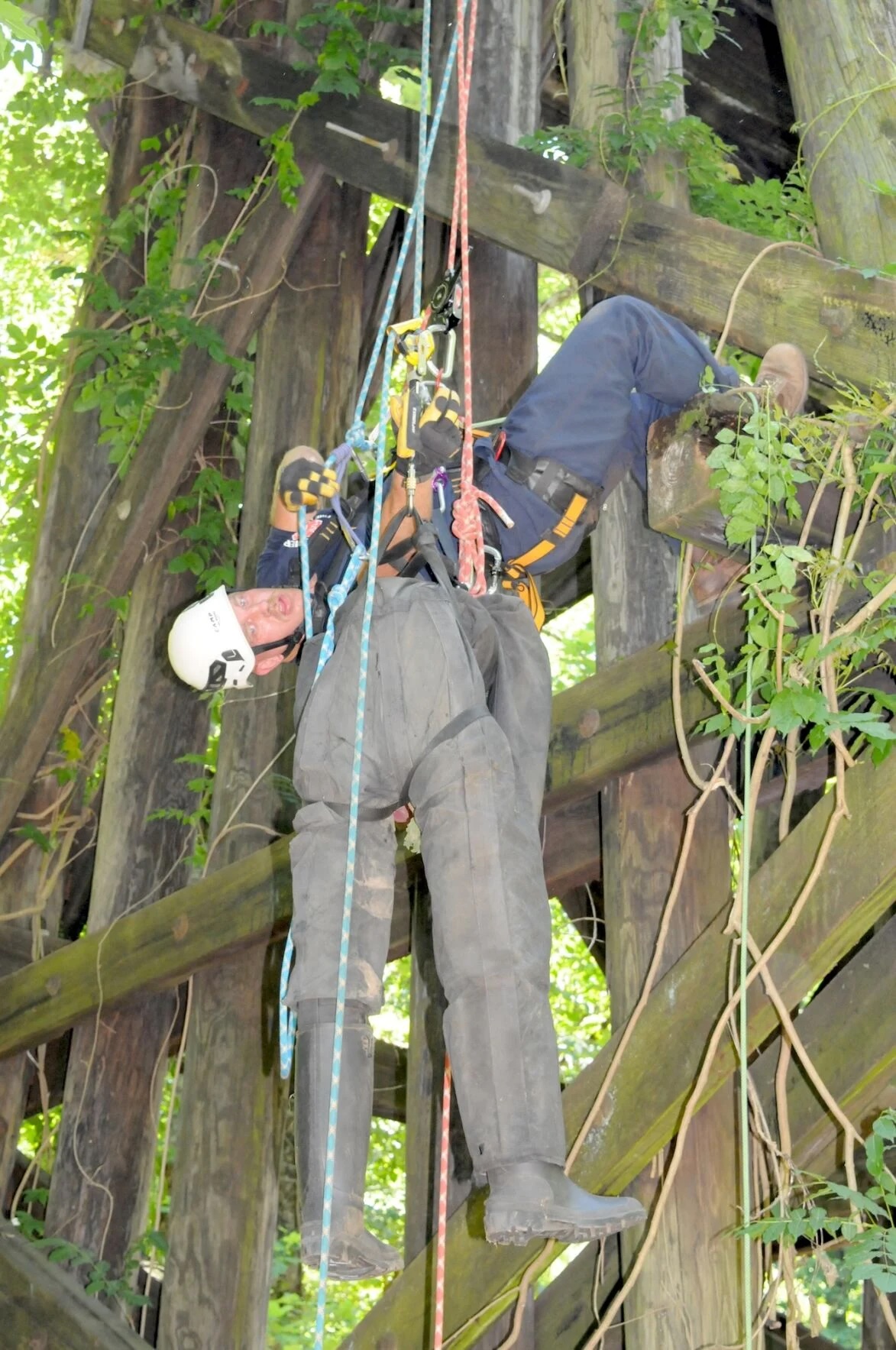
Getting lost is easy. Finding someone is difficult.
That’s why Gilmer County Fire and Rescue conducts extensive Special Operations training for its personnel.
“It’s a volunteer thing to decide to go into Special Operations,” Special Operations Division Chief Jeff Statham said. “The people that you see on our Special Ops teams like what they do.”
Gilmer’s Special Operations stories begin with the environment.
Gilmer has mountains, steep ridges, fast streams, thick forests and deep lakes. All these parts of the landscape mean certain kinds of emergencies are possible.
“We’re a little different than some areas around the state because we are a mountainous region,” he said.
All these emergencies require training to handle.
“It does require a lot of time and training to be really good at something,” Statham said.
All these special operations branches can work together. To recover a body from fast-flowing water, divers get help from the ropes team for extra stability. At other times, the boats team will provide transport to the swift water team.
“Some of our people are cross-trained in different areas,” he said. “They’ll have two or three specialties, so when we have an emergency, we can mix these people together.”
After training, Special Operations begin with a 911 call.
Usually, people call when they realize that someone has gone missing.
It’s better when things don’t get to this point.
If you’re doing an activity outdoors, especially for the first time, it’s good to go with an experienced friend.
“If it’s something new, find people that do it,” Statham said. “Don’t just go buy a kayak and go running down the Cartecay.”
Always tell someone when you plan to be back by.
If someone isn’t back by the time they say or by nightfall, you should call 911, he said.
It’s better to call GCFR too early than too late.
“Do I mind that I drove 25 miles to get there? No, I don’t. I’m actually tickled to death that they found them,” Statham said.
After the initial call, GCFR will plan a response.
There are five major call types. These include calls that need a rope, calls that need boats, calls that need divers, calls involving swift water, and calls that involve wilderness searches.
GCFR has specialized teams for each of these categories.
“All of these will be encompassed with different types of equipment,” Statham said.
Sometimes, calls can be a mix of these types.
Emergencies involving water are the most deadly, he said.
If someone isn’t recovered within an hour of a water emergency, they are most likely dead, Statham said.
This fact is why water safety is so important.
You shouldn’t swim in fast-moving water. It can be stronger than it looks. And you should always wear a life vest.
“It would be very hard to find someone that had a life vest on that drowned,” he said.
Just receiving the call, getting ready and driving to the location can take nearly 35 minutes.
“I can send divers in the water to do a quick, hasty search if there’s a good enough location,” he said. “But once I hit that hour, I have to fall under a recovery operation.”
While CPR can occasionally revive someone, drowning usually can’t be reversed.
“In my time in public safety, I haven’t experienced seeing anyone that actually drowned be revived,” Statham said.
After this one-hour window, any search in water is about finding bodies.
Searches in water work the same way as any other search, he said.
First, GCFR checks the last area the person was seen.
If this isn’t successful, they start checking less obvious areas and call in help.
Eventually, a search can sometimes bring in emergency personnel from other counties and cover an enormous area.
It’s almost impossible to find and recover a body in extremely deep water. But GCFR personnel do their best.
“You want to find them,” Statham said. “If you can’t solve it, you kind of feel like you failed a little bit. But you have to remember that sometimes it works that way.”
On land, survival is far more likely. The earlier someone can be found, the better.
Search teams use tracking dogs, drones and helicopters to look for missing people in the woods.
If you’re lost, the best thing you can do is find an open clearing near your location. It’s easier to spot someone when they are visible in the open.
GCFR personnel know how to do their job and have a clear method for searching areas.
They use probability to figure out where to search, Statham said.
“Say you’re on a ridge and behind you is just more elevation,” he said. “What’s the common person going to do? Are you going to walk downhill? Or are you going to walk uphill?”
This method helps them find people as effectively as possible.
If you’re in an area they haven’t searched yet, and wander back into an area they have searched already, you might miss your chance to be rescued.
When you’re found, the GCFR has the tools to recover you wherever you are. If you’re at the bottom of a ravine, the ropes team can rappel down and get you up.
The best way to avoid getting lost is to prepare before going into the woods.
You should bring a phone for communication and a separate GPS device for navigation, Statham said. You should also bring extra batteries.
“A GPS is necessary,” he said. “Your phone dies quickly when you’re using certain programs, and that’s your communication tool.”
No matter how you’ve gotten lost, GCFR is happy to find you and make sure you’re safe.
“It’s always great to complete what you were doing and be successful,” Statham said. “The problem is, for us to prove ourselves and our training means somebody is having a bad day.”